Look at the throw-in times for next Sunday's club matches: 11:30, 14:00, 17:45. Three times, all written without am or pm, and the last two are bigger than 12.
What time of day is 17:45? Could you turn up to the wrong match if you misread it? Today we crack the rule for writing times after midday without using am or pm.
Write the three fixture times on the IWB and invite hands. Expect mixed answers for 17:45, some pupils will guess 5:45 pm correctly, others will be stuck on 'why is it not just 5:45 then?'. Hold the question open; the rule lands in the next step. If a pupil says 'you take 12 away', revoice, 'yes, that's the rule we're about to write down', and bank the language for later.
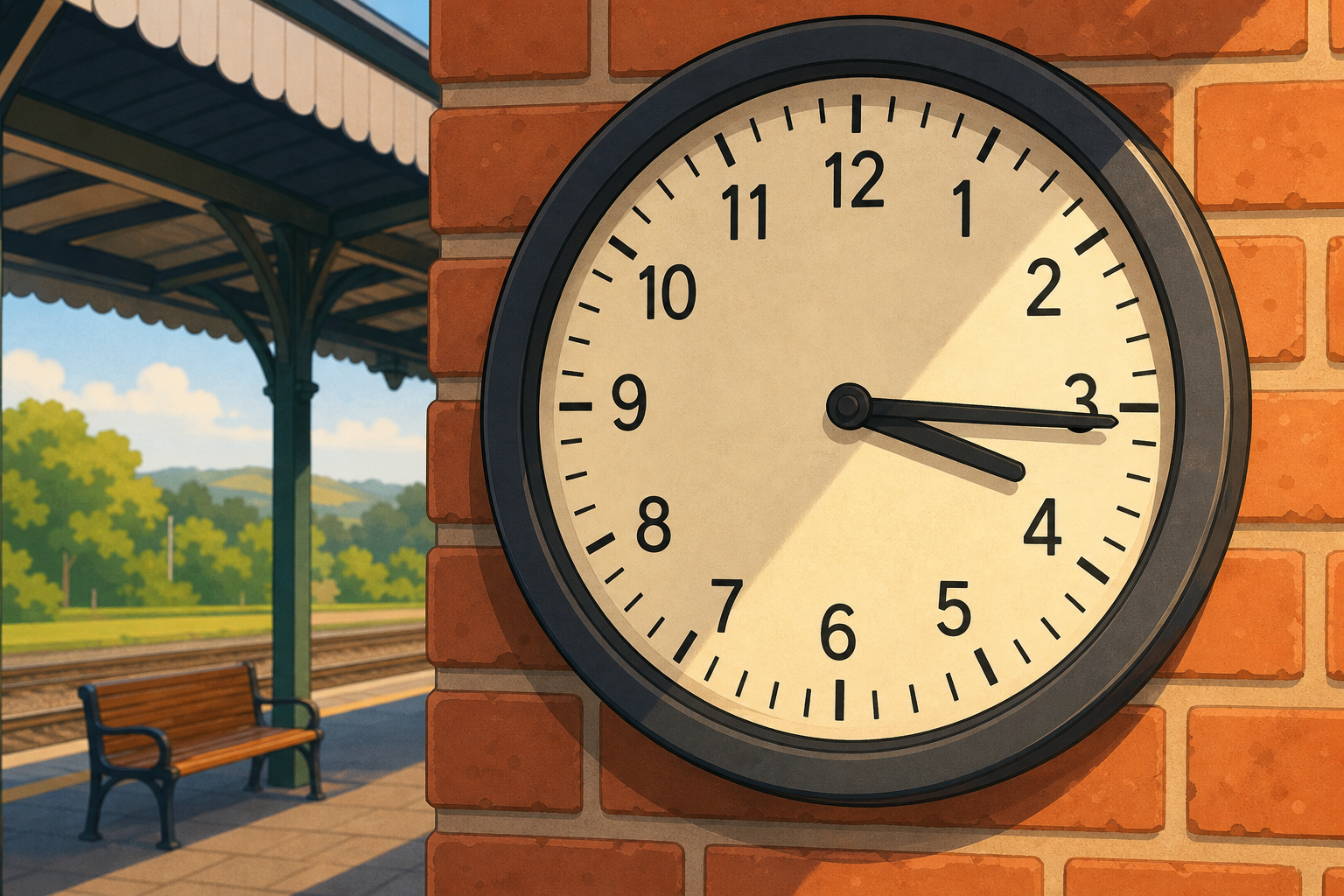
Watch three 24-hour times on the clock. Each clock face is the ordinary one we already know, with the hours 1 to 12 around the edge. The digital readout below names the same moment in 24-hour form. The hands point at the numbers we recognise; only the way we WRITE the time changes.
Notice how the hour hand sits exactly where it would sit on an ordinary clock at 1, at 6:30, at 9:15. The clock face hasn't changed; only the digital number has.
Point at each clock in turn and say the time both ways aloud: 'thirteen hundred, which is one o'clock in the afternoon'; 'eighteen thirty, which is half past six in the evening'; 'twenty-one fifteen, which is quarter past nine at night'. After the third clock, pause and write the rule on the side of the IWB: after midday, take 12 off the hours to get the pm time. Work out with the class 13 − 12 = 1, 18 − 12 = 6, 21 − 12 = 9.
Now we turn 12-hour times into 24-hour times together. Today's set, all match-day examples: 2:45 pm, 11:20 am, 4:00 pm, 7:30 pm.
One of these does NOT need the take-away-12 rule. Which one?
Pupils take turns at the IWB to set each one on the clock and read both forms aloud.
This round is for talking it through together, pupils take turns at the board and the class agrees or corrects out loud.
Walk each example in the new order. 2:45 pm → 14:45: ask the pupil 'is it morning or afternoon?' then 'so do we keep the 2 or add 12?'. 11:20 am → 11:20: this is the trap, deliberately placed second so pupils don't pattern-lock on +12. If a pupil says 'is it 23:20?', revoice the rule, 'morning times don't need the rule because they're already under 12'. 4:00 pm → 16:00: work out 4 + 12 = 16, and say it aloud as 'sixteen hundred'. 7:30 pm → 19:30: work out 7 + 12 = 19. Rotate four pupils to the board across the four examples.
In your maths copy, draw a two-column table headed 24-hour on the left and 12-hour on the right. Write each of these 24-hour times in the left column and its 12-hour equivalent (with am or pm) on the right, one under the other. Circle every time after midday.
Walk the room glancing at the circled times, every time except 09:15 should be circled, because every time except 09:15 is after midday. This is whole-class copybook practice, not marking; if a pupil has the conversion wrong, prompt them with the rule ('take 12 off the hours') rather than supplying the answer. Allow about two minutes.
Today's bank has FOUR match scenarios for working out end times. We'll do the first one TOGETHER as a worked example, then pupils take turns at the board for the rest.
For the first one, count up to the next full hour first: 07:30 plus 30 minutes brings us to 08:00, then 1 hour more brings us to 09:00, then 15 minutes more brings us to 09:15. Set the hands and the digital readout confirms in 24-hour form.
This round is the practice bank. Start by working the first problem aloud with the class to model the count-up strategy, then pupils take turns at the board for the next three. The class confirms each answer before moving on. The same 4-problem bank reruns at home as tonight's homework, so keep the board work brisk rather than over-explaining.
For the worked example, narrate the count-up at each landing: '07:30 plus 30 minutes brings us to 08:00, then 1 hour brings us to 09:00, then 15 minutes more brings us to 09:15'. Check each landing point with the class as you go. For each subsequent challenge the clock opens on the start time and the elapsed readout counts up live as the pupil drags. Look for the cross-noon case (09:00 + 4 h 15 m = 13:15), pupils may set 13:15 by counting the hours hand round, but if anyone says '13:15 is one fifteen in the afternoon' revoice the rule for the class. Remind pupils watching from their seats to work out the answer in their heads before the pupil at the board lands the hands.
You're previewing this lesson. Get full access to this lesson and hundreds more — each one ready to teach, with interactive activities, printable resources and pupil progress tracking built in.