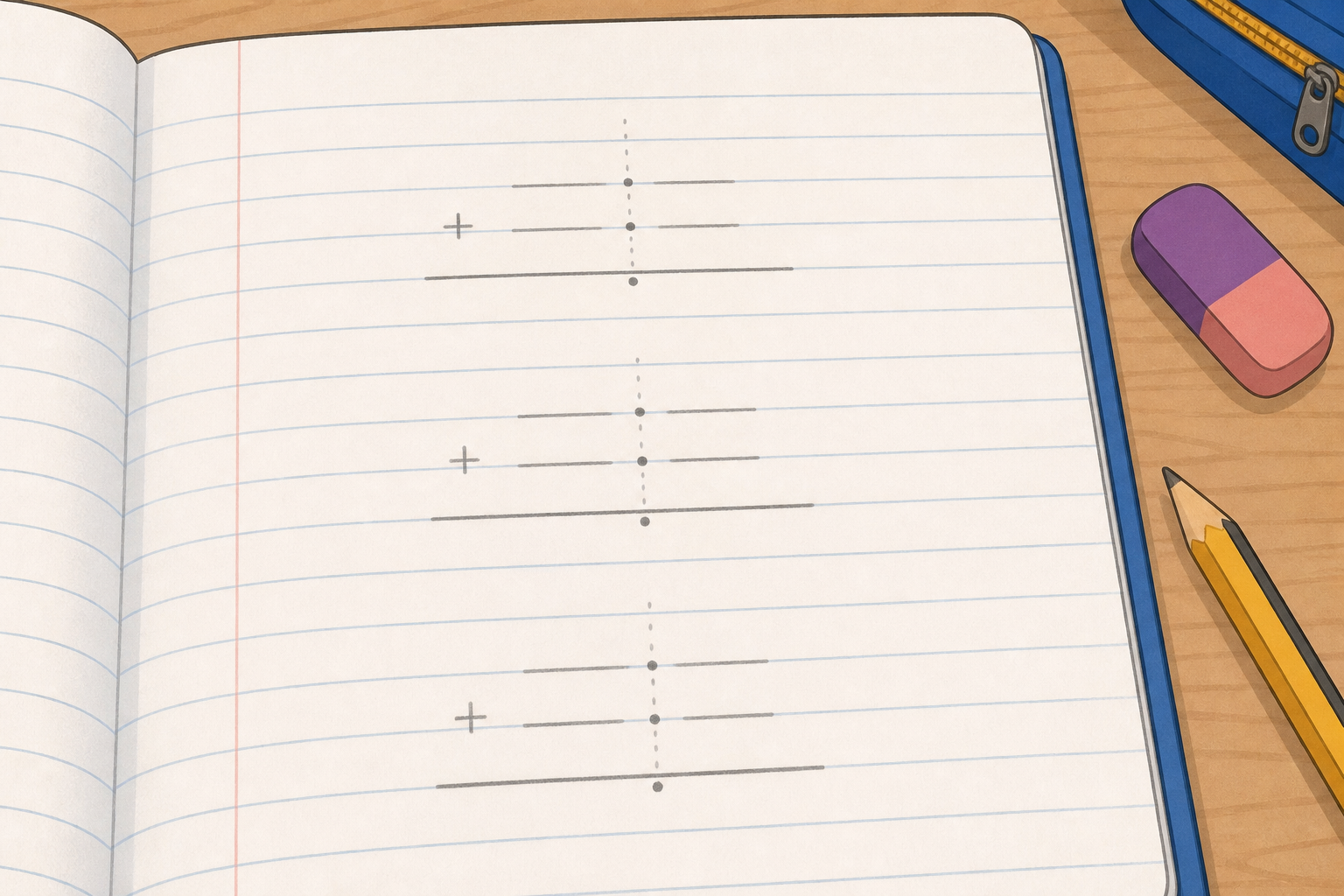
Look at the sum on the board. Someone has stacked the two numbers using the right edge of the digits — the 7 sits directly above the 5:
4.7 + 0.85 -----
Notice that the decimal point in 4.7 does not sit directly above the decimal point in 0.85. They wander.
Hands up: what is wrong with how these two numbers have been lined up?
The wrongly-aligned sum is now on the IWB as part of the description — you don't need to redraw it. Take three hands-up answers, not open call-outs; you are listening for someone to say the decimal points are not in a single vertical line, or that the 7 (tenths) is sitting over the 8 (tenths) but the 5 (hundredths) has nothing above it. Don't tell them the rule yet — let the next step do the teaching.
If pupils only say 'it looks wrong' without naming why, revoice: 'so where exactly is the problem? Point at the part that is wrong.' The goal of this hook is curiosity, not the answer.
Now watch four worked sums on the column-addition interactive. The decimal points line up in a single vertical line every time. Where one number we're adding has fewer places, a zero holds the empty column. Notice how the carry-1 jumps the same way it did with whole numbers.
The trailing-zero trick: 4.7 becomes 4.70 so the hundredths column has something to add.
Same idea on smaller numbers: 0.3 becomes 0.30.
The lonely thousandth: 1.05 becomes 1.050 so the thousandths column has a 0 above the 5.
The cascade regroup: every column tips over a 10, the carry-1 ripples all the way to the units, and the answer crosses one whole.
Walk each example aloud, one at a time. On each one, pause and ask the class 'where does the decimal point go?' before the answer lands. Break up the four-example beat with the pacing cues below so the watch does not turn into one long block.
Do not move on until the class can name the rule out loud: 'line up the decimal points, fill the empty columns with zeros, then add.'
Today we work two sums together on the IWB.
Pupils take turns at the board. The class agrees or corrects out loud.
This round is for talking it through together — pupils take turns at the board and the class agrees or corrects out loud.
Open the interactive on 6.4 + 2.85. Walk through column-by-column: hundredths first (0 + 5 = 5), tenths next (4 + 8 = 12, write 2, carry 1), units (6 + 2 + carry 1 = 9). Sum is 9.25. Have one pupil drive each column from the board.
Then run the second problem with the class: 0.7 + 0.567. The trailing-zero trick lives in two places here (0.7 → 0.700), and the answer is 1.267 — crosses one whole. Ask 'where did the carry come from?' on the unit column.
If a pupil at the board lines digits up by the right edge, do not just correct — ask the class 'what's missing?' and let another pupil revoice the points-line-up rule.
In your maths copy, set up these three decimal sums vertically — one under the other — with the decimal points lined up in a single straight line down the page. Fill any empty column with a zero before you add.
We will work each column together, and you write the answer with the decimal point in the right place.
Whole-class copybook practice — every pupil writes together, IWB paused. Allow about a minute for set-up (vertical alignment of points only, no adding yet), then work each sum column-by-column with the class, pausing after every column for pupils to write the digit and any carry in their own copies before the next column starts.
Walk the room glancing for the vertical alignment of decimal points — this is whole-class copybook practice, not marking. The most common error is right-edge alignment (digits flush right, points crooked). Tap the desk of any pupil whose points wander; do not say the rule for them. Watch for missing trailing zeros — if a pupil has 4.7 over 0.85 with the hundredths column empty above the 5, ask quietly 'what holds that column?'
On 9.99 + 0.01, slow the pace deliberately — narrate the cascade as the class writes: 'hundredths make 10, write 0 carry 1; tenths now make 10, write 0 carry 1; units make 10, write 0 carry 1 — answer is 10.00.'
Today's bank: five decimal sums that get harder as we go. The first two should be quick.
One of these has a surprise carry — watch for it.
This round is the practice bank — pupils take turns at the board, check each answer, and the class confirms before moving on. The same 5-problem bank reruns at home as tonight's homework, so keep the board work brisk rather than over-explaining.
Send a different pupil to the board for each problem. Before they tap Check, ask the class to predict the unit digit of the answer — this catches lazy carrying. Watch especially for:
If a pupil's check fails, ask 'which column went wrong?' — do not show them; let them re-walk the sum on the board.
You're previewing this lesson. Get full access to this lesson and hundreds more — each one ready to teach, with interactive activities, printable resources and pupil progress tracking built in.