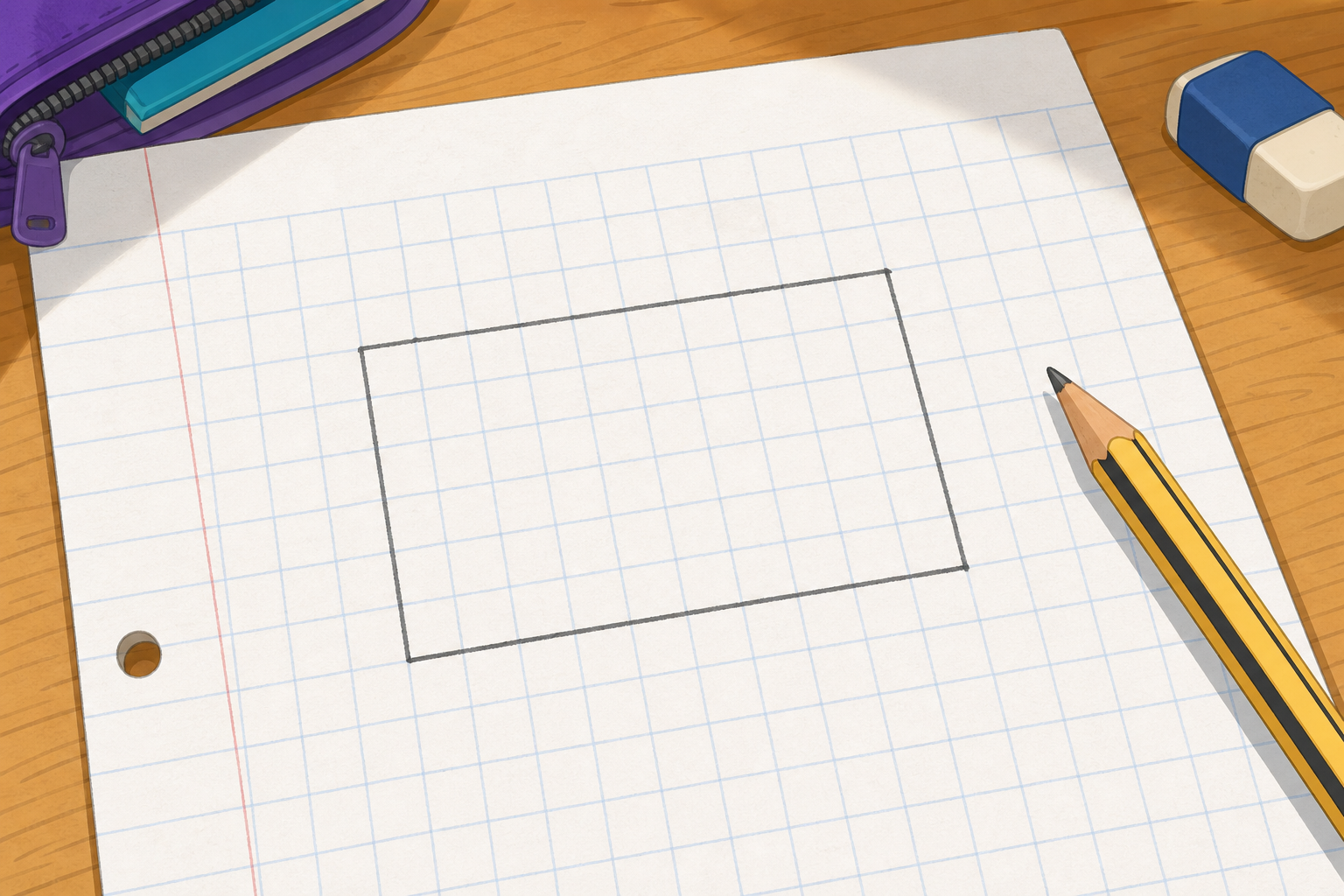
Look at this rectangle on the board. Six squares along, four squares up. How many small squares are inside altogether? Hands up: what is the quickest way to count them?
Take three hands-up answers and bank them on the board without grading: count them one at a time, count the rows, multiply six by four. All three are reasonable — the lesson will land on the third as the fastest. Five seconds of quiet think-time before any hands go up.
Watch carefully as we measure the area of three rectangles by counting the unit squares each one covers. Each square is one centimetre wide and one centimetre tall, so we count in square centimetres (cm²).
Six squares along the length, four squares up the width. Count the rows of six together: 6, 12, 18, 24. The rectangle covers 24 square centimetres.
The length and width are equal, so the rectangle is also a square. Five rows of five: 5, 10, 15, 20, 25.
A long thin rectangle, eight along by three up. Three rows of eight: 8, 16, 24. Notice anything? Same area as Example 1, but a different shape.
Walk each example aloud, slowly. Pause on the units after each multiplication — the cm² answer is the bit pupils most often drop.
Now look at this rectangle: twelve squares along, seven squares up. Count those one at a time and we would be here all afternoon. Watch as we use a faster way — multiply length by width.
This is the climactic moment of the model arc — the formula falls out because we do not want to count individual squares any more. Take it slowly: name the length, name the width, multiply, then attach the square-unit (cm²). After the reveal, ask the class to say the formula aloud: area equals length times width.
Now we work three rectangles together as a class. One pupil at a time comes up to the board: drag the corners to set the dimensions, then read the area off the readout. Everyone else watches, works the multiplication in your head, and calls out to agree or correct each answer before we move on.
This round is for talking it through together — pupils take turns at the board and the class agrees or corrects out loud.
Three rectangles to work through on the IWB:
Pupils at desks watch the board and call out their prediction before the pupil at the IWB confirms.
In your maths copy, sketch each of today's four modelled rectangles in a row down the page. Label the length and width along the sides of each one. Underneath each rectangle, write the formula l × w = area, then fill in your two numbers and the answer with the units (cm²). The four rectangles are:
Walk the row glancing at the units (cm²) on each line — that is the most common omission. This is whole-class copybook practice, not marking; circulate and prompt quietly where the unit is missing or the length and width are not labelled.
You're previewing this lesson. Get full access to this lesson and hundreds more — each one ready to teach, with interactive activities, printable resources and pupil progress tracking built in.