Quick question on the board: what is 4.7 metres in centimetres?
Think it through quietly for a few seconds, then hands up. If you already know the rule, you'll share it with the class; if it's gone fuzzy since the last time you used it, listen and see if it comes back as we go.
This is recall, not a cold open: pupils have already met ×100 in your place-value work, so confident hands should appear. Give 5 seconds of silent thinking first, then take three hands-up answers, not open call-outs. Listen for any pupil who says multiply by one hundred — that is the move we will unpack across the lesson, and naming it now flags the lens to look through.
Watch four length conversions. Each time, look for the same pattern: changing to a smaller unit (like centimetres) gives a bigger number, and changing to a bigger unit (like metres) gives a smaller number.
Walk each example aloud, one at a time. Before tapping each rung, hold the screen and ask the class which rule applies — ×10, ×100, ×1000, or one of the divides? Take a couple of answers, then tap to reveal and revoice whoever had it right. That keeps the class predicting before they see the result.
Anchor the rule before moving on: a smaller unit needs a bigger count of them; a bigger unit needs a smaller count.
Now we drive the interactive together. Pupils take turns at the board to tap a rung and convert a real length.
Lengths we will try: a 3.2 m corridor banner in centimetres, a 0.4 km Westport laneway in metres, and a 75 cm school chair in millimetres.
This round is for talking it through together — pupils take turns at the board and the class agrees or corrects out loud.
For each length, set the starting value and its unit, take a quick prediction of the rule (×10, ×100 or ×1000), then tap the destination rung — the digits walk across the place-value columns one step at a time and the ×10 / ×100 / ×1000 step lights up between the rungs as the answer lands. Three named lengths in this order: 3.2 m → cm, then 0.4 km → m, then 75 cm → mm.
Keep the class predicting the rule before the rung is tapped, not reading the result after — the walk itself is the confirmation, so there is nothing to press.
Watch for two slips: pupils saying 'the decimal point moves' (it does not — the digits move past it), and pupils who lose the rule going from km to mm because that is three jumps, not one. Reanchor on the chain in the next step.
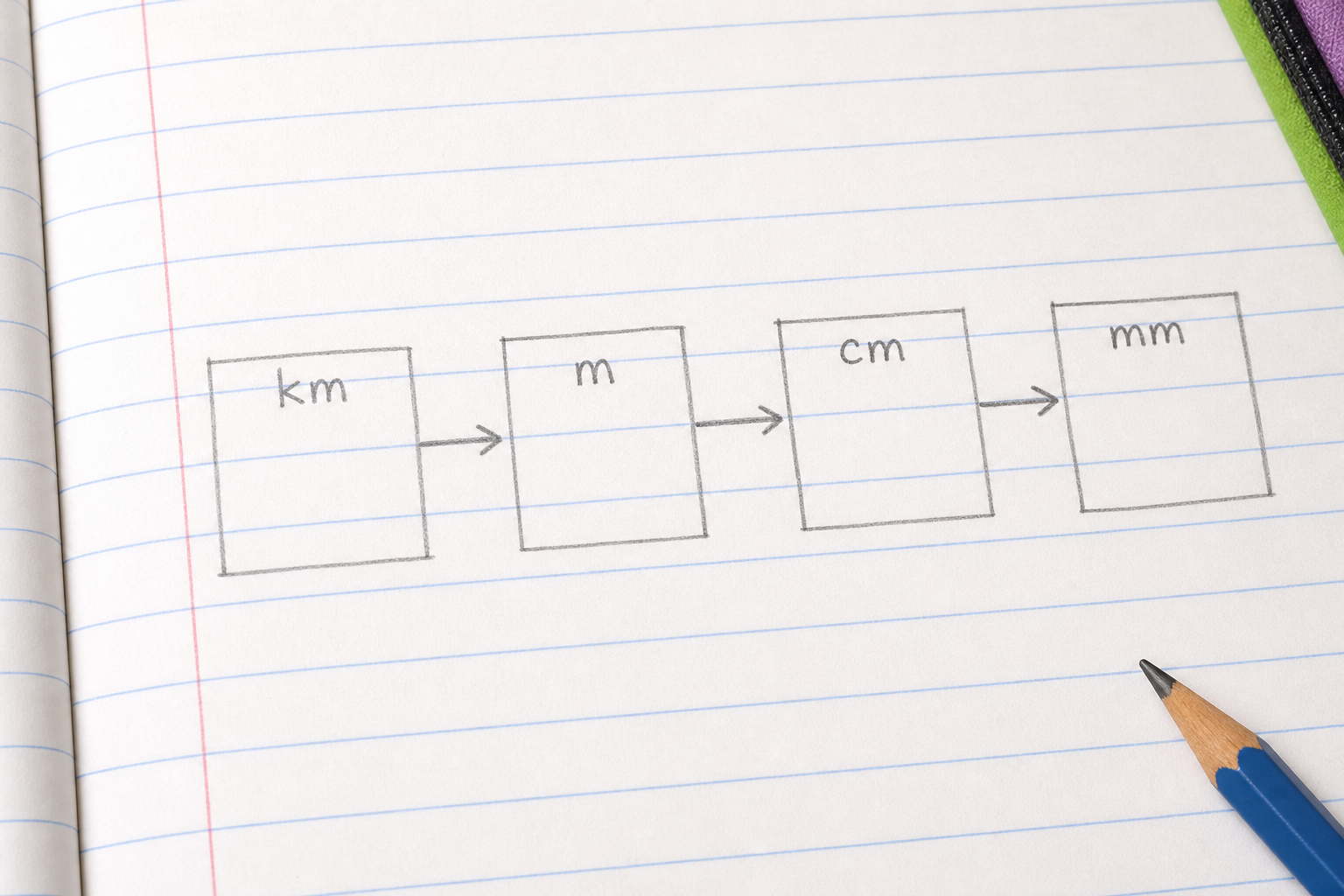
Open your maths copy and sketch this chain across the page:
km → m → cm → mm
Label each arrow with its rule (×1000, ×100 and ×10). Then write 1.5 km at the start, and fill in the value at every stage of your chain.
Walk the room glancing at arrow labels — this is whole-class copybook practice, not marking. If a pupil's chain is missing the ×10 labels between m, cm and mm, point at the next arrow and ask 'how many of these in one of those?'.
The four values pupils should land are 1.5 km → 1,500 m → 150,000 cm → 1,500,000 mm. Five minutes is enough at 5th-class pace if pupils sketch the chain first, then write the values along it.
Today's bank: six length-conversion challenges. They climb from a one-step move (mm to cm) through two-step moves (cm to m, m to cm) up to the chain stretch (km all the way to mm, three ×10 steps in a row).
Pupils take turns at the board. Predict the rule before each Check, and watch for the stretch where the digits step three columns.
This round is the practice bank — pupils take turns at the board, check each answer, and the class confirms before moving on. Six challenges in total; aim for about 1.5 minutes on each of the one-step and two-step moves, and slow down for the km → mm stretch where pupils need to count the ×10s before solving (about 4 minutes including the unpack).
For the stretch, pause and ask 'how many ×10s do we need?' before letting them solve. The answer is three — that is the whole point of the lesson.
Watch for pupils confusing direction: going from km to mm makes the NUMBER bigger; going from mm to km makes it smaller. Smaller unit, bigger count.
If the class flies through the six and a couple of minutes remain, the activity holds three extension challenges (trickier km↔cm and m↔mm jumps); take one or two as bonus board turns rather than starting a new explanation.
You're previewing this lesson. Get full access to this lesson and hundreds more — each one ready to teach, with interactive activities, printable resources and pupil progress tracking built in.