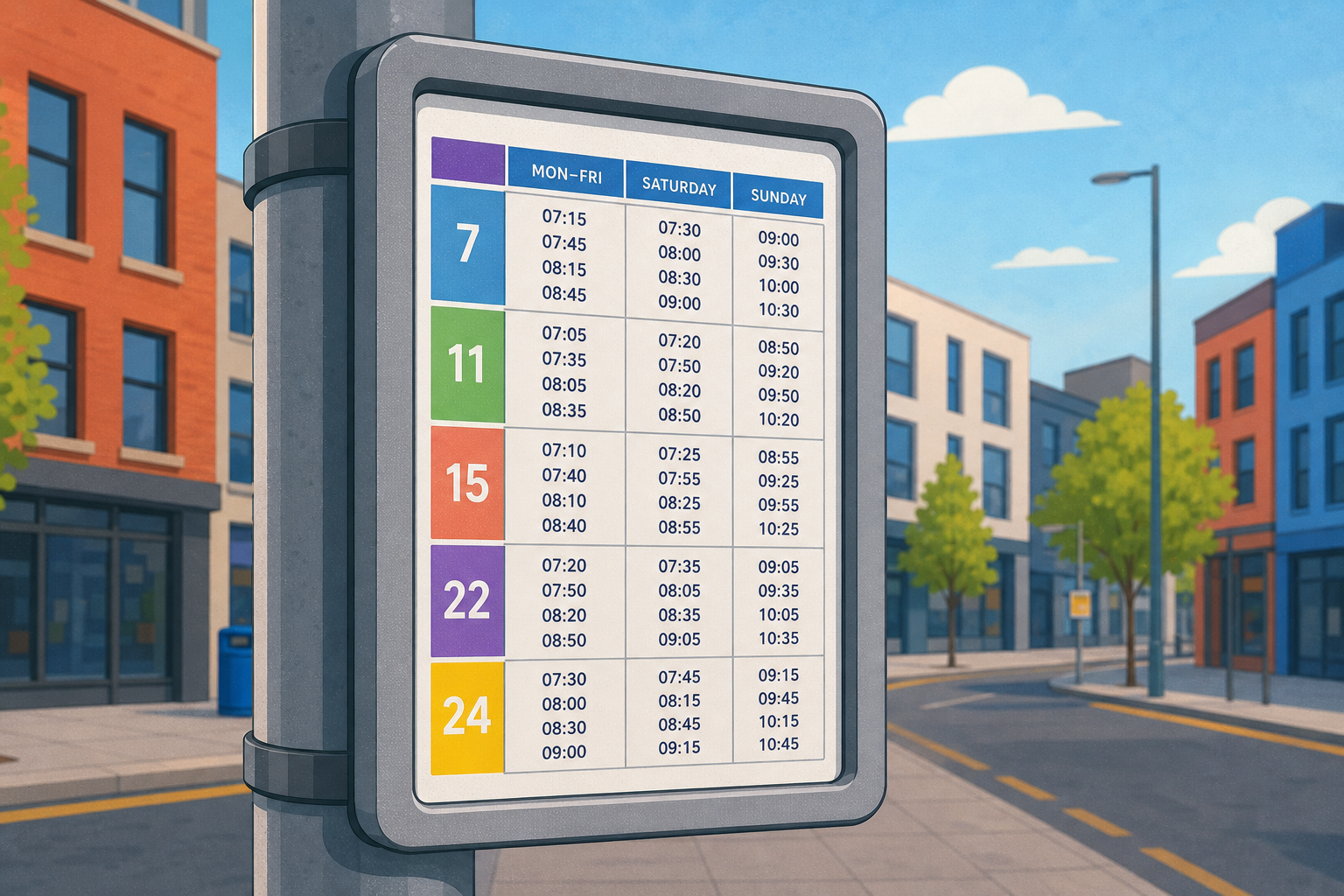
A Dublin Bus leaves the school stop at 8:47 and pulls into town at 9:25. How long did the journey take?
This catches everyone out at first. The trick is not to add the digits in your head and panic, it's to break the journey at the next hour-mark. We'll learn the move today, then apply it to four real bus journeys.
Write the two times on the IWB and collect three or four pupil predictions before any reveal. Common shouts will be 38, 42, 22, 78. Don't correct yet, put each on the board and tell the class we'll come back to them after Watch and Notice. The wrong answers are the lesson's hook, not a problem to head off.
Watch four elapsed-time examples on the IWB. The first one bridges the hour at 9:00; the second and third stay inside the same hour; the fourth lands cleanly on the next hour.
From 8:47, count 13 minutes up to 9:00. Then count 25 minutes past 9:00 to 9:25. Total: 13 + 25 = 38 minutes.
Same hour the whole way. Count on in fives from :15 to :55. Total: 40 minutes.
Same hour. From :05 to :50 is 45 minutes.
Half-hour exactly. The end time lands on the hour-mark, so the count is clean: 30 minutes.
Walk each example aloud, one at a time. Pause on Example 1, this is the load-bearing one.
Common misconception to head off: pupils treat minutes like decimals and subtract digit-by-digit (9:25 minus 8:47 giving 1:22?). The bridge stops this.
We'll work through these together as a class. Each card shows a start time and a number of minutes to count on. Pupils take turns at the board; the class talks each one through before tapping the matching time.
This round is for talking it through together, pupils take turns at the board and the class agrees or corrects out loud.
The on-screen countdown is visual scaffolding for the whole bank, not a per-card race, so set the pacing by the discussion, not the clock.
The first three cards stay inside the same hour so pupils warm up on simple counting-on. From card 4 onwards the offset crosses an hour-mark, pause before tapping and ask 'do we need to bridge here?' Listen for pupils explaining the 13-and-25 split aloud; revoice the strong ones so everyone hears the move once before the Class Challenge.
If a pupil picks a distractor like 7:75 (didn't wrap to the next hour), don't correct directly, ask the class 'is 7:75 a real time on a clock?' and let them spot it. That's the fastest fix for the wrap-around misconception.
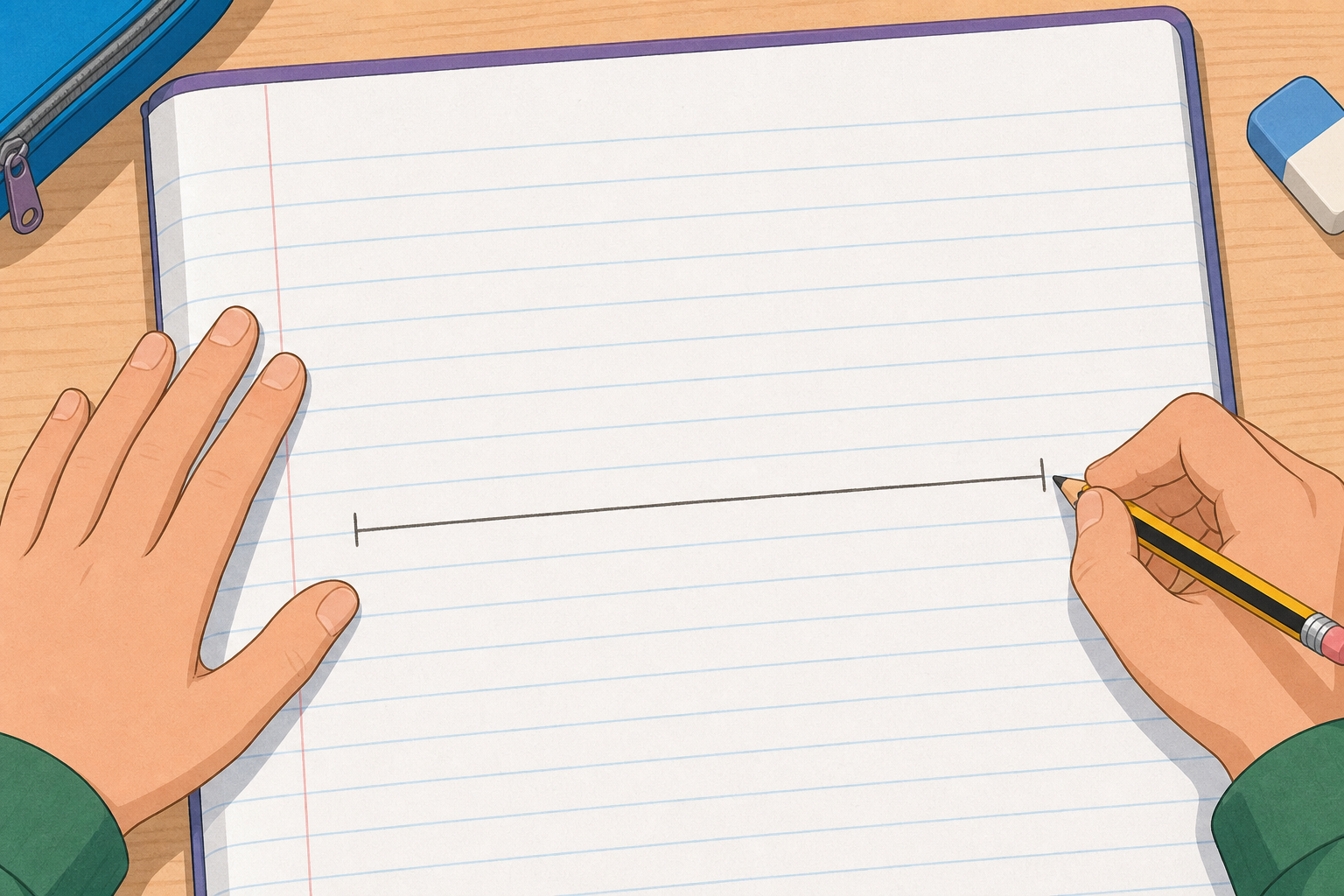
In your maths copy, work each elapsed-time problem on a sketched number line. Mark the start and end times on the line, count up to the next hour first, then on to the end. Write the total minutes underneath each one.
Walk the room and glance at how pupils place the start and end times on the line and where they mark the hour-bridge in between, this is whole-class copybook practice, not marking. The first problem (7:35 to 8:10) bridges 8:00; the second (11:20 to 11:55) stays inside the hour; the third (3:48 to 4:15) bridges 4:00. Look for a pupil who has neatly split each one at the hour-mark on their line, that's the picture to point out at the end.
Today's bank: five Irish bus journeys. Read each journey label for the depart time, then set the arrival time on the clock and check. The widget confirms when the answer matches.
7:18 to 7:55 · 9:35 to 10:12 · 11:40 to 12:08 · 4:55 to 5:25 · 2:48 to 3:22.
This round is the practice bank, pupils take turns at the board, check each answer, and the class confirms before moving on. The same 5-problem bank reruns at home as tonight's homework, so keep the board work brisk rather than over-explaining.
Before each turn, read the journey label aloud so the class hears the depart time clearly, that's the start the pupil at the board is counting from.
The bank rises in trickiness. Pace each turn with the class lever shown:
If a pupil sets the clock and lands close-but-wrong (e.g. 10:13 instead of 10:12), let them re-check rather than hinting, the widget's tick / not-yet does the work.
You're previewing this lesson. Get full access to this lesson and hundreds more — each one ready to teach, with interactive activities, printable resources and pupil progress tracking built in.