Look at the corridor outside our classroom and the playground beyond the door. Which one is longer? How could we settle it without walking the whole way?
Take three hands-up answers, not open call-outs. Give five seconds of quiet think-time before any hands go up. Don't measure anything yet, this beat is about predictions, not accuracy.
Watch as we hold a metre stick up against real things around our room — the board rail, a Maths book, the classroom door. Each time, look for an anchor you already know the length of, picture how many of it would fit, and say your estimate out loud. Then we measure it together to see how close we were.
Work through three real lengths one at a time, with an actual metre stick in your hand. For each one: hold the metre stick (or the Maths book) against the object, ask the class to picture how many fit and say an estimate, take a few aloud, then measure it together and compare.
Always take the estimate before you measure — the estimate is the thinking, the measuring is the check. Push pupils to name the anchor they used rather than just call out a number.
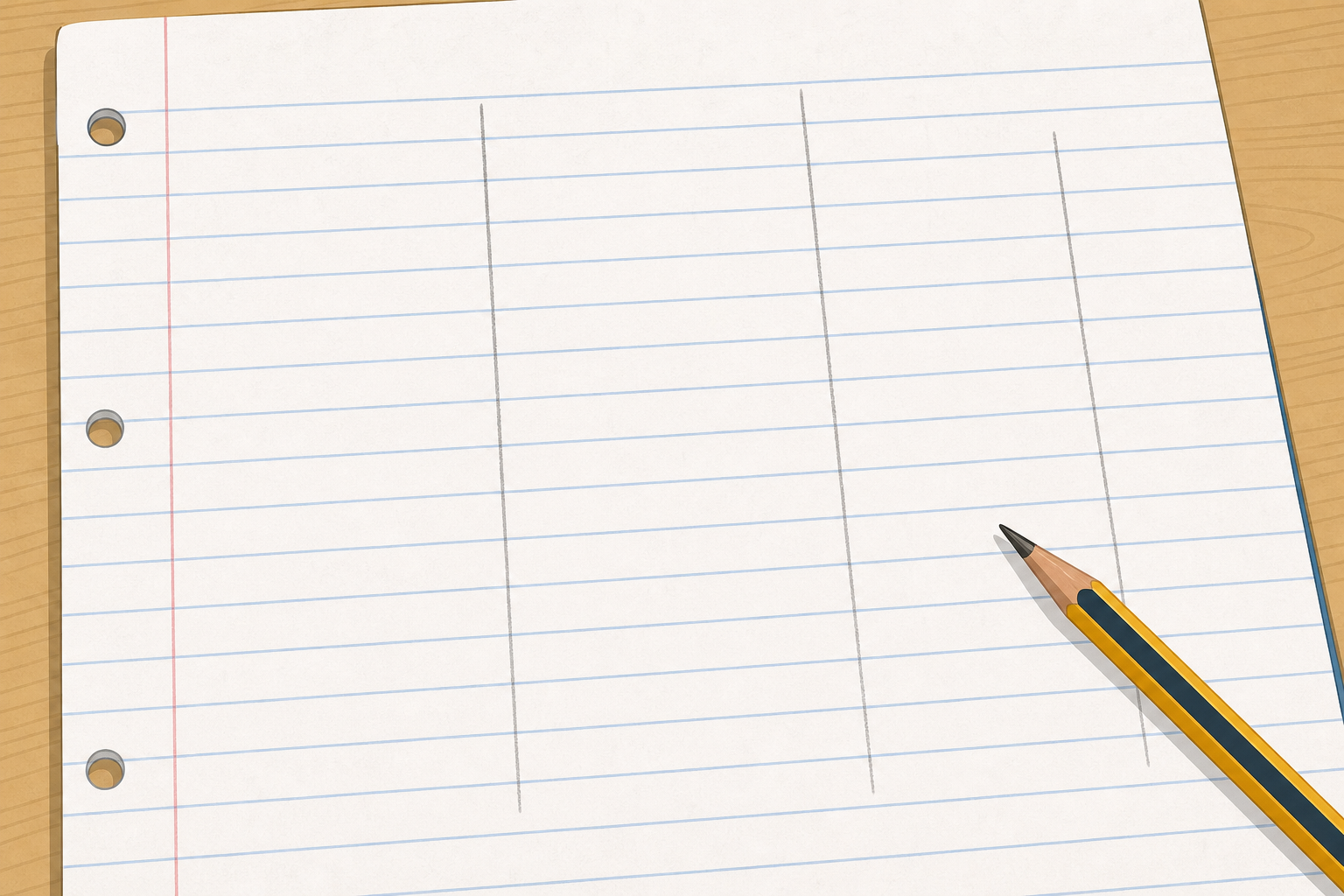
In your maths copy, draw three columns down the page and write the headings 'Estimate', 'Actual', and 'Difference' across the top. Leave the rows blank for now — you'll fill this table in twice today: first with the classroom lengths we measure together, then with your own yard routes outside. Each time the rule is the same: write your estimate before you measure.
Walk the rows glancing at column headings and alignment — no marking, this is whole-class copybook practice, not assessment. Setting the table up now means the Estimate column gets filled in before the metre stick comes out. Say it aloud: estimate first, in pen, then measure. An estimate that matches the actual exactly every time is the giveaway it was written afterwards.
Now we try it together with real classroom lengths: the teacher's desk, the width of the door frame, and the distance from the front of the room to the back wall. Write your estimate in your table first, then we measure each one with a metre stick and you fill in the actual and the difference.
Take the three lengths one at a time. For each: invite a few estimates aloud, have everyone write their own estimate in the Estimate column, then send a pupil to lay the metre stick end-over-end while the class counts, and record the actual together. Work out the difference as a class the first time, then let pupils do their own.
Push pupils to NAME the anchor they used (metre stick, Maths book) every time — that naming is what turns a guess into an estimate. Celebrate close estimates and far ones equally: a far estimate tells you something useful for next time.
Groups of four or five, one metre stick, one copybook and one pencil per group. Take the class to whatever flat space your school has room in — the yard, the hall, or the corridor. Before the lesson, mark three routes with chalk or masking tape: a Short route under one metre, a Medium route around five metres, and a Long route ten to fifteen metres.
If the yard is unusable, run the same Short / Medium / Long structure indoors — masking tape for the Short line, a stretch of the hall or classroom for the Medium, and the full length of the corridor for the Long.
Grouping and rotation. Split the class into groups of four or five, one metre stick per group. Groups cycle through the three routes in any order; aim for about three minutes per route plus rotation time.
Pace conversion on the IWB before heading out. Stand a pupil's pace against a metre stick on the board: one pace is about 70 cm, so about 7 paces make 5 metres. That gives every pupil an anchor for turning paces into metres on the Medium and Long routes.
Insist on estimate-before-measure. Pupils who measure first and read their estimate off the metre stick learn nothing. Re-route any group whose first move is to grab the stick — ask them to write their estimate in the copybook before the stick comes out.
Circulate; listen for the anchor. Move from group to group rather than leading the whole class. Listen for pupils naming a specific anchor (metre stick, Maths book, half a metre stick, my own pace) when they explain their estimate; that anchor-naming is what turns a guess into an estimate.
Natural unit choice. The Short route lives in centimetres; the Medium and Long routes live in metres. Use the Short route to surface the difference between estimating to the nearest metre and to the nearest 10 cm — pupils tend to round a short length to a whole metre.
You're previewing this lesson. Get full access to this lesson and hundreds more — each one ready to teach, with interactive activities, printable resources and pupil progress tracking built in.