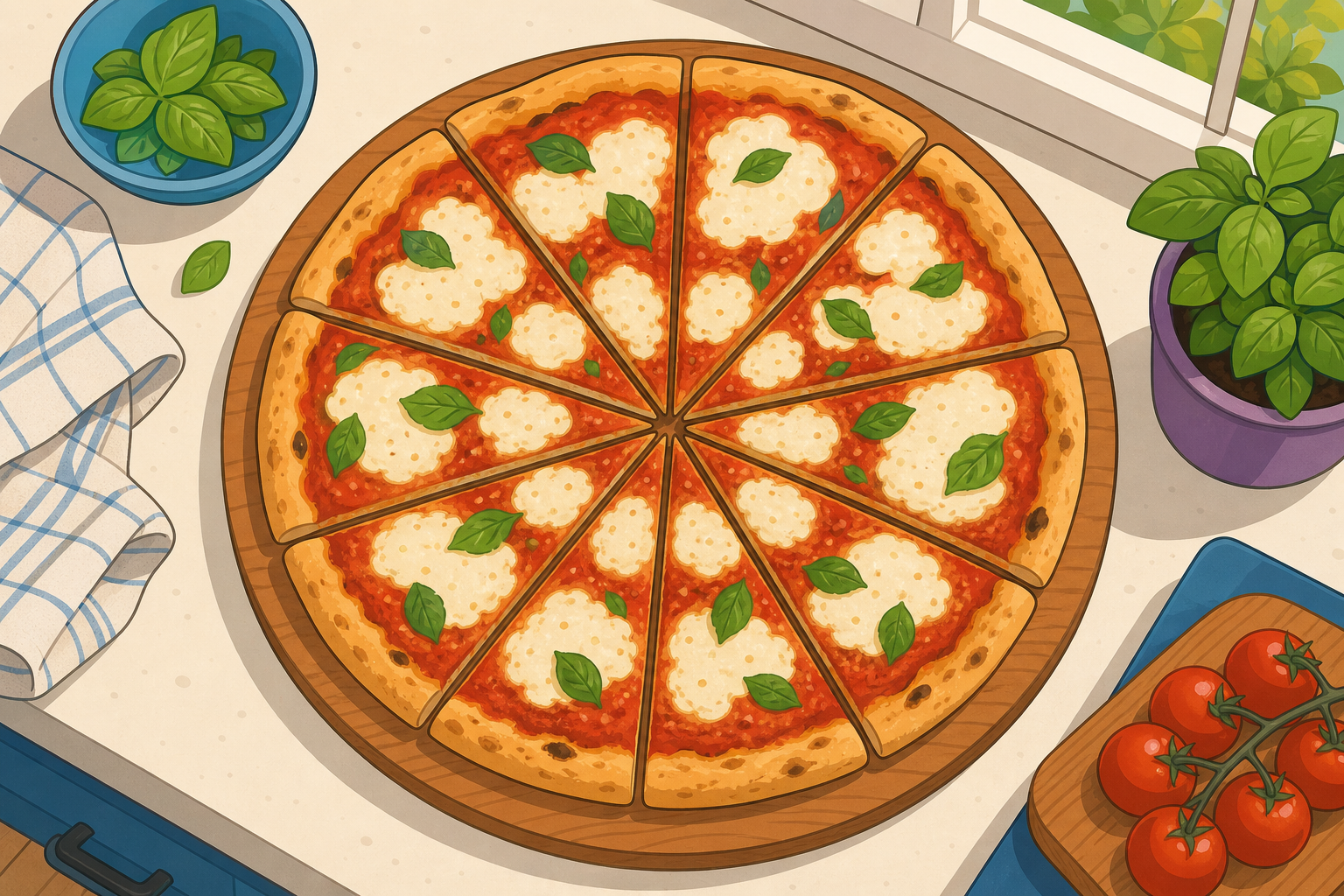
Imagine your family orders one pizza, and ten of you sit down to share it fairly. How would we cut it so nobody feels short-changed? How much of the pizza does each person get?
Today we are going to give that fair share a name and a picture. The fair share is called one tenth, and we will see how ten of these fair shares fit back together to make the whole pizza.
Open with a quick maths-talk on the pizza scenario. Push for the word equal — fair sharing means the slices are the same size. If a pupil says "a tenth" or "one tenth" before you do, revoice it back: "Yes — one tenth. That's our new word today." Keep the hook tight — this is the warm-up, not the teaching.
The first picture shows one whole strip on its own, then ten tiny tenth-strips lined up right below it. They cover exactly the same length. Ten tenths, all the same size, make one whole.
Now look at the same one whole alongside two halves. Halves are big pieces — only two of them cover the whole. Tenths are small pieces — it takes ten of them. But both cover the whole. The size of the pieces is what changes; the whole stays the same.
One half is exactly five tenths. When we line up a half-strip and a tenths-strip shaded to five parts, they match exactly. This is the key link we will use later when we ask how many tenths sit between half and 7/10.
Finally, three of the ten parts are shaded in. We say three-tenths and we write it 3/10. The bottom number tells us how many parts the whole is split into; the top number tells us how many of those parts are shaded.
Walk each snapshot aloud, one at a time, and do not move on until the class can say each equivalence back confidently.
Now we explore the tenths strip together. The top strip is one whole and is locked — no shading allowed. The bottom strip is divided into ten tenths, and that's the one we'll work on. Take turns coming up to the board: when the class calls out a number of tenths, drag the shading on the bottom strip to match. We'll try 4 tenths, then 8 tenths, then 9 tenths. Each time, read the shaded amount aloud as a class: "four tenths," "eight tenths," "nine tenths."
This round is for talking it through together — pupils take turns at the board and the class agrees or corrects out loud.
Rotate three or four pupils through the IWB. Each time the shading changes, ask the rest of the class "how many tenths are shaded now?" and take a couple of answers before the next pupil comes up. If a pupil shades the wrong count, do not correct directly — instead ask "count them aloud with us" and let the visible count surface the slip. Listen for pupils saying "four out of ten" instead of "four tenths" — revoice to the fraction wording.
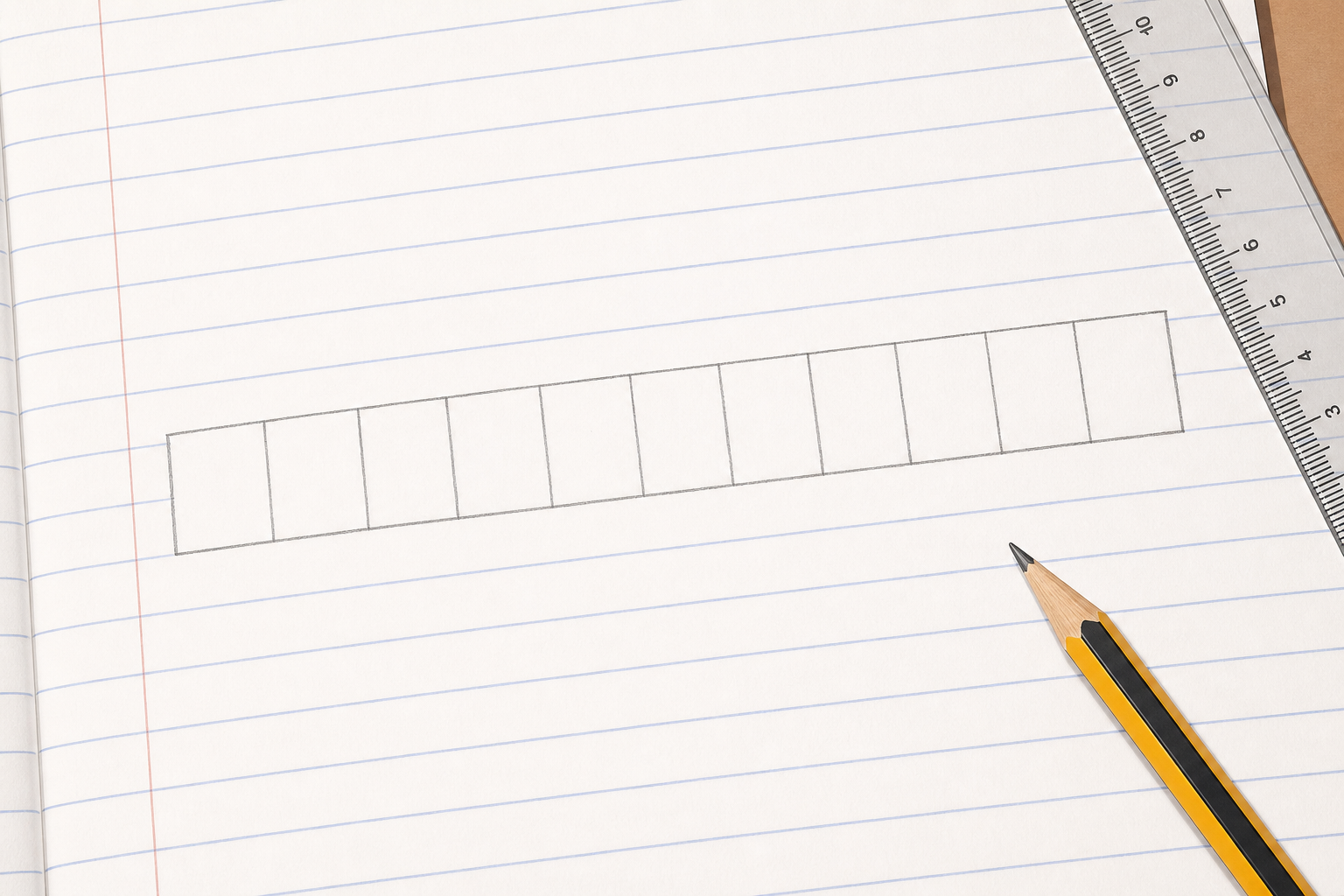
Now pause the board. In your maths copy, use your ruler to sketch one long rectangle and divide it into ten equal parts (count carefully — ten parts means nine dividing lines). Shade in 3/10 by colouring three of the ten parts, and write 3/10 underneath. Then sketch a fresh strip below it and shade 7/10, labelled. You'll have two clear tenth-fractions on the page when you're done.
Walk the rows glancing at division accuracy — this is whole-class copybook practice, not marking. The common slip is nine equal parts instead of ten (pupils count the dividing lines instead of the spaces); if a strip looks lopsided, prompt "use the ruler to space them evenly." Two completed labelled strips per pupil is the target. Pupils who finish early can mouth the count under their breath while waiting.
Today's challenge bank — pupils take turns at the board to shade each target on the tenths strip, and the class checks together before tapping Check:
The last one's a thinking puzzle. Talk it out as a class before anyone shades. Remember: one half is exactly five tenths.
This round is the practice bank — pupils take turns at the board, check each answer, and the class confirms before moving on. The same 4-problem bank reruns at home as tonight's homework, so keep the board work brisk rather than over-explaining.
For the fourth target (between half and 7/10), pause BEFORE the shading happens. Ask: "How many tenths is one half?" (five). "How many tenths is 7/10?" (seven). "So which number sits between five and seven?" — six. Then let a pupil shade 6/10 and tap Check. Don't reveal the answer too early on this one — the in-between reasoning IS the lesson.
You're previewing this lesson. Get full access to this lesson and hundreds more — each one ready to teach, with interactive activities, printable resources and pupil progress tracking built in.