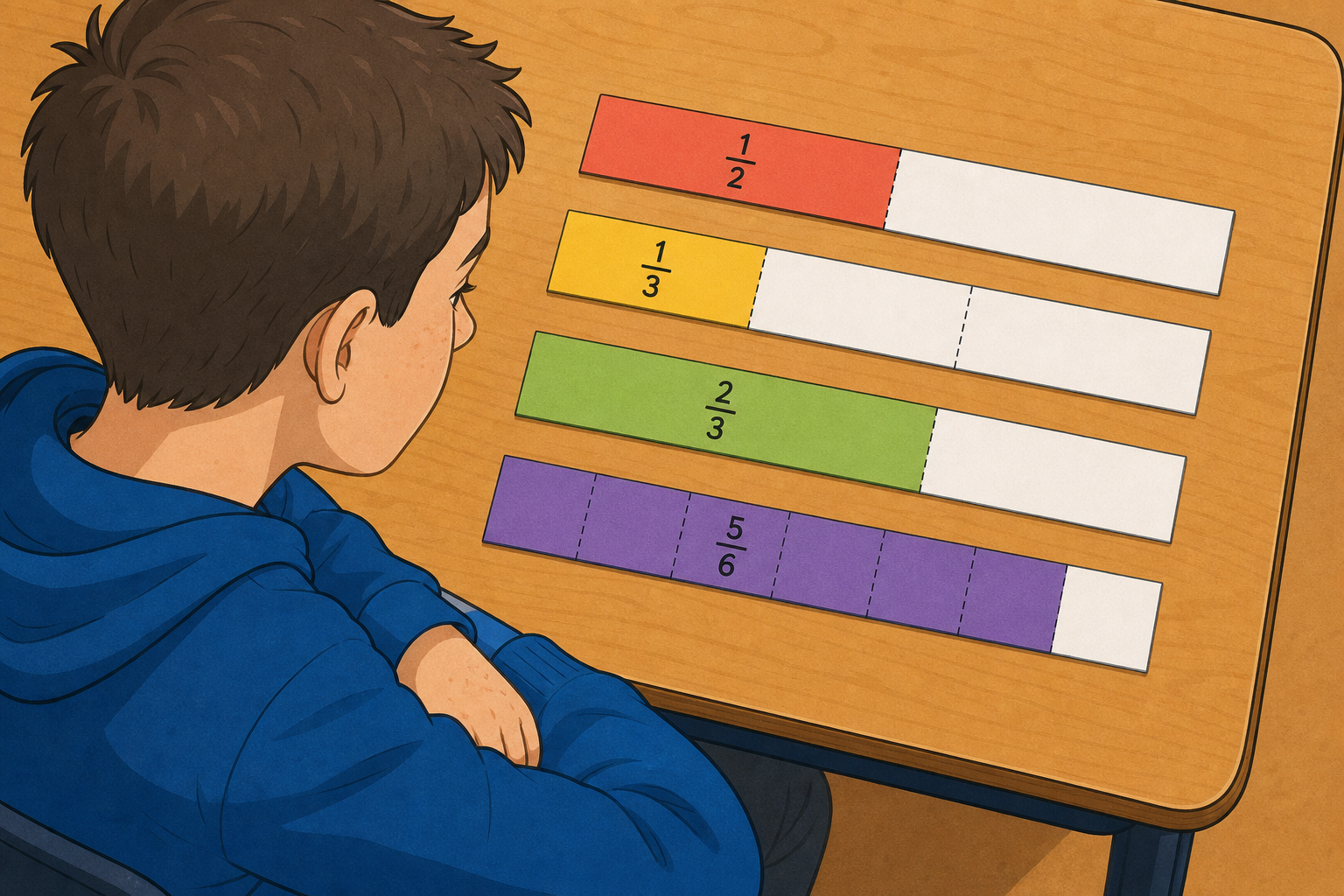
Four fractions are on the board in random order: 1/2, 1/3, 2/3, 5/6.
Hands up, which one is the biggest? Which one is the smallest? What single trick would help you put all four of them in order from smallest to biggest?
Take three hands-up answers, not open call-outs. Let pupils name the biggest, then the smallest, then guess at the trick that orders them all. Do not reveal the order yet; the Watch and Notice step builds it on the IWB.
Watch three sets of four fractions go in order on the IWB. Each set is in ascending order, the smallest at the top, the biggest at the bottom, and the fraction strips show why. Look at the strip lengths: every set works the same way once you find a common denominator.
Walk each example aloud, one at a time. Between examples, ask the class for the common denominator to keep the watching beat alive.
Press on the trick: find a denominator that fits ALL four, then the numerators sort themselves.
Today's set on the IWB: 1/4, 3/8, 1/2, 5/8. The strips are on screen but they are NOT in order yet. Look at the strip lengths, which fraction is shortest? Which is longest? What common denominator lines all four up so the comparison is obvious?
Call out 'smaller' or 'bigger' as the strips move, the class agrees or corrects each move out loud.
One pupil comes up to drag the strips into ascending order; the class calls out 'smaller' or 'bigger' on each move so the whole room shares the work.
Once the order is agreed, ask: what is the common denominator that makes this obvious? Expect '8', 1/4 = 2/8, 1/2 = 4/8. Write the four equivalent eighths on the IWB underneath the strips: 2/8, 3/8, 4/8, 5/8. The numerators sort themselves.
In your maths copy, take this set of four fractions:
Rewrite each one with denominator 6 underneath the original. Then number them 1 to 4 from smallest to biggest at the bottom.
Walk the room glancing at the rewrites, this is whole-class copybook practice, not marking. Look for pupils writing 1/3 as 2/6 and 1/2 as 3/6. If a pupil writes 1/2 as 2/6, that is the place to lean in: which numerator goes on top when we change the denominator?
Today's bank: four sets of four fractions to order from smallest to biggest. Each set is a bit less friendly than the last, by set 4 the common denominator is not the first one that springs to mind.
While one pupil is at the board, the class agrees or corrects each move out loud.
This round is the practice bank, pupils take turns at the board, check each answer, and the class confirms before moving on. Keep the board work brisk rather than over-explaining.
For set 4 — {1/3, 1/2, 5/8, 3/4} — pause when the class hits the common-denominator question. The lowest common denominator is 24 (2 × 3 × 4 fails to cover 8; 24 covers 2, 3, 4 AND 8). Use this as the seed for the maths-talk wrap that follows.
In 24ths the order is clear: 1/3 = 8/24, 1/2 = 12/24, 5/8 = 15/24, 3/4 = 18/24.
You're previewing this lesson. Get full access to this lesson and hundreds more — each one ready to teach, with interactive activities, printable resources and pupil progress tracking built in.