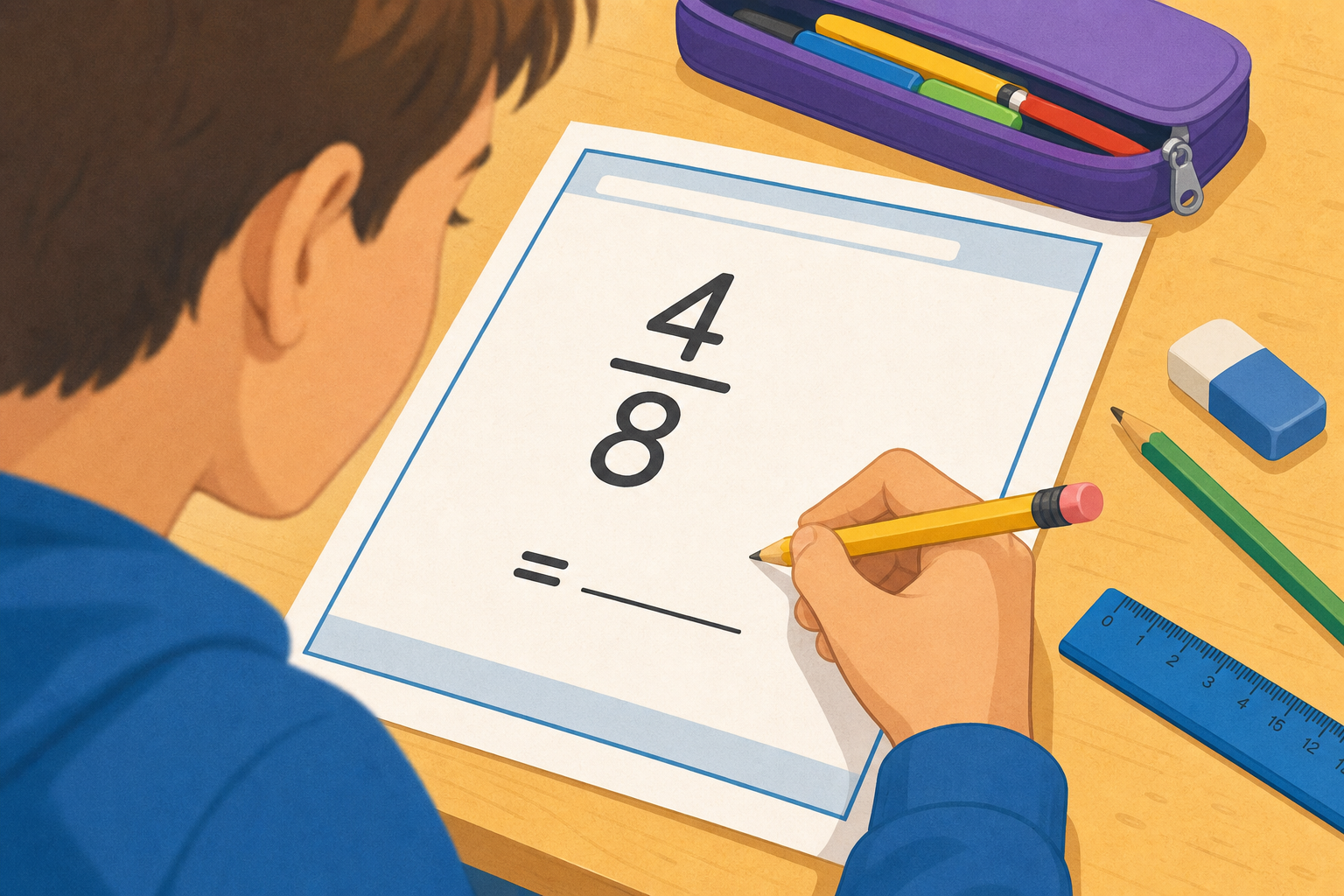
Hands up: when you see 4/8, what is the simplest way to write the same fraction?
Write 4/8 on the IWB before the hook. Take three hands-up answers — likely 2/4, 1/2, half. Praise all three as equivalent, then write 1/2 underneath with the question 'is that the simplest we can go?' to seed the lesson.
Watch four worked examples on the fraction strips. Each one starts with a fraction we want to simplify, then shows the simplest form on a shorter strip directly below it. Both shaded portions line up exactly — that is how we know the two fractions are equivalent. The heading above each pair shows the divide-by step in writing.
Top and bottom both divided by 4. The ÷4/4 step underneath the fraction shows the single divider we use.
Top and bottom both divided by 3. A different divider, same idea.
Top and bottom divided by 4 in one step. We could also write ÷2/2 first (12/16 = 6/8), then ÷2/2 again to reach 3/4 — same answer, two small steps.
Top and bottom divided by 5. Same simplest form as 12/16 — from a different starting fraction.
Walk each worked example aloud, one at a time. Point at the locked top strip first, then the simpler bottom strip, then narrate the divider. Read the ÷4/4 (or ÷3/3, etc.) notation in the heading aloud so pupils hear the form they will be writing in their copies later.
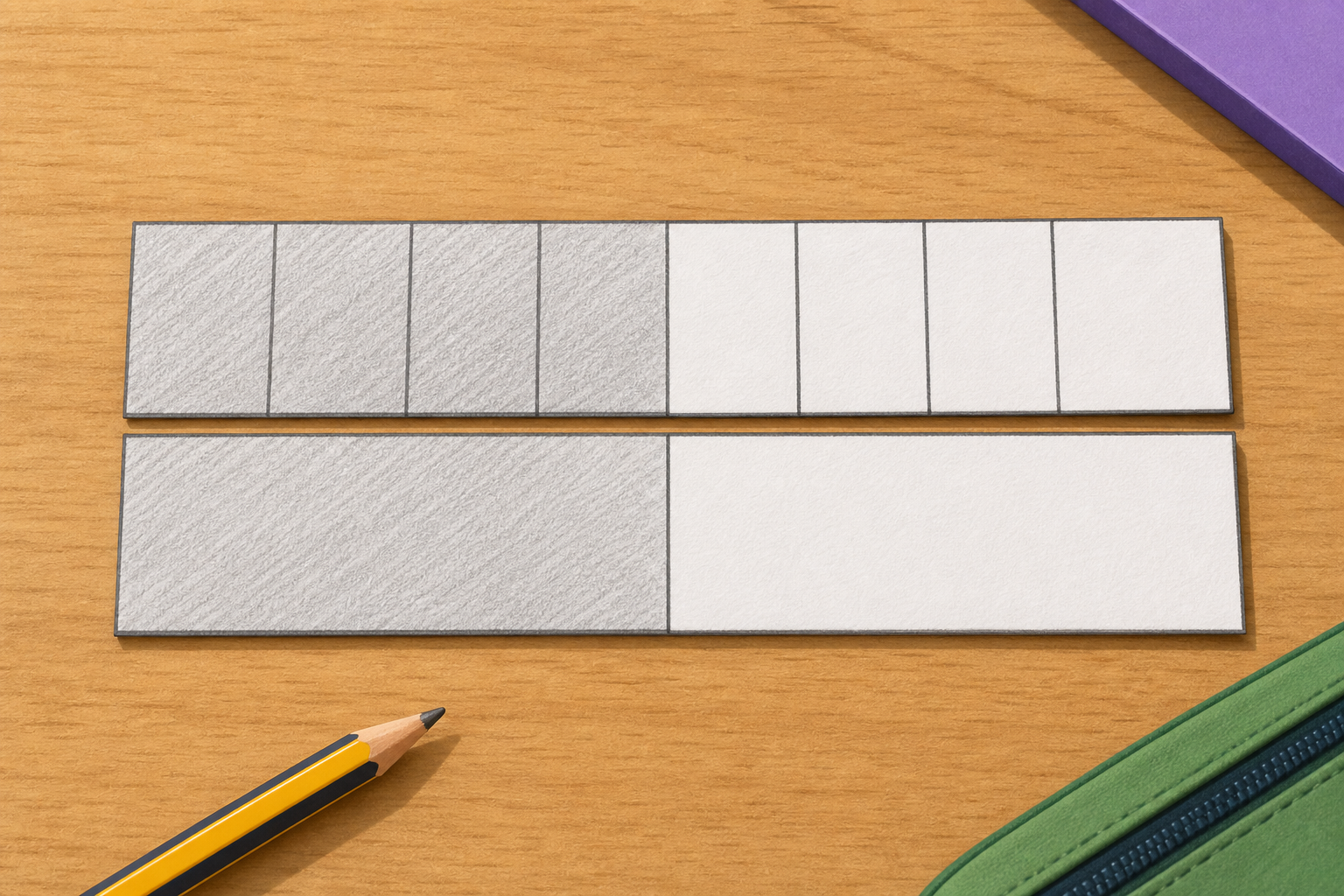
Watch as we stack three strips at the board. A pupil at the board shades 4/8 on the eighths strip, then 2/4 on the quarters strip, then 1/2 on the halves strip. Each shaded length should end at exactly the same point — that's the picture of an equivalent simplification.
Class job: as each shading lands, say whether it 'lines up' with the strip above or needs a 'shift'.
This round is for talking it through together — pupils take turns at the board and the class agrees or corrects out loud.
Set the strips one at a time: 4/8 first, then 2/4, then 1/2. After each shading lands, ask the watching class whether it 'lines up' or needs a 'shift' and take a quick answer. Pause on the moment all three line up — this is the visual heart of simplifying. Revoice: 'three fractions, same shaded length, smallest numbers wins'.
In your maths copy, work each simplification by writing the divide-by step underneath. For example, write 4/8 on one line, then below it write 4/8 ÷4/4 = 1/2 and underline the 1/2 as the simplest form. Now do the same for these four fractions:
Walk the rows glancing at the divide-by working — this is whole-class copybook practice, not marking. Look for pupils writing ÷4/4 (or ÷3/3, etc.) as a single divider rather than separate top and bottom divisions; either notation is fine so long as the same number divides both top and bottom.
Today's bank: simplify each fraction to its simplest form. Pupils take turns at the board. The top strip is locked at the starting fraction; the pupil at the board moves the shaded count on the bottom strip until both shaded lengths line up exactly, then taps Check. Before each Check, the watching class predicts the divider.
The fractions get trickier as we go: 6/8, then 9/12, then 8/12, then the stretch 24/36 — the bigger numbers and the shared factors catch people out.
This round is the practice bank — pupils take turns at the board, check each answer, and the class confirms before moving on. Keep the board work brisk rather than over-explaining.
Before each pupil sets the simpler strip, ask the class to predict the divider ('divide top and bottom by what?') and take a quick answer. The Check button confirms; revoice any wobble. On the 24/36 stretch, pause and ask: 'what's the biggest number that divides both 24 and 36?' — 12 is the answer; ÷12/12 gets there in one step.
You're previewing this lesson. Get full access to this lesson and hundreds more — each one ready to teach, with interactive activities, printable resources and pupil progress tracking built in.