Hands up: what is the biggest number you have ever seen written down? Think of numbers on signs, price tags, bills at home, or scoreboards. Some might be figures into the hundreds of thousands.
Take three hands-up nominations rather than open call-outs. The point is to get pupils thinking about large numbers they have already met in everyday life.
Watch four numbers slot into place-value columns. We start small and build up. Each number teaches us something a bit different. Before each one lands, read the column names out loud with me so we all hear what each column is called.
Four thousands, no hundreds, seven tens, three units. Notice how the zero in the hundreds column does an important job. It holds the column open. Take it away and the four slides into the wrong place — the 4 would only be worth 400, not 4,000. We read this as "four thousand and seventy-three" — we don’t say the zero out loud, but we still need it on the page.
Nine of each. What happens if we add one more? The thousands column fills up and tips one digit to the left into a brand-new column.
Now we need a new column on the left: TTh, ten-thousands. One ten-thousand, two thousands, five hundreds, no tens, eight units.
Six digits this time, with the HTh column (hundred-thousands) on the left. Four hundred thousand, no ten-thousands, five thousands, six hundreds, one ten, two units. Read it left to right and the comma helps you find your place.
Walk each example aloud, one at a time. Pause on the zeros, because that is where reading errors happen.
Between each example, point at the column headers and ask the class to read the names back with you (both the full name and the abbreviation: 'hundred-thousands, HTh; ten-thousands, TTh; thousands, Th; hundreds, H; tens, T; units, U'). This keeps the watching class working and lets the HTh/TTh abbreviations bed in alongside their full names.
Today the columns stretch all the way to hundred-thousands: HTh, TTh, Th, H, T, U. When a number is called out, one person comes up to the board to build it. While they build, everyone in their seat reads the columns silently and works out the finished number. Then we read the finished number back aloud. If a column looks off, we name the column we need to fix.
This round is for talking it through together. Pupils take turns at the board and the class agrees or corrects out loud.
Aim for five builds across the round, rotating five different pupils. A good ladder: 608 (revisit the placeholder zero), 5,047 (zero in the hundreds column), 23,400 (trailing zeros in tens and units), 180,005 (HTh in play, two big internal zeros), 412,005 (HTh again with an internal zero). After each build, give the watching class a few seconds of silent thinking, then ask them to read the number back aloud. If a column is off, the class names the column to fix rather than the teacher pointing.
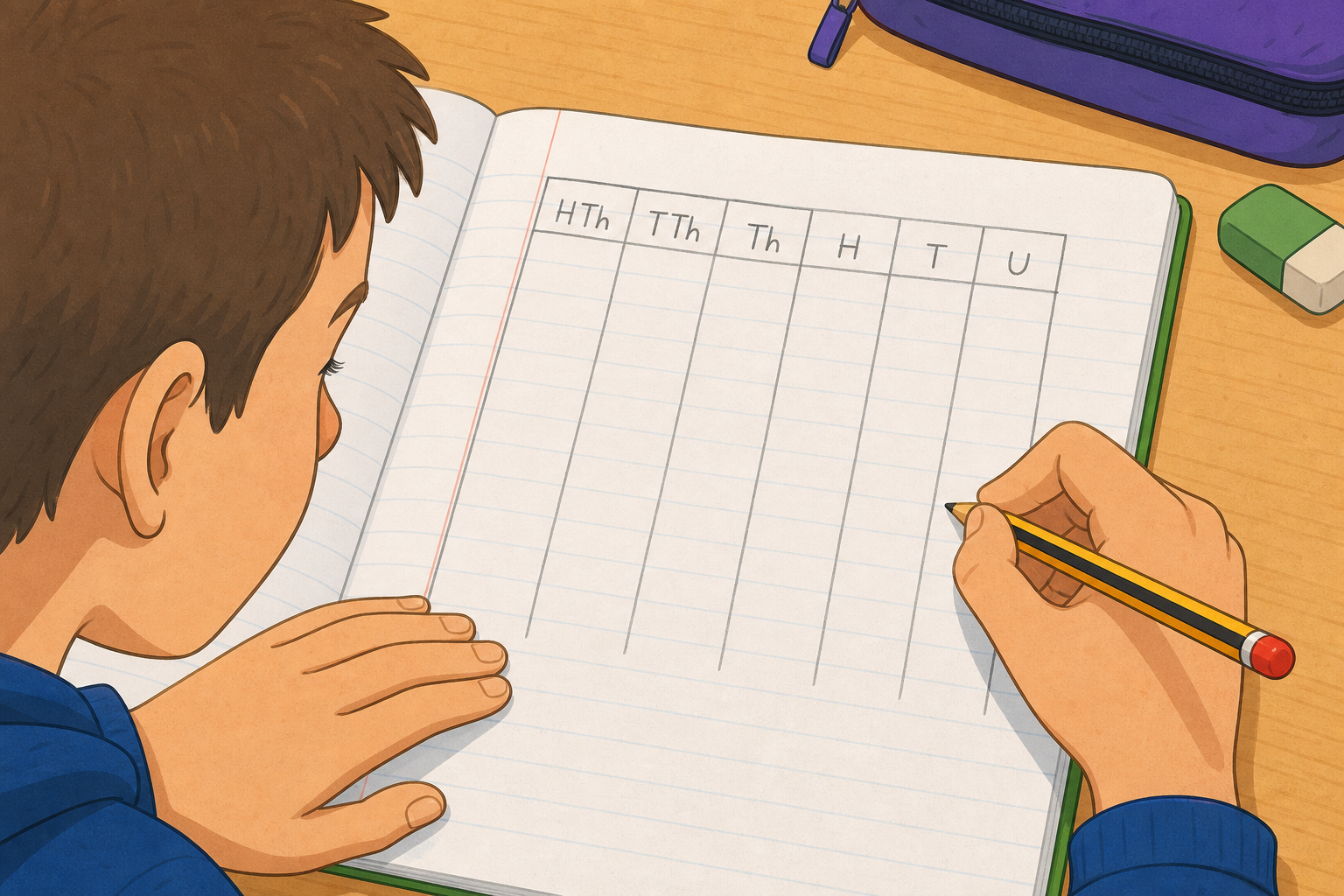
In your maths copy, sketch six place-value columns and label them across the top: HTh, TTh, Th, H, T, U. Then write each of today's four numbers into the columns, one under the other, with the units digit lined up on the right edge. If a number has fewer digits than columns, leave the leftmost columns empty: the digits always stay anchored on the right. Read each number aloud once it is written.
Walk the room glancing at column labels and right-edge alignment. This is whole-class copybook practice, not marking. Three habits to spot: pupils who leave a placeholder zero out (4,073 written as 4_73), pupils who let the digits drift left when their number has fewer digits than columns, and pupils who forget to keep the units column lined up on the right edge. Four minutes is enough time to sketch the frame once, write all four numbers, and read each aloud.
Today's bank: 3,072, then 70,309, then 105,008, then 800,070. We take turns at the board. While one pupil builds, everyone in their seat works out silently which zeros are doing the placeholder work. Before the builder taps Check, they say the placeholder zeros out loud. The class agrees or names any zero they missed. Then we read the whole number back aloud.
This round is the practice bank. Pupils take turns at the board, check each answer, and the class confirms before moving on. The same 4-problem bank reruns at home as tonight's homework, so keep the board work brisk rather than over-explaining.
The watching class's job is named on screen: work out the placeholder zeros silently while the builder works, agree (or correct) when the builder explains, then read the finished number back aloud when the teacher asks. This keeps every pupil in the round, not just the four at the board.
Watch for the classic slip on 800,070: pupils try to drop the 8 into the TTh column. Revoice: 'eight hundred thousand, so the 8 lives in the HTh column'. The 70,309 problem has the same trap with the 7 in TTh. The 105,008 problem tests two internal zeros at once, so slow down on this one and ask the class to name each empty column.
Why does each column to the left mean ten times as much as the column on its right? And where in real life have you already seen the ten-times rule? Think about money (cent and euro) and measurement (mm, cm, m). Where else does ten-times show up?
Listen for pupils naming the ten-times rule and connecting it to the columns. Revoice: 'every step left is one bigger column, and one bigger column is always ×10. That is what makes it base ten.'
Expect money first (100 cent in a euro is a ×10 ×10 step) and measurement next (10 mm in a cm, 100 cm in a metre). If nobody offers either, prompt directly. Use this moment to plant the seed for tomorrow: decimals use the same ×10 rule going the other way, which is what makes cent-and-euro split the way they do.
Tomorrow we keep the ×10 rule but turn it around. We split one whole into ten equal parts and meet tenths for the first time. The columns start to grow to the right of the units, and decimals enter the picture.
Two or three minutes is plenty. The bridge to Lesson 2 (introducing tenths) is the same ×10 rule running in reverse, so it pays to name that link out loud now, while today's column thinking is still fresh.
You're previewing this lesson. Get full access to this lesson and hundreds more — each one ready to teach, with interactive activities, printable resources and pupil progress tracking built in.