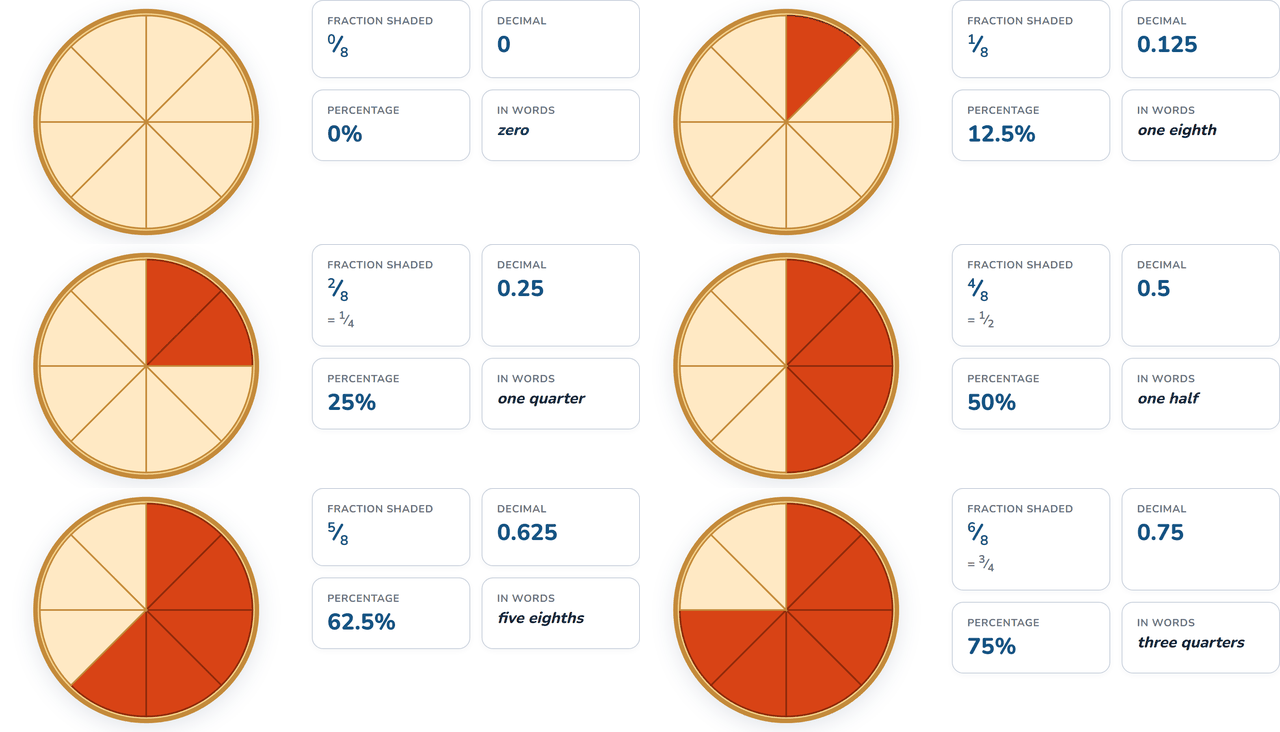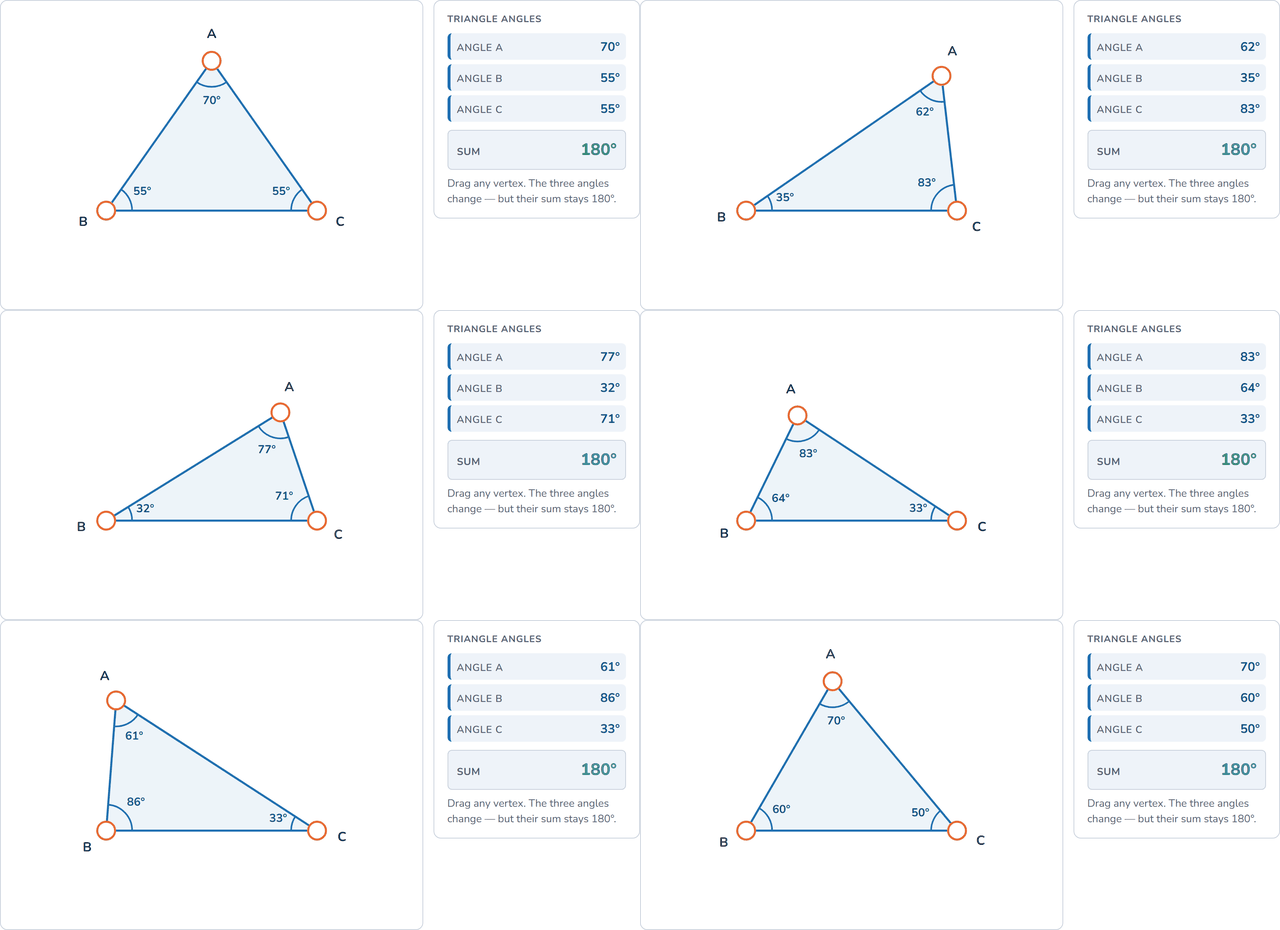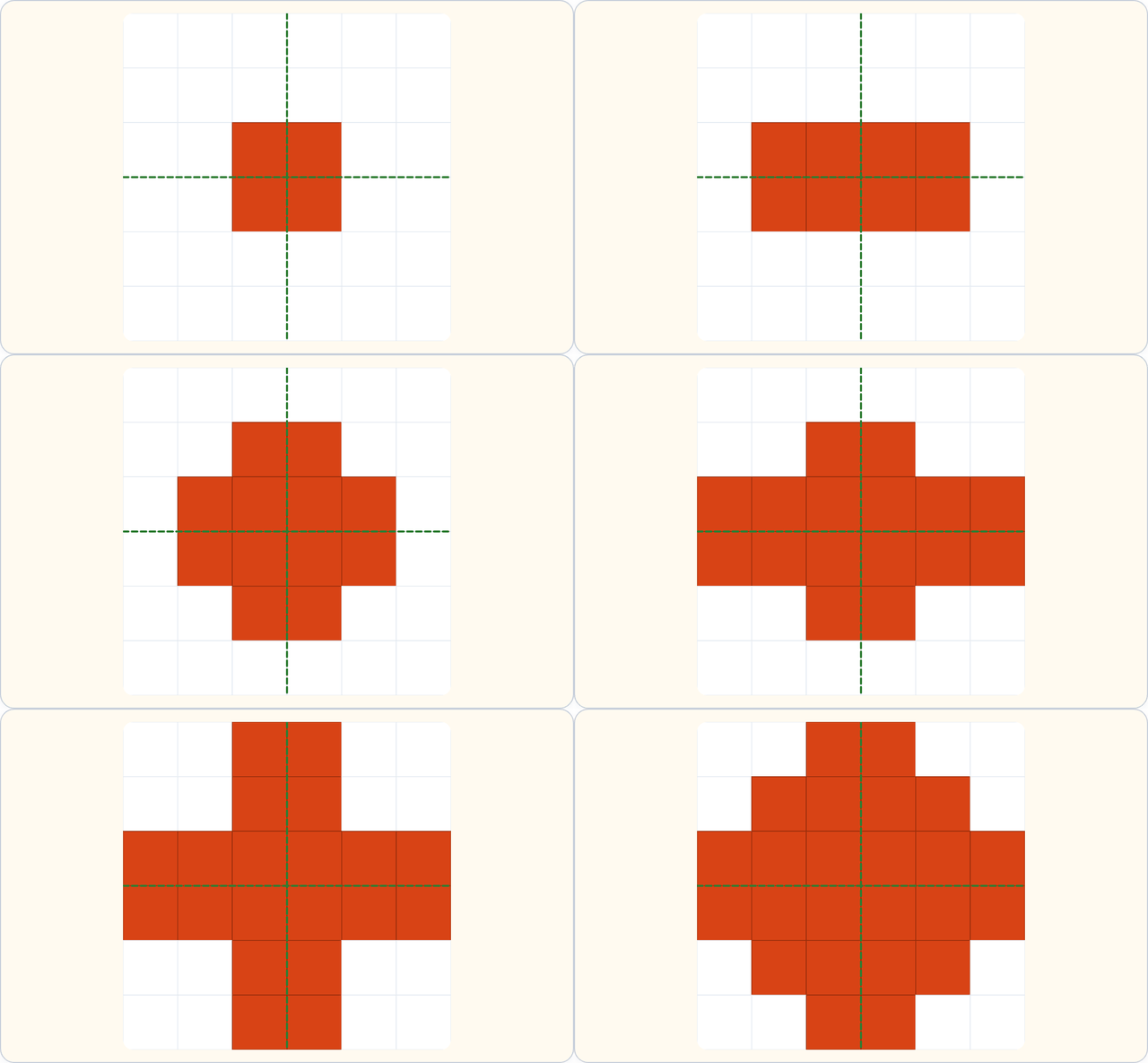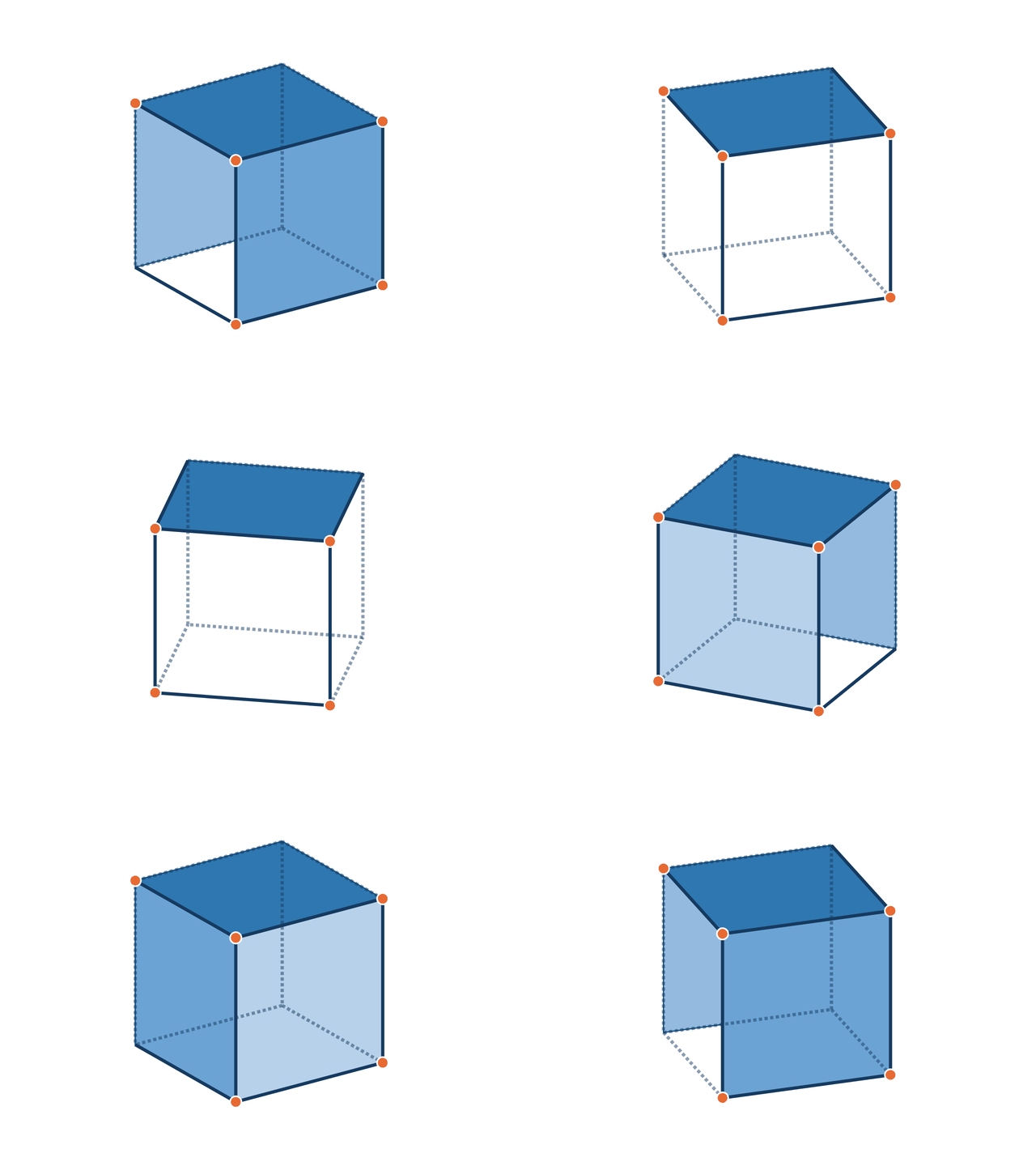
This course delivers a complete fourth-class mathematics programme aligned with the NCCA Maths curriculum. Pupils develop secure understanding of place value to 9,999, master mental and written strategies for all four operations, and explore fractions, decimals, measures, area, perimeter, volume, 2D and 3D shapes, angles, symmetry, location, data handling, chance, and early algebra. Practical investigations, problem-solving, and cross-strand reviews build confidence, reasoning, and mathematical thinking throughout the year.
Read more
Everything you need for Maths, all year.

A complete year of Maths, delivered by teacher-led interactive-whiteboard lessons, a printed pupil Activity Book, and a Teacher Resource Book, built to the NCCA Primary Mathematics Curriculum.

Interactive whiteboard lessons
Pupil Activity Book Mathematics 123learn Bran the Irish wolfhound Look inside
Teacher Resource Book Mathematics 123learn Teacher resource books and materials

Explore the Course

Click any lesson with to preview it

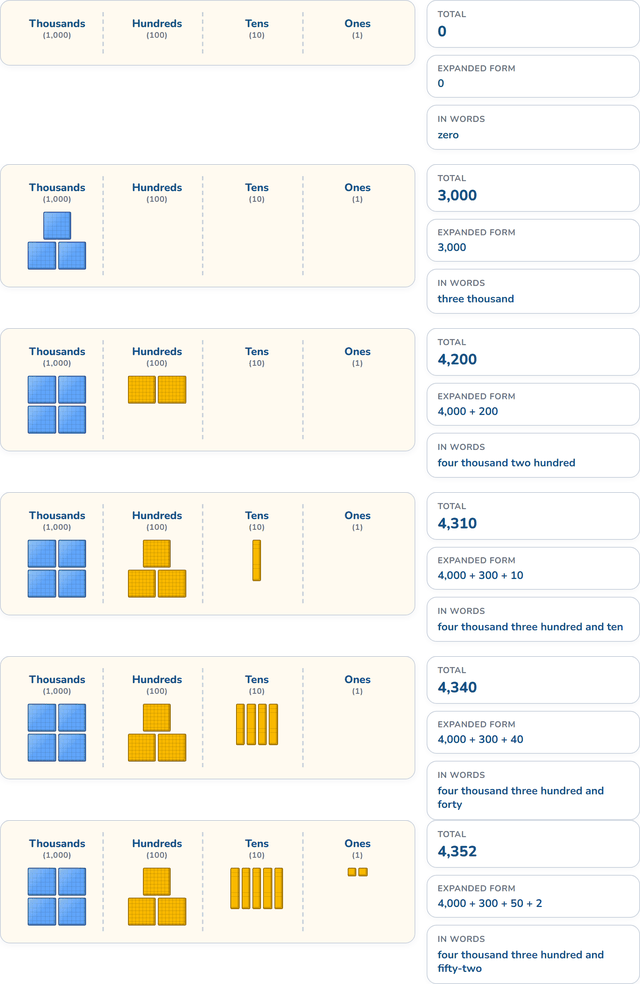
Secure place value across the thousands. Pupils read, write, partition, compare, order, round and estimate whole numbers to 9,999.

Place Value to 999: Hundreds, Tens and Units Sample Activity Book Teacher Resources
Place Value to 9,999, the Thousands Column Sample Activity Book Teacher Resources
Reading and Writing 4-digit Numbers Sample Activity Book Teacher Resources
Partitioning and Renaming Numbers
Comparing Numbers to 9,999, Digit by Digit
Ordering a Set of Numbers
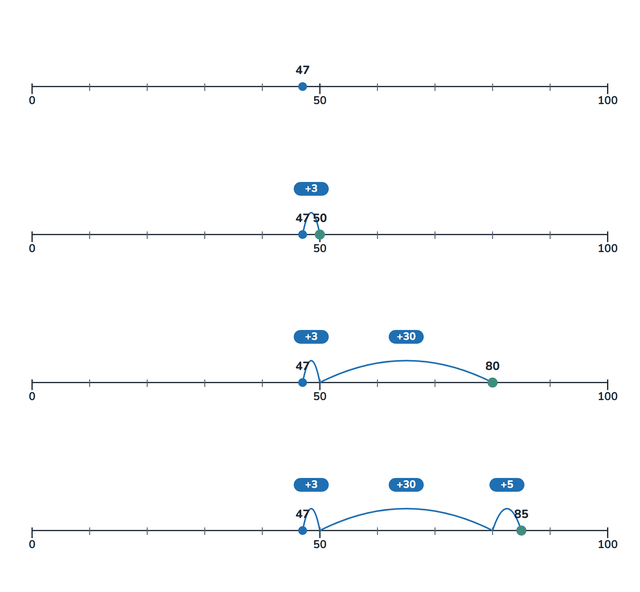
Placing and Estimating Numbers on a Number Line
Counting on and Back in 10s, 100s and 1000s
Rounding to the Nearest 10
Rounding to the Nearest 100
Rounding to the Nearest 1000 and Estimating
Place-value Investigation and Review, Biggest and Smallest Number

Build flexible mental strategies and secure written methods for all four operations, and the links between them.

Mental and Written Addition and Subtraction
Mental Addition Strategies: Partition, Count on and Near Doubles Sample Activity Book Teacher Resources
Mental Subtraction: Count Back or Count up Sample Activity Book Teacher Resources
Written Addition of 3-digit Numbers with Regrouping Sample Activity Book Teacher Resources
Written Addition of 4-digit Numbers
Written Subtraction of 3-digit Numbers with Renaming
Written Subtraction of 4-digit Numbers
Addition and Subtraction Word Problems, Choose the Operation
Multiplication, Division and Mixed Problem Solving
Multiplication Facts, the 2, 4, 5 and 10 Tables and Their Patterns
Multiplication Facts, the 3, 6, 9 and 7, 8 Tables
Multiplication as Arrays and Repeated Addition
Multiplying a 2-digit Number by 1 Digit, Partition and the Grid Method
Multiplying a 3-digit Number by 1 Digit
Division as Sharing and Grouping, the Division-multiplication Link
Division with Remainders
Dividing 2- and 3-digit Numbers by 1 Digit
Mixed-operation Problem Solving, Which Operation?

Compare, order and find equivalent fractions and fractions of a quantity; meet tenths and hundredths as the first decimals and link them to fractions and money.

Fractions: Parts, Equivalence, Comparing and Quantities
What Is a Fraction? Part-whole Review
Fractions of a Length and of a Set
Fractions on a Number Line
Equivalent Fractions with Fraction Strips
Comparing Fractions
Ordering Fractions
Finding a Unit Fraction of a Quantity
Finding a Non-unit Fraction of a Quantity
First Decimals: Tenths, Hundredths and Links to Fractions and Money
Tenths, the First Decimal Place
Reading and Writing Decimals with Tenths, Tenths on a Number Line
Hundredths, the Second Decimal Place
Linking Simple Fractions and Decimals
Comparing and Ordering Decimals
Fractions and Decimals in Money and Measure

Estimate and measure length, weight and capacity with the right instrument and unit, and rename equivalent metric units.

Length, Estimate and Measure with a Ruler (Cm and Mm)
Length, Metres and Centimetres, Choosing the Unit
Renaming Length Units (M to Cm, Cm to Mm)
Kilometres and Distance, Estimating Longer Lengths
Weight, Estimate and Weigh in Kg and G on a Scale
Renaming Weight (Kg to G), Reading Scales
Capacity, Estimate and Measure in L and Ml with a Jug
Renaming Capacity (L to Ml), Reading a Jug Scale
Measures Word Problems (Length, Weight, Capacity)
Measures Investigation, Estimate Then Measure Around the Room and Yard

Find perimeter by adding the sides, area by counting square units and as rows by columns, and volume by counting unit cubes.

Perimeter, the Distance Around a Shape (Add the Sides)
Perimeter of Rectangles and Regular Shapes
Area by Counting Square Units
Area of Rectangles, Rows by Columns Links to Multiplication
Same Perimeter, Different Area, an Investigation
Volume, Counting Unit Cubes in a Cuboid
Area, Perimeter and Volume Review

Tell and calculate time across analog, digital and 24-hour forms and across the units of time; calculate with euro and cent in everyday money contexts.

Time: Telling, the 24-hour Clock, Units, Elapsed Time and the Calendar
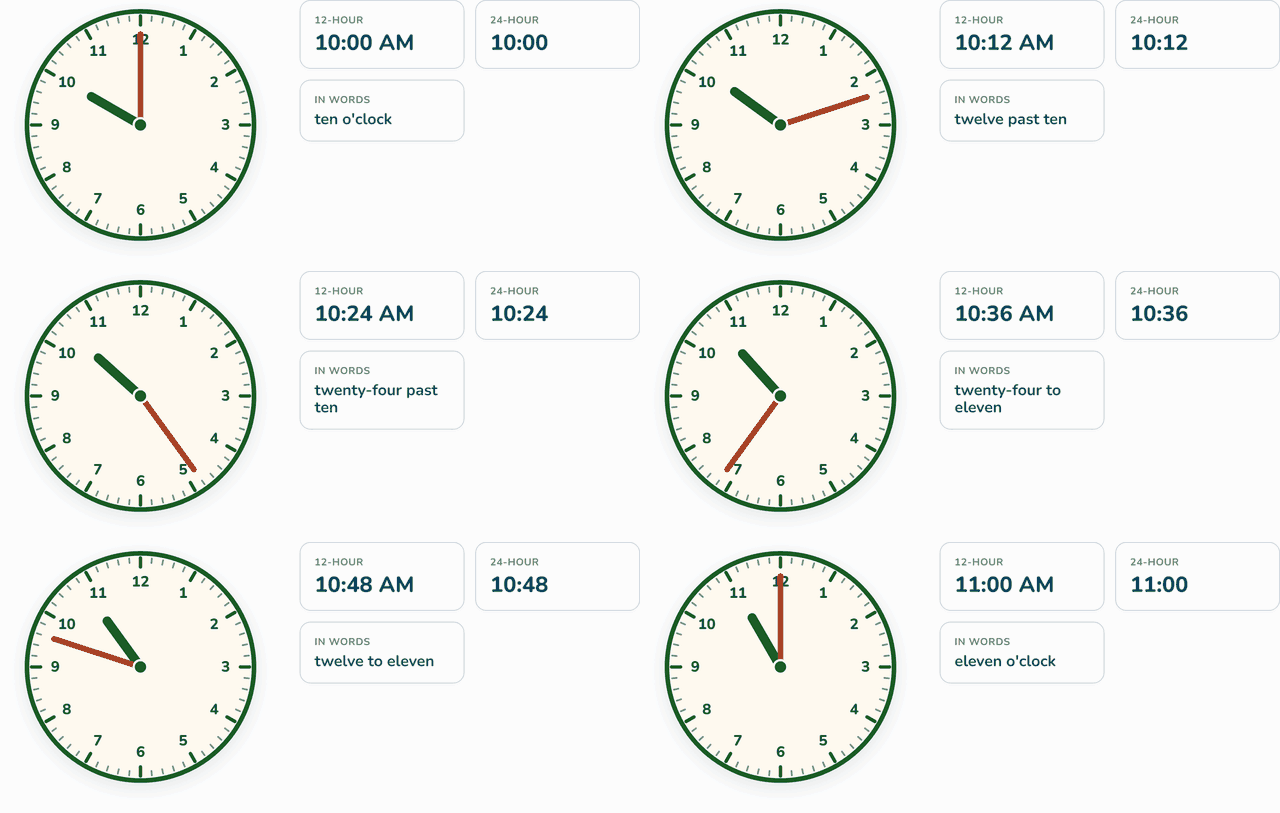
Telling Time to 5-minute Intervals (Analog)
Telling Time to the Minute, Analog to Digital
The 24-hour Clock, an Introduction
Units of Time and How They Relate
Elapsed Time and Simple Timetables
Calendar and Dates Problems
Money: Coins and Notes, Totalling, Change and Value, with a Review
Money, Coins and Notes, Making Amounts in Euro and Cent
Money, Totalling a Shopping Basket
Money, Giving Change
Money, Value for Money and Spending a Set Amount
Time and Money Problem-solving Review

Investigate and classify 2D and 3D shapes by their properties, name the parts of a circle, and recognise and classify angles as amounts of turn.

2D and 3D Shapes
2D Shapes, Sides, Vertices and Naming
Classifying Triangles, Equilateral, Isosceles and Scalene
Classifying Quadrilaterals
Regular and Irregular Polygons, Pentagon, Hexagon and Octagon
The Circle, Centre, Radius and Diameter
3D Shapes, Faces, Edges and Vertices
3D Shapes, Nets and Building Models
Angles as Turns and Their Classification
Angles, an Angle Is an Amount of Turn
Right Angles, Finding Them in Shapes and the Room
Comparing Angles to a Right Angle, Acute and Obtuse
Classifying Angles, Acute, Right, Obtuse and Straight
Angles Inside 2D Shapes
Shape and Angle Investigation and Review

Find lines of symmetry and model reflections, rotations, translations and tessellations; give and follow directions and read simple grid references.

Symmetry and Transformation
Line Symmetry, Finding Lines of Symmetry
Completing Symmetrical Patterns Across a Mirror Line
Reflection, Reflecting a Shape Across a Line
Rotation, Quarter, Half and Three-quarter Turns
Translation, Sliding Shapes on Squared Paper
Tessellation, Shapes That Fit Together
Location: Directions, Routes and Grid References
Directions and Routes (Left/right, N/S/E/W)
Grid References, Locating Positions on a Simple Grid
Location and Transformation Investigation

Pose questions and collect, display and analyse data with tallies, pictograms and bar charts (mode, range and a gentle mean); describe and test the likelihood of everyday events.

Data: Collecting, Displaying and Analysing
Posing a Question and Collecting Data with a Tally
Tally Charts to Frequency Tables
Pictograms, One Symbol Means One
Pictograms with a Scale (One Symbol = 2, 5 or 10) and Reading Them
Making a Bar Chart with a Chosen Scale
Reading and Interpreting Bar Charts
Comparing Two Data Sets
Sorting Data with Carroll and Venn Diagrams
The Mode and the Range (Most Common, and the Spread)
The Mean (Average) of a Small Set, a Gentle First Look
Chance: Likelihood and Testing Predictions
Chance, the Language of Likelihood
Ordering Events on a Likelihood Line
Testing Predictions with Dice and Spinners
Data and Chance Investigation, Survey, Display and Conclude

Find and use the rule behind number and shape patterns, and read and solve number sentences with a missing value shown as a box or a letter, closing with a cross-strand year review.

Patterns and the Rules Behind Them
Number Patterns and Sequences, Find the Rule
Growing and Shrinking Patterns, Predict the Next Terms
Repeating Patterns and Their Rule (Shape and Colour)
Input and Output, Number Rules Shown as a Table
Patterns in the Tables and Multiples
Number Sentences, the Unknown, and a Cross-strand Year Review
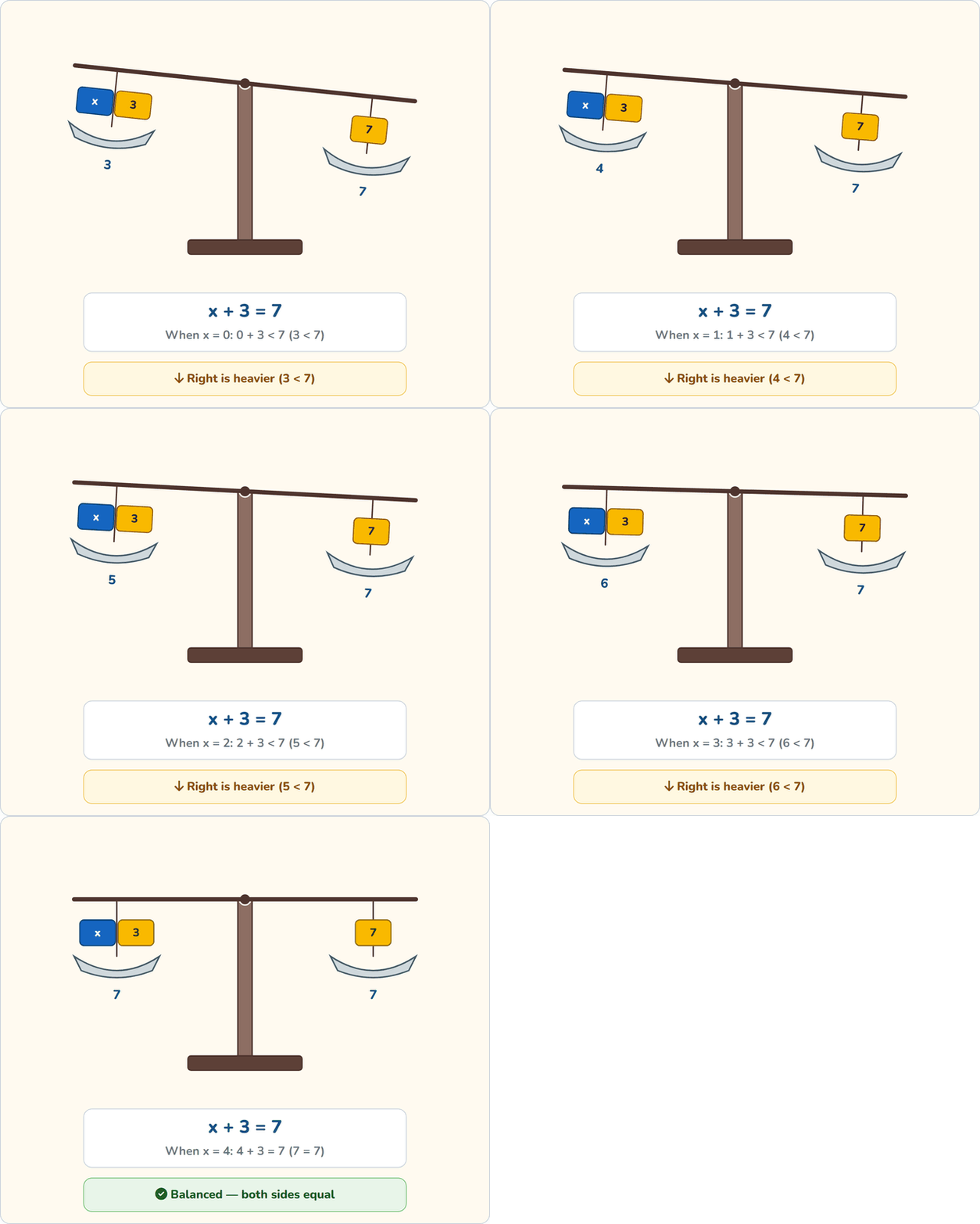
The Equals Sign Means Balance
Finding the Missing Number (Box + 5 = 12)
Using a Letter or Word for the Unknown (a + 3 = 10)
Turning Word Problems Into Number Sentences
Properties of Operations, Order and Inverse Links
Equivalent Expressions (3 + 3 + 3 = 3 X 3)
Algebra Investigation, Patterns and Rules
End-of-year Review, Number, Measures and Shape
End-of-year Review, Data, Chance and Algebra, Maths-journal Reflection

Secure place value across the thousands. Pupils read, write, partition, compare, order, round and estimate whole numbers to 9,999.

Place Value to 999: Hundreds, Tens and Units Sample Activity Book Teacher Resources
Place Value to 9,999, the Thousands Column Sample Activity Book Teacher Resources
Reading and Writing 4-digit Numbers Sample Activity Book Teacher Resources
Partitioning and Renaming Numbers
Comparing Numbers to 9,999, Digit by Digit
Ordering a Set of Numbers
Placing and Estimating Numbers on a Number Line
Counting on and Back in 10s, 100s and 1000s
Rounding to the Nearest 10
Rounding to the Nearest 100
Rounding to the Nearest 1000 and Estimating
Place-value Investigation and Review, Biggest and Smallest Number

Build flexible mental strategies and secure written methods for all four operations, and the links between them.

Mental and Written Addition and Subtraction
Mental Addition Strategies: Partition, Count on and Near Doubles Sample Activity Book Teacher Resources
Mental Subtraction: Count Back or Count up Sample Activity Book Teacher Resources
Written Addition of 3-digit Numbers with Regrouping Sample Activity Book Teacher Resources
Written Addition of 4-digit Numbers
Written Subtraction of 3-digit Numbers with Renaming
Written Subtraction of 4-digit Numbers
Addition and Subtraction Word Problems, Choose the Operation
Multiplication, Division and Mixed Problem Solving
Multiplication Facts, the 2, 4, 5 and 10 Tables and Their Patterns
Multiplication Facts, the 3, 6, 9 and 7, 8 Tables
Multiplication as Arrays and Repeated Addition
Multiplying a 2-digit Number by 1 Digit, Partition and the Grid Method
Multiplying a 3-digit Number by 1 Digit
Division as Sharing and Grouping, the Division-multiplication Link
Division with Remainders
Dividing 2- and 3-digit Numbers by 1 Digit
Mixed-operation Problem Solving, Which Operation?

Compare, order and find equivalent fractions and fractions of a quantity; meet tenths and hundredths as the first decimals and link them to fractions and money.

Fractions: Parts, Equivalence, Comparing and Quantities
What Is a Fraction? Part-whole Review
Fractions of a Length and of a Set
Fractions on a Number Line
Equivalent Fractions with Fraction Strips
Comparing Fractions
Ordering Fractions
Finding a Unit Fraction of a Quantity
Finding a Non-unit Fraction of a Quantity
First Decimals: Tenths, Hundredths and Links to Fractions and Money
Tenths, the First Decimal Place
Reading and Writing Decimals with Tenths, Tenths on a Number Line
Hundredths, the Second Decimal Place
Linking Simple Fractions and Decimals
Comparing and Ordering Decimals
Fractions and Decimals in Money and Measure

Estimate and measure length, weight and capacity with the right instrument and unit, and rename equivalent metric units.

Length, Estimate and Measure with a Ruler (Cm and Mm)
Length, Metres and Centimetres, Choosing the Unit
Renaming Length Units (M to Cm, Cm to Mm)
Kilometres and Distance, Estimating Longer Lengths
Weight, Estimate and Weigh in Kg and G on a Scale
Renaming Weight (Kg to G), Reading Scales
Capacity, Estimate and Measure in L and Ml with a Jug
Renaming Capacity (L to Ml), Reading a Jug Scale
Measures Word Problems (Length, Weight, Capacity)
Measures Investigation, Estimate Then Measure Around the Room and Yard

Find perimeter by adding the sides, area by counting square units and as rows by columns, and volume by counting unit cubes.

Perimeter, the Distance Around a Shape (Add the Sides)
Perimeter of Rectangles and Regular Shapes
Area by Counting Square Units
Area of Rectangles, Rows by Columns Links to Multiplication
Same Perimeter, Different Area, an Investigation
Volume, Counting Unit Cubes in a Cuboid
Area, Perimeter and Volume Review

Tell and calculate time across analog, digital and 24-hour forms and across the units of time; calculate with euro and cent in everyday money contexts.

Time: Telling, the 24-hour Clock, Units, Elapsed Time and the Calendar
Telling Time to 5-minute Intervals (Analog)
Telling Time to the Minute, Analog to Digital
The 24-hour Clock, an Introduction
Units of Time and How They Relate
Elapsed Time and Simple Timetables
Calendar and Dates Problems
Money: Coins and Notes, Totalling, Change and Value, with a Review
Money, Coins and Notes, Making Amounts in Euro and Cent
Money, Totalling a Shopping Basket
Money, Giving Change
Money, Value for Money and Spending a Set Amount
Time and Money Problem-solving Review

Investigate and classify 2D and 3D shapes by their properties, name the parts of a circle, and recognise and classify angles as amounts of turn.

2D and 3D Shapes
2D Shapes, Sides, Vertices and Naming
Classifying Triangles, Equilateral, Isosceles and Scalene
Classifying Quadrilaterals
Regular and Irregular Polygons, Pentagon, Hexagon and Octagon
The Circle, Centre, Radius and Diameter
3D Shapes, Faces, Edges and Vertices
3D Shapes, Nets and Building Models
Angles as Turns and Their Classification
Angles, an Angle Is an Amount of Turn
Right Angles, Finding Them in Shapes and the Room
Comparing Angles to a Right Angle, Acute and Obtuse
Classifying Angles, Acute, Right, Obtuse and Straight
Angles Inside 2D Shapes
Shape and Angle Investigation and Review

Find lines of symmetry and model reflections, rotations, translations and tessellations; give and follow directions and read simple grid references.

Symmetry and Transformation
Line Symmetry, Finding Lines of Symmetry
Completing Symmetrical Patterns Across a Mirror Line
Reflection, Reflecting a Shape Across a Line
Rotation, Quarter, Half and Three-quarter Turns
Translation, Sliding Shapes on Squared Paper
Tessellation, Shapes That Fit Together
Location: Directions, Routes and Grid References
Directions and Routes (Left/right, N/S/E/W)
Grid References, Locating Positions on a Simple Grid
Location and Transformation Investigation

Pose questions and collect, display and analyse data with tallies, pictograms and bar charts (mode, range and a gentle mean); describe and test the likelihood of everyday events.

Data: Collecting, Displaying and Analysing
Posing a Question and Collecting Data with a Tally
Tally Charts to Frequency Tables
Pictograms, One Symbol Means One
Pictograms with a Scale (One Symbol = 2, 5 or 10) and Reading Them
Making a Bar Chart with a Chosen Scale
Reading and Interpreting Bar Charts
Comparing Two Data Sets
Sorting Data with Carroll and Venn Diagrams
The Mode and the Range (Most Common, and the Spread)
The Mean (Average) of a Small Set, a Gentle First Look
Chance: Likelihood and Testing Predictions
Chance, the Language of Likelihood
Ordering Events on a Likelihood Line
Testing Predictions with Dice and Spinners
Data and Chance Investigation, Survey, Display and Conclude

Find and use the rule behind number and shape patterns, and read and solve number sentences with a missing value shown as a box or a letter, closing with a cross-strand year review.

Patterns and the Rules Behind Them
Number Patterns and Sequences, Find the Rule
Growing and Shrinking Patterns, Predict the Next Terms
Repeating Patterns and Their Rule (Shape and Colour)
Input and Output, Number Rules Shown as a Table
Patterns in the Tables and Multiples
Number Sentences, the Unknown, and a Cross-strand Year Review
The Equals Sign Means Balance
Finding the Missing Number (Box + 5 = 12)
Using a Letter or Word for the Unknown (a + 3 = 10)
Turning Word Problems Into Number Sentences
Properties of Operations, Order and Inverse Links
Equivalent Expressions (3 + 3 + 3 = 3 X 3)
Algebra Investigation, Patterns and Rules
End-of-year Review, Number, Measures and Shape
End-of-year Review, Data, Chance and Algebra, Maths-journal Reflection

Curriculum Mapping

See exactly how this course maps to official curriculum specifications

Curriculum Area
Outcomes
Algebra
Patterns, rules and relationships
ALG.PRR.1 ALG.PRR.2 ALG.PRR.3a ALG.PRR.3b ALG.PRR.4a ALG.PRR.4b
Expressions and equations
ALG.EXP.2 ALG.EXP.3 ALG.EXP.4
Data and chance
Data
DAT.DAT.1 DAT.DAT.2 DAT.DAT.3 DAT.DAT.4a DAT.DAT.4b
Chance
DAT.CHN.3 DAT.CHN.4a DAT.CHN.4b
Measures
Measuring
MEA.MSR.1 MEA.MSR.2 MEA.MSR.3a MEA.MSR.3b MEA.MSR.4a MEA.MSR.4b
Time
MEA.TIM.1 MEA.TIM.2a MEA.TIM.2b MEA.TIM.3a MEA.TIM.3b MEA.TIM.4
Money
MEA.MON.1 MEA.MON.2 MEA.MON.3 MEA.MON.4
Number
Uses of number
NUM.USE.1
Numeration and counting
NUM.NCT.1a NUM.NCT.1b NUM.NCT.2
Place value and base ten
NUM.PVT.1 NUM.PVT.2a NUM.PVT.2b NUM.PVT.3 NUM.PVT.4
Sets and operations
NUM.OPS.1 NUM.OPS.2 NUM.OPS.3 NUM.OPS.4
Fractions
NUM.FRC.1 NUM.FRC.2a NUM.FRC.2b NUM.FRC.3a NUM.FRC.3b NUM.FRC.4a NUM.FRC.4b
Shape and space
Spatial awareness and location
SHA.SAL.1a SHA.SAL.1b SHA.SAL.2a SHA.SAL.2b SHA.SAL.3a SHA.SAL.3b SHA.SAL.4a SHA.SAL.4b
Shape
SHA.SHP.1 SHA.SHP.2 SHA.SHP.3a SHA.SHP.3b SHA.SHP.4a SHA.SHP.4b
Transformation
SHA.TRN.1 SHA.TRN.2 SHA.TRN.3 SHA.TRN.4a SHA.TRN.4b

The curriculum does not include official reference codes for individual learning outcomes, so we have assigned a code scheme to make it easier to identify and track coverage.

What Students Will Learn

Learning Goals

  1. Develop deep understanding of place value in whole numbers up to 9,999 and apply rounding and estimation strategies
  2. Master mental and written methods for the four operations and solve mixed word problems with confidence
  3. Work fluently with fractions, decimals, and their connections in measurement and money contexts
  4. Measure and calculate length, weight, capacity, perimeter, area and volume using appropriate units and tools
  5. Recognise, describe and classify 2D and 3D shapes, angles, symmetry, transformations and location on grids

Learning Outcomes

  1. Read, write, partition and compare 4-digit whole numbers using place value up to 9,999.
  2. Round numbers to the nearest 10, 100 or 1,000 and use rounding to estimate answers.
  3. Add and subtract 3- and 4-digit numbers using mental strategies, column methods with regrouping, and solve related word problems.
  4. Recall multiplication facts up to 10 × 10, multiply 2- and 3-digit numbers by a single digit using the grid method, and divide 2- and 3-digit numbers by a single digit with remainders.
  5. Recognise, compare and order fractions and decimals (tenths and hundredths), and find unit and non-unit fractions of quantities.
  6. Estimate, measure, rename and solve problems involving length in mm, cm, m and km, weight in g and kg, and capacity in ml and l.
  7. Calculate the perimeter of 2D shapes, the area of rectangles by counting squares or using rows × columns, and the volume of cuboids by counting unit cubes.
  8. Tell time to the minute on analogue and digital clocks, use the 24-hour format, calculate elapsed time, and solve problems with euro and cent including giving change.
  9. Identify, classify and name 2D shapes, 3D shapes and angles (acute, right, obtuse), and complete or create symmetrical patterns, reflections, rotations and translations.
  10. Collect and organise data using tally charts, pictograms, bar charts, Carroll diagrams and Venn diagrams, then calculate mode, range and mean, and describe likelihood of events.

What You'll Need

Required Equipment

Equipment used in some of the lessons in this course. Items can be shared among students.

IWB/Projector/Large Screen

Ready to bring this course to your school?

Get in touch to discuss pricing and ordering for your school.

Ready to get started?
Pricing & Ordering Contact Us
🍪 Our website uses cookies to make your browsing experience better. By using our website you agree to our use of cookies. Learn more