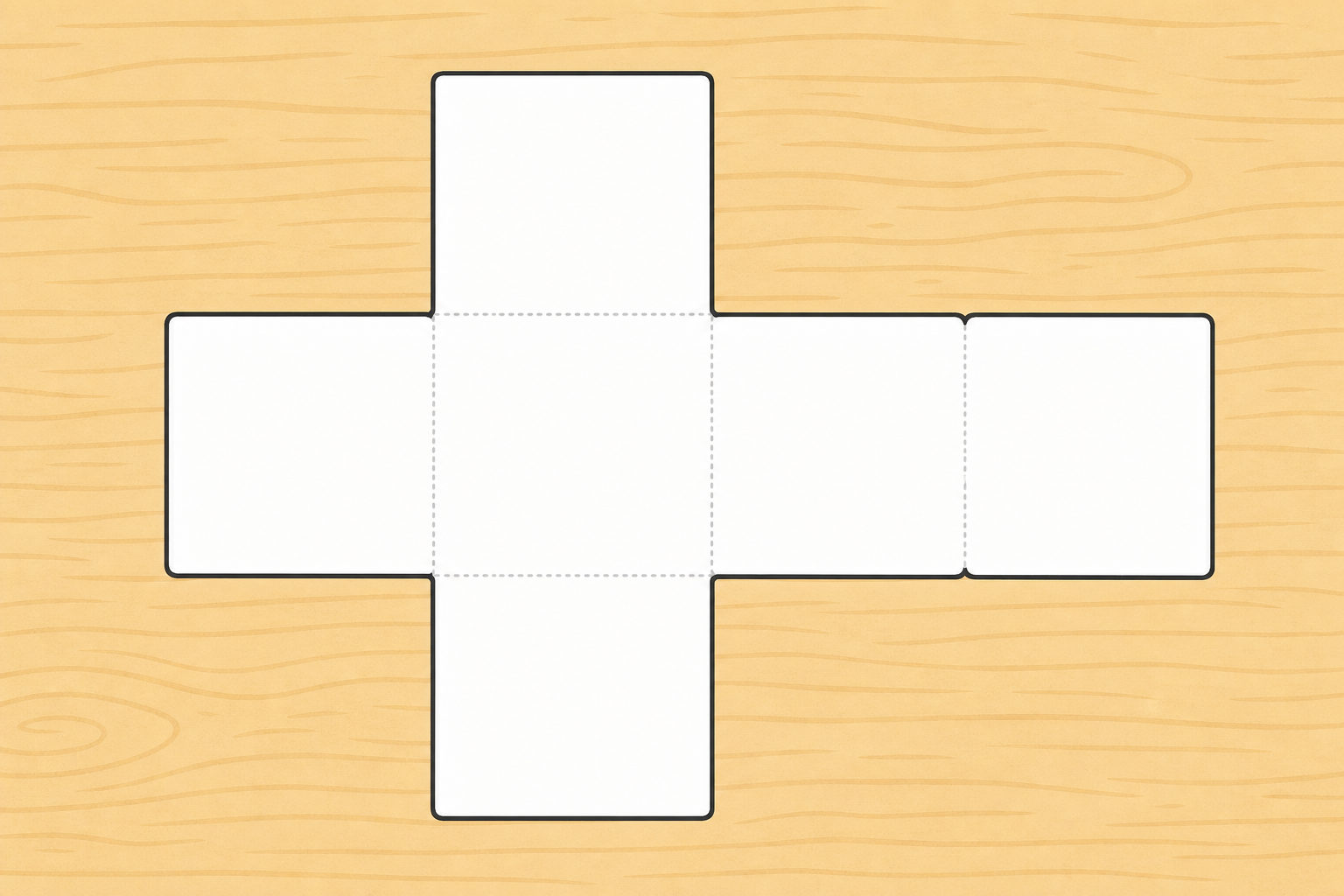
Here is a shape made of flat pieces joined together, opened out completely flat.
Look at the flat piece. How many flat parts can you count on it while it is lying open?
Watch a flat shape on the board fold up. It is a net: all the faces of a solid, joined edge to edge and laid flat.
As it closes, watch how each flat square becomes a face of the solid. Count the squares before it folds, and see if that count matches the number of faces on the cube it makes.
Now we build nets on the board and fold them to test. We will try three arrangements in turn. First lay squares in a cross and fold it, does it close into a cube? Then lay the squares in a straight line and fold, does it still close? Then arrange squares in a T-shape and fold. Each time, count the squares first, then fold and check.
In your maths copy, sketch the net of a cube as six squares joined in a cross. Then write underneath which solid it folds into.
Now we predict, then fold to check. We work through three arrangements of six squares we tried together. First a cross of six squares. Then a T-shape of six squares. Last, six squares in a straight line. Before each fold, say whether you think it closes into a cube or leaves a gap.
You're previewing this lesson. Get full access to this lesson and hundreds more — each one ready to teach, with interactive activities, printable resources and pupil progress tracking built in.