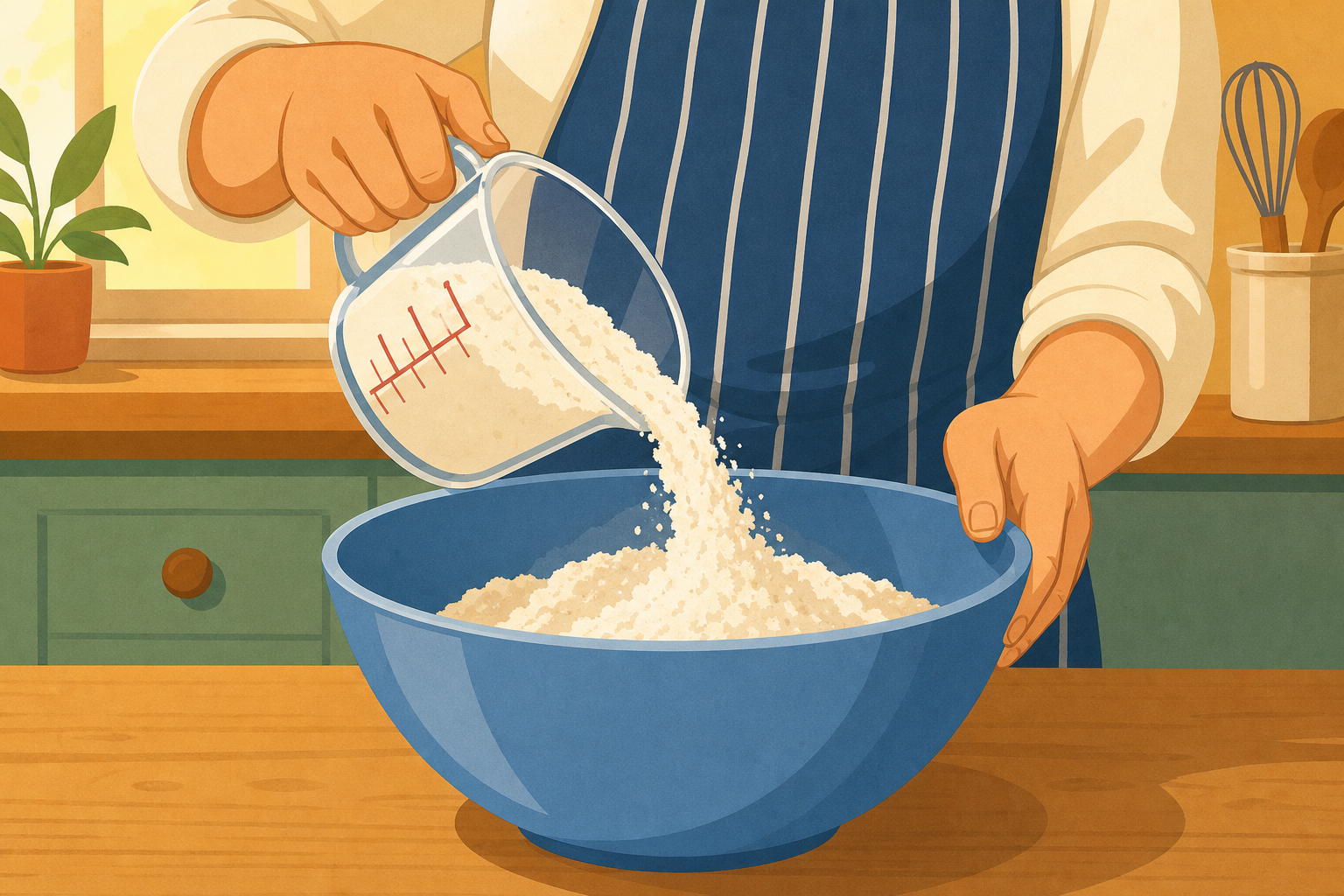
You are baking with a recipe. One bowl already holds 2½ cups of flour, and you tip in another 1¾ cups. Roughly how much flour is in the bowl now, before we work it out exactly? Is it closer to 4 cups, or more than 4?
Here is the tricky part: when the two fraction bits (½ and ¾) come together, they make more than one whole cup. So what happens to that extra whole?
Take two or three hands-up estimates, not open call-outs. You are only fishing for "a bit more than 4" here, not the exact answer.
Do not resolve the extra-whole question yet — that is the whole point of Watch and Notice. Just plant the idea that the fractions can spill over into a new whole.
Each number line shows the completed jumps for a sum: a jump for the whole number, then a jump for the fraction. Notice what happens when the fraction parts add up to more than a whole one, and where the marker has landed.
2½ + 1¾: jump +1 to 3½, then jump ¾. Before that jump ask, will this cross the next whole? ½ + ¾ overflows past a whole, land on 4¼.
Columns for the same sum: wholes 2 + 1 = 3, fractions ½ + ¾ = 1¼. Model this layout on the board, wholes over wholes and fractions over fractions, since they use it in copies next. Carry the extra whole: 3 + 1 = 4, ¼ left over, recombine to 4¼.
3⅓ − 1⅔: the make-or-break borrow. Jump back 1 to 2⅓, but ⅓ is too small to take ⅔ from. Point at the marker at 2⅓: break a whole into 3/3, join to the 1/3 already there to make 4/3, leaving 1 whole. Then 4/3 − 2/3 = 2/3, land on 1⅔.
2¾ + 1½: overflow again, same denominator. Jump +1 to 3¾, then ½. 3/4 + 2/4 = 5/4, one whole and a quarter, carries to 4, land on 4¼. Draw out that overflowing fractions always produce a fresh whole.
Today we work these three together on the number line, in order: 2¼ + 1½, then 3¾ − 1½, then 1¾ + 2½. That last one is the one to watch: three quarters plus one half spills over a whole, so predict where it will land before we check it.
For each one we jump the whole number first, then the fraction, and read off where the marker stops on the quarter marks.
This round is for talking it through together — pupils take turns at the board and the class agrees or corrects out loud.
Do the easy overflow-free one first (2¼ + 1½ = 3¾) so everyone gets a clean turn. Then 3¾ − 1½ = 2¼, a subtraction with no borrow. Save 1¾ + 2½ for last: ¾ + ½ = 5/4 = 1¼, so the answer is 4¼ — the overflow pay-off. Ask the class to call the landing point before you drop the marker.
Rotate three pupils to the board, one per sum. The rest predict with hands-up, not call-outs.
First we set out one subtraction together on the board so you can see how to borrow when the fraction column is too small. Watch how a whole is renamed into fraction parts inside the columns, then how we finish the sum.
After that, in your maths copy, set out each mixed-number calculation the way we modelled: put the wholes in one column and the fractions in another column. Add or subtract each column, carry or borrow if you need to, then recombine into one mixed number. Underline your final mixed number.
Work these three:
Before copies open, model 4½ − 1¾ in two columns on the board (the missing written borrow).
Rewrite ½ as 2/4 so both fractions share a denominator:
wholes | fractions
4 | 2/4
− 1 | 3/4
2/4 is smaller than 3/4, so borrow: cross out 4, write 3; the borrowed whole becomes 4/4, join to 2/4 to make 6/4.
Now: 3 | 6/4
− 1 | 3/4
Fractions: 6/4 − 3/4 = 3/4. Wholes: 3 − 1 = 2. Recombine: 2¾.
Leave that model visible. Pupils then do all three in copies. Walk the room for column lineup, carry on the additions, and whether the last one matches the board borrow. Watch the slip of taking the smaller fraction from the larger the wrong way without borrowing.
Four mixed-number problems, each a step harder than the last. We work through them together: add or subtract the whole numbers first, then the fractions, and check each answer before moving on.
These are the practice questions — pupils take turns at the board, check each answer, and the class confirms before moving on. Keep the board work brisk rather than over-explaining.
The first two have no overflow or borrow — quick wins. The flour problem (2¾ + 1½ = 4¼) has the fraction overflow. The make-five stretch is open: many correct answers (2½ + 2½, 3¼ + 1¾, 1⅓ + 3⅔ …). Revoice a strong answer: "the whole numbers and the fractions both have to add to five altogether."
You're previewing this lesson. Get full access to this lesson and hundreds more — each one ready to teach, with interactive activities, printable resources and pupil progress tracking built in.