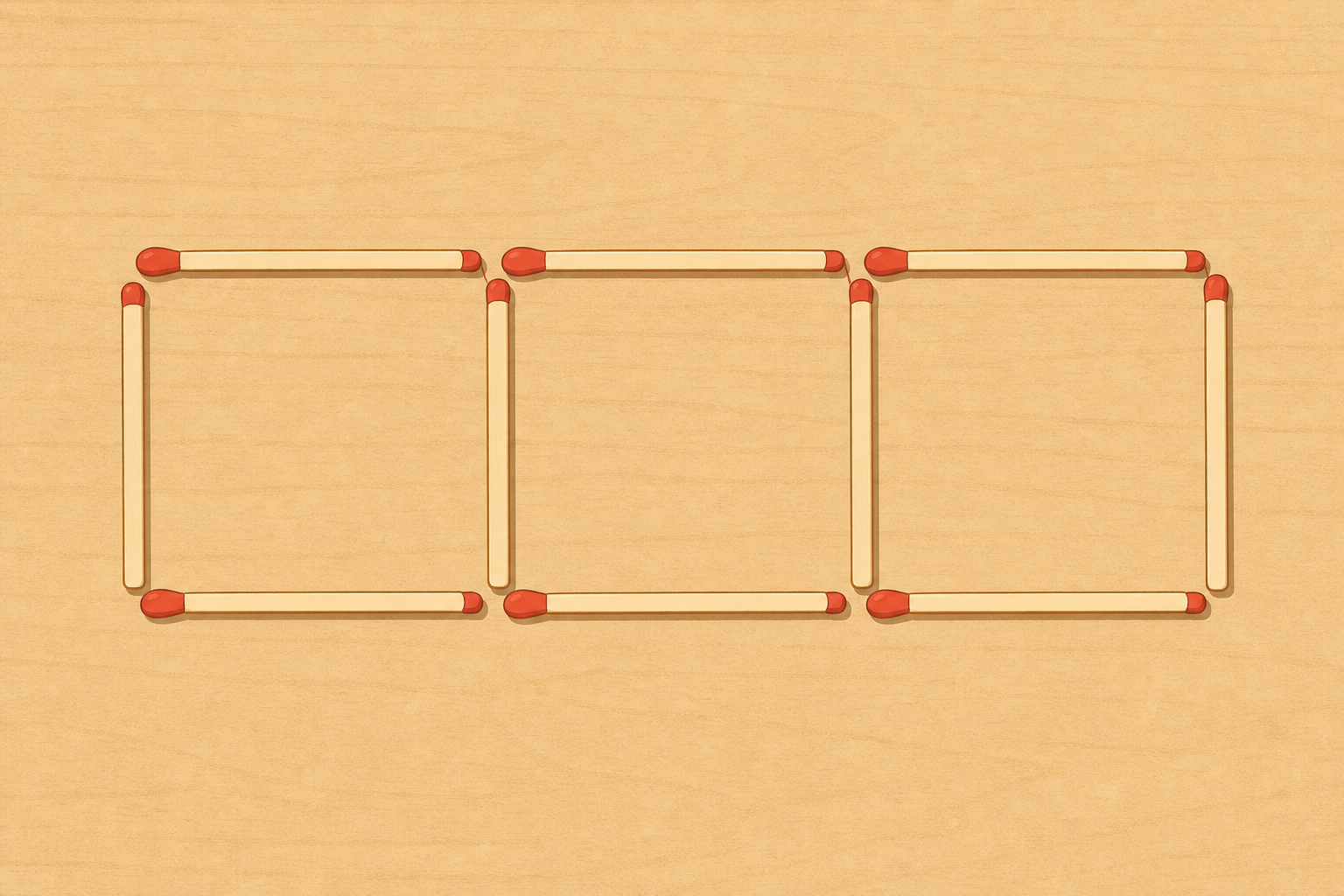
Here is a row of squares built from matchsticks. One square takes 4 sticks. Two squares side by side take 7 sticks, because the middle stick is shared. Three squares take 10.
How many sticks will the fourth square row need? Have a guess before we build it.
Here are two growing patterns marked out along the number line. Each mark shows a count, and the gap between one mark and the next is the jump.
Here is a second pattern. Look at how big each gap is.
One of these grows by the same jump every time. The other grows by a jump that gets bigger. See if you can tell which is which from the gaps.
Now we work two patterns on the same number line, one after the other. One pupil comes up to mark a count while the rest of the class watches and agrees or corrects out loud. Press Reset to clear the line before the second pattern.
First, the counts from the matchstick-square pattern. 4, 7 and 10 are already on the line — that is one, two and three squares. Find the jump, mark the next count, and say the rule. Keep going along the line to reach step 6 without laying out six rows of matchsticks.
Then reset the line and mark a shrinking pattern: 20, 16, 12. Find how the jump changes and mark what comes next.
In your maths copy, draw the first four steps of the "add 3 sticks" square pattern — one square, then two joined, then three, then four. Beside your drawing, make a pattern record table: one column for the step number and one column for the stick count. Fill in 4, 7, 10, 13. Then write the rule you found underneath.
Now we investigate the "add 3 sticks" pattern all the way through, using the pattern record table you drew in your copy.
How many matchsticks does the row of squares need at each step, and what rule lets you predict a step you have not built?
Check counts 4, 7, 10, 13 in the pattern record table; write the rule in words; keep adding 3 to reach step 6 (19); continue the table to step 10 (31) and notice the count is 3 × step number + 1; explain how the table helped.
Record: the pattern record table (step number in one column, stick count in the other) plus a written rule and two predictions
Share back: one group reads its rule and its prediction for step 10, and the class checks it against the table
You're previewing this lesson. Get full access to this lesson and hundreds more — each one ready to teach, with interactive activities, printable resources and pupil progress tracking built in.