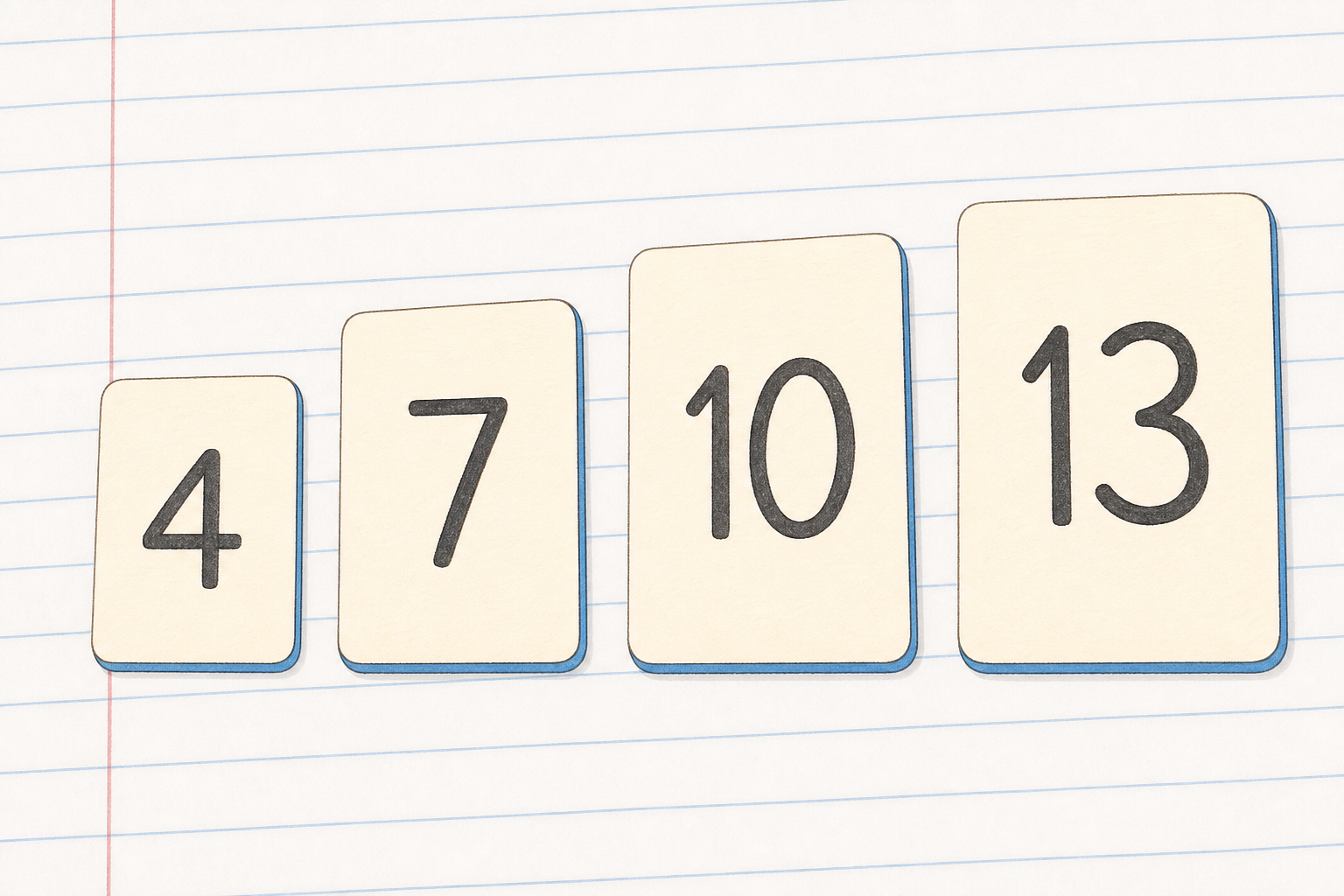
Here is a pattern that grows: 4, 7, 10, 13 … What would the 100th number be? And is there a way to know without writing out all one hundred of them?
You are not expected to know this yet. By the end of today you will be able to answer it. This is the last algebra lesson of primary school, so today we pull together three big ideas from the year: patterns, expressions and equations.
Take two or three hands-up answers for the 100th term before revealing anything. Some pupils will want to count on in threes; hold out for the idea that finding a rule beats continuing the list. Do not confirm the rule yet, that is the job of Watch and Notice.
Two function machines are on screen. Together we will work out what the forwards machine does to each position in the pattern 4, 7, 10, 13, then how the backwards machine finds a position from a known value. Watch each step of the working.
Let n stand for the position: 1st term n=1, 2nd n=2, and so on.
Before the arrow lands, ask why the multiplier is 3, not another number — the pattern steps up by 3, so 3 lots of the position build the value, then a fixed +1. Rule: 3n + 1. Name it: an expression.
Test it against the fourth term: 3 × 4 = 12, plus 1 is 13 — matches.
Second machine is the pivot: the rule that generated the pattern becomes the equation that solves for a term. Say it plainly — forwards we put a position in and get a value; backwards we know the value and find the position.
Take a term of 34: write 3n + 1 = 34. Name it: an equation. Undo in reverse — take away 1 to get 3n = 33, then share by 3 to get n = 11.
Walk the reverse working slowly, pointing at each step; ask why we take away the 1 before we share by 3.
Today we work through one full challenge together. We take it one stage at a time. First we look at the pattern 5, 9, 13, 17. Then we say its rule in words. Then we write it as an expression. Finally we set up an equation to find which position gives 61.
Talk this one through together — pupils take turns at the board and the class agrees or corrects out loud. The explore machine covers the pattern-and-rule stage; the expression and equation stages are board-and-talk, so keep the pen moving as you build them.
Feed positions 1, 2, 3 through the machine so the class sees the step is 4 each time and the start is 5. Draw out the rule: times four, then add one, so the expression is 4n + 1. Then flip it: to reach 61, write 4n + 1 = 61, undo the +1 to get 4n = 60, share by 4 to get n = 15. Check by feeding 15 back through the machine.
Watch for the classic slip of undoing the ×4 before the +1 — head it off by asking which did the machine do last?
In your maths copy, work the sample challenge through its stages and label each one as you go:
Then check your solution by putting it back into the rule.
Walk the room glancing that each stage is labelled and that the equation is undone in the right order — this is whole-class copybook practice, not marking. If a pupil has 4n = 61 − 1 muddled, prompt which step did the machine do last, and so which do we undo first?
A five-stage algebra mystery. Solve each stage to unlock the next:
This is the practice round. Run it one way: each pupil works the five stages in their maths copy, and after each stage the class confirms the answer aloud before moving to the next. The 'unlocks' framing is just a narrative device to describe the order — there is no on-screen gate.
The stages rise in difficulty — stage 1 is a plain pattern step, stage 5 is a two-step equation, so every pupil can enter and the strongest stretch to the end.
Stretch prompt for fast finishers: write your own five-stage mystery, starting from a pattern of your choice. They wait quietly or draft this — no separate device work.
You're previewing this lesson. Get full access to this lesson and hundreds more — each one ready to teach, with interactive activities, printable resources and pupil progress tracking built in.