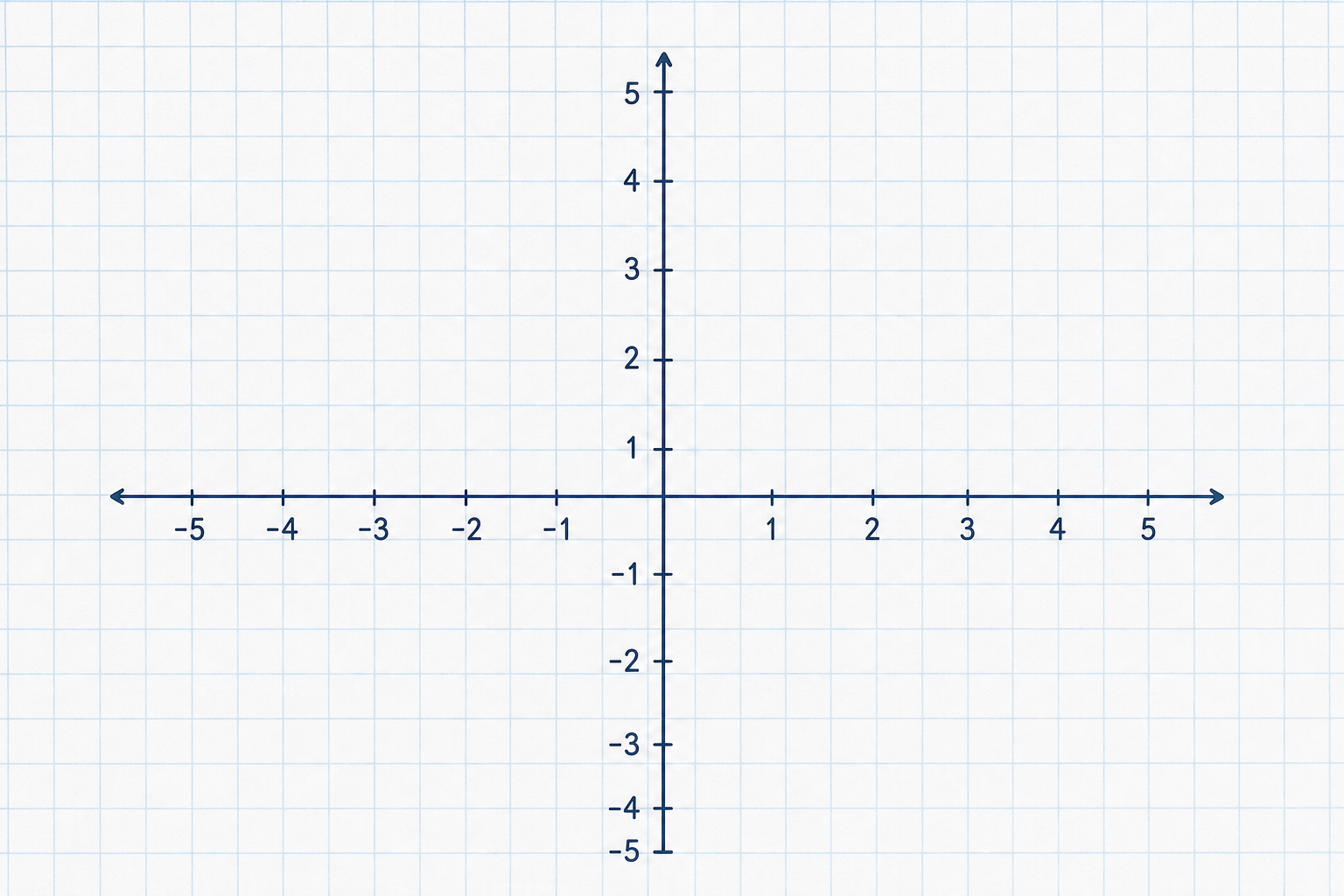
You already know how to plot points that go right and up. But a coordinate grid does not stop at zero. The two lines cross at zero and carry on in every direction, so a point can go left as well as right, and down as well as up.
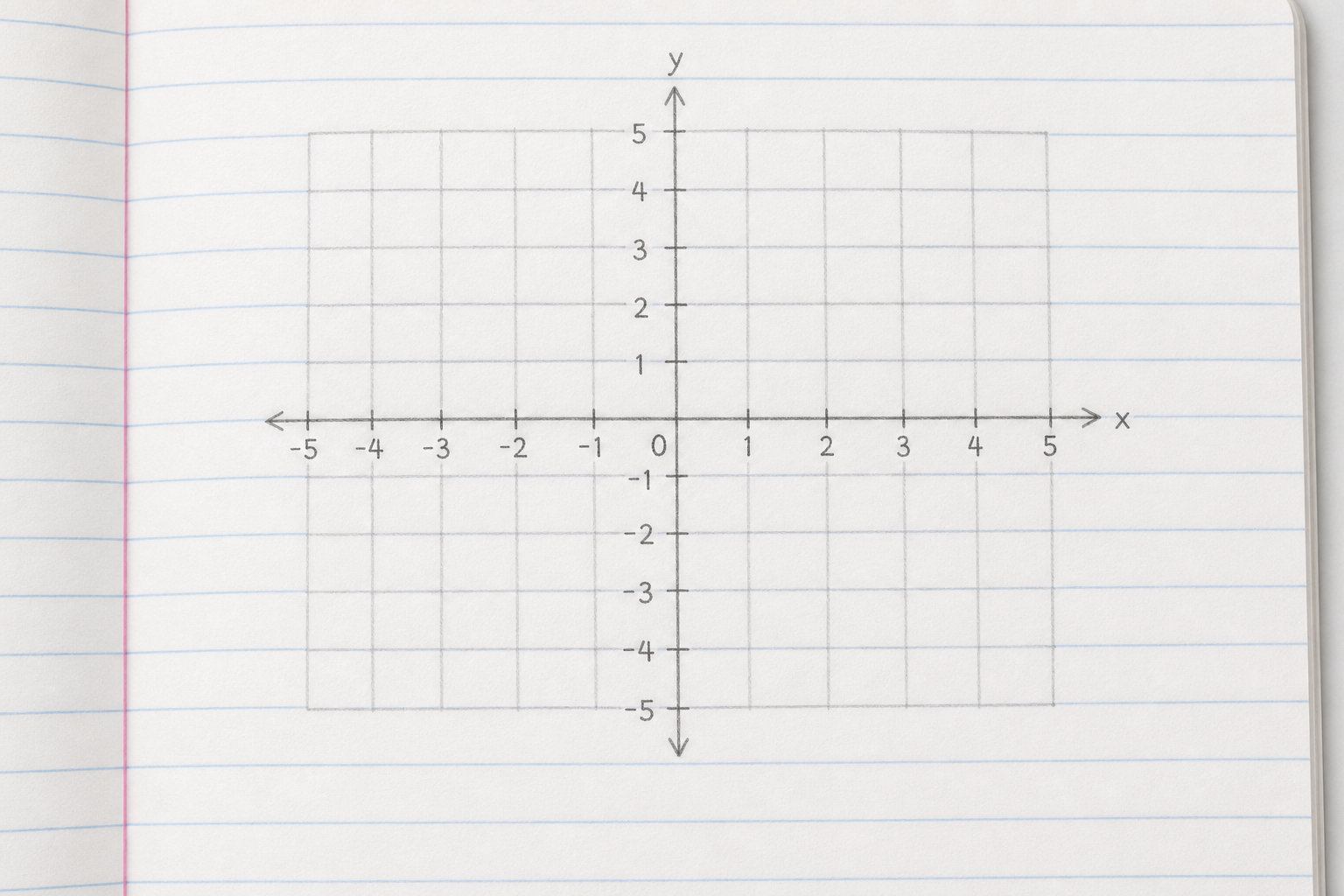
What do you think a point like (−3, 4) means? Which way would each number send it?
Show the four-quadrant grid on the board as pupils settle. Take two or three hands-up guesses about where (−3, 4) lands, no open call-outs. Don't confirm or correct yet — the next step builds the answer with the class. Give five seconds of quiet think-time before hands go up.
You already know the first quadrant: right along, then up. Now the grid runs the other way too, and the two axes cut it into four regions. Notice which way each minus sign pushes a point, and what happens when a coordinate is zero.
Grid numbering, anticlockwise from top-right: first quadrant top-right, second top-left, third bottom-left, fourth bottom-right. Point at each minus as it lands — minus on first number pushes left, minus on second pushes down.
(−3, 4): ask right or left? up or down? Left three, up four — top-left, so second quadrant.
(−2, −5): both signs minus, the both-directions case. Ask what makes it different from the first. Left two, down five — bottom-left, third quadrant.
(0, −3): the zero is the point. Sits on the y-axis, on the line, not in any quadrant. Head off the idea that every point has a quadrant number.
Today we plot these points together, one at a time: (4, −1), then (−3, 4), then (1, 3), then (−5, −2). Say which way each minus sends the point before it lands, and name the quadrant number it belongs to.
Talk this one through together — pupils take turns at the board and the class agrees or corrects out loud.
Run the four points in order — they spread one into each of the four quadrants, so the class meets the whole plane in one round.
Before each reveal, ask a pupil to predict the quadrant number; revoice a good answer (so both minus means left AND down, which is quadrant three).
In your maths copy, sketch a four-quadrant grid with each axis running from −5 to +5. Then plot each of today's points on it, one at a time:
Label each point with its (x, y) pair and write the quadrant number beside it.
Walk the room glancing at whether pupils have the axes labelled and the zero at the centre — no marking, this is whole-class copybook practice. Common slip: reversing x and y, so a point lands in the wrong quadrant number.
Take turns at the board to plot each called point. Before each one, predict which quadrant number it will land in, then check.
This is the practice round — pupils take turns at the board, check each answer, and the class confirms before moving on. Keep the board work brisk rather than over-explaining.
The practice set rises through the plane: an easy first-quadrant point, a one-flip point, a both-minus point, an on-axis point, then a stretch that asks pupils to plot three points and notice they line up. Watch for the reversed-order slip on the both-minus points — that is where the class most often lands in the wrong quadrant number.
You're previewing this lesson. Get full access to this lesson and hundreds more — each one ready to teach, with interactive activities, printable resources and pupil progress tracking built in.