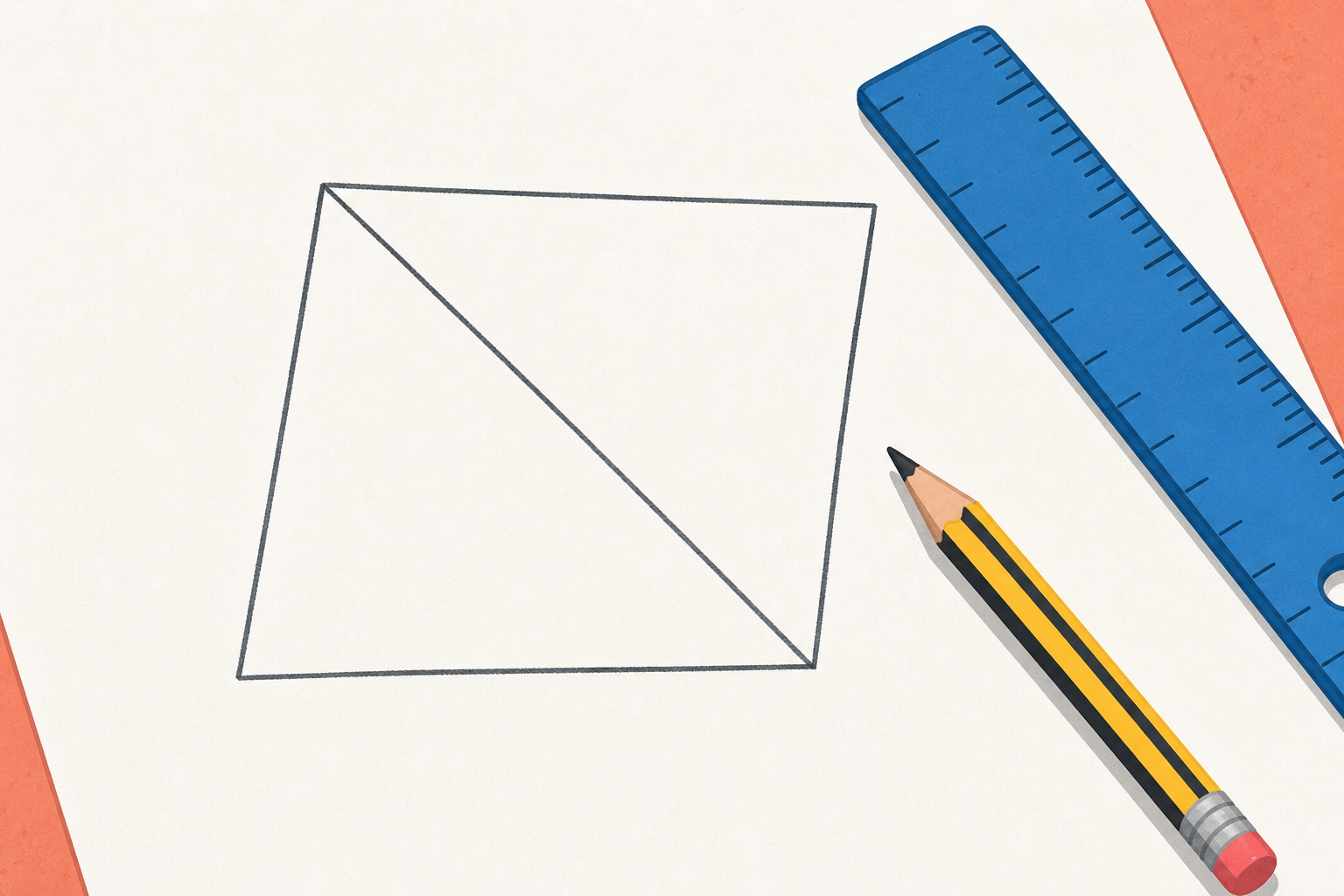
Picture a four-sided shape with one line ruled from a corner straight across to the opposite corner. That one line splits the shape into two triangles.
You already know that the three angles inside a triangle add up to 180°. So have a go at this before we work it out: if a quadrilateral is made of two triangles, what do you think all four of its angles add up to?
This is a problem-first lesson — do not state the 360° rule yet. Take three hands-up predictions and write them on the board without confirming any of them; the class tests them across the next two steps.
Give five seconds of quiet think-time before hands go up. Listen for a pupil who reasons two triangles, so two lots of 180 — hold that thought rather than confirming it.
Here are three quadrilaterals side by side. Each one already has its four angles labelled and its total printed underneath. Read the printed total on each shape and notice what they all have in common.
Whatever the shape, the four angles land on the same total. Once each triangle is worth 180° and one diagonal makes two triangles, that total is 2 × 180° = 360°. Every quadrilateral's four angles add up to 360°.
These three snapshots sit side by side — point at each one in turn rather than explaining it in advance.
Only after the third do you name the rule, and pull it from the two-triangles reasoning a pupil offered in the hook: one diagonal, two triangles, 180 each, so 360 altogether.
In your maths copy, draw a quadrilateral of your own. Rule one diagonal from a corner to the opposite corner to split it into two triangles.
Write 180° inside each triangle, then show underneath how they combine:
Walk the room glancing for a diagonal that genuinely reaches an opposite corner — some pupils cut off a corner instead. This is whole-class copybook practice, not marking. Give pupils time to rule the diagonal accurately with a ruler before they label the two triangles; the missing-angle calculation comes up in the Class Challenge, so this beat is construction only.
Today we work through a quadrilateral together on the board by dragging its corners.
One pupil drags a corner and the four angles change on screen. Everyone else watches the shape and predicts which angle will shrink before the drag — and checks together that no matter how the shape bends, the four angles still add to exactly 360°.
Talk this one through together — pupils take turns at the board and the class agrees or corrects out loud.
Bring individual pupils up to drag a corner. The move that lands the idea: make one angle huge and watch another shrink to compensate, while the sum readout holds at 360°. Revoice: so the angles trade off, but the pot is always 360.
Rest of the class watches the readout and predicts which angle will shrink before the drag.
Today we find the missing angle in each of these quadrilaterals in turn. Three angles are given and we work out the fourth so the four add to 360°:
Work each one out quietly in your head first, then we check it together on the board. You are not expected to get it right first time — the last ones are trickier on purpose, and trying the method even when you are unsure is exactly what we are practising.
This is the practice round — pupils take turns at the board, check each answer, and the class confirms before moving on. Roughly two minutes per problem keeps four board turns inside the slot; keep the board work brisk rather than over-explaining.
Method cue: add the three you know, then take that from 360.
You're previewing this lesson. Get full access to this lesson and hundreds more — each one ready to teach, with interactive activities, printable resources and pupil progress tracking built in.