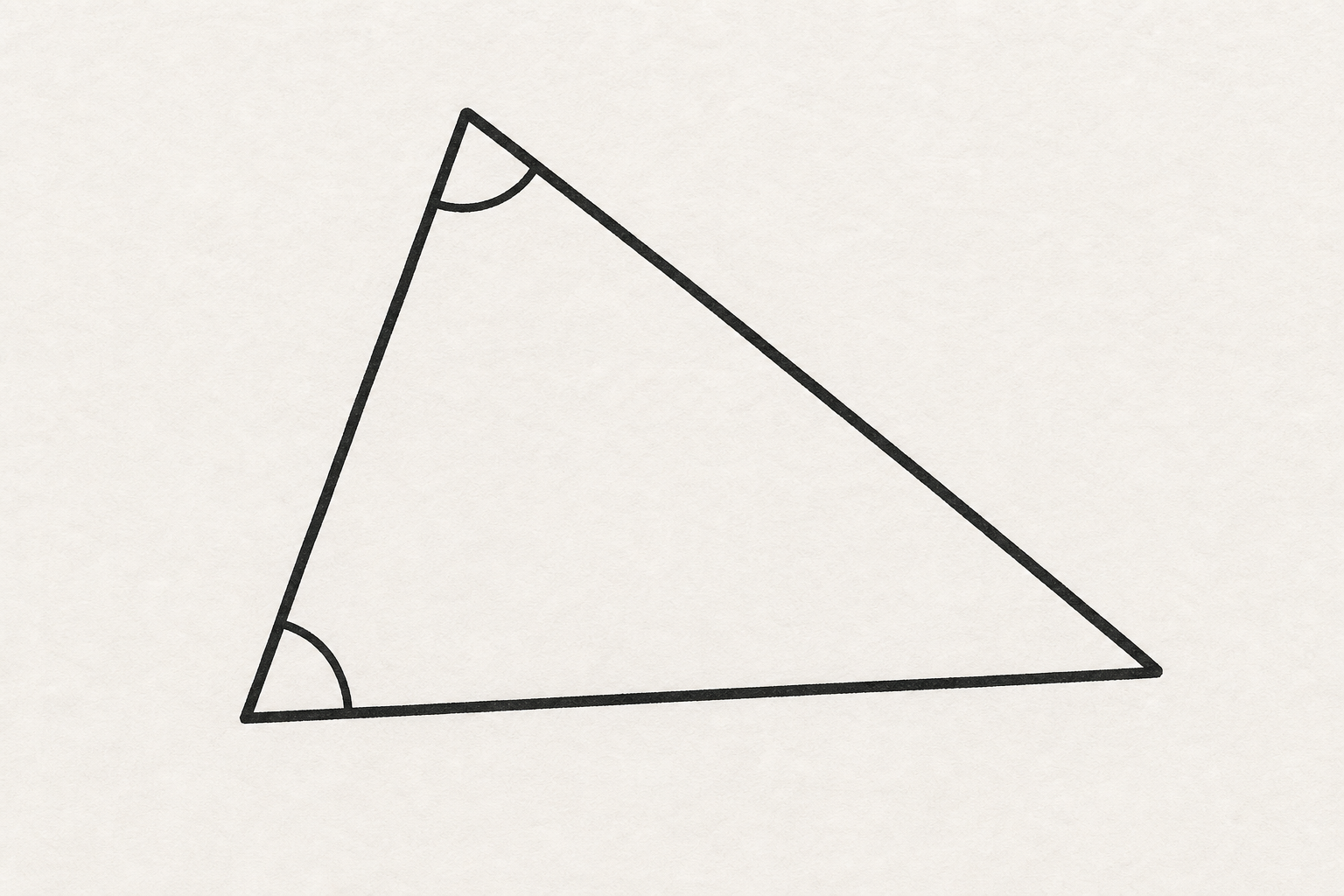
Picture a triangle. Two of its corners have been measured for us: one corner is 50° and one corner is 60°. Nobody has measured the third corner yet.
Before we measure anything, have a go. What do you think the third angle is? Would you expect it to be big or small?
Sketch the triangle on the board as you speak, marking one corner 50° and one 60° and leaving the third blank, so the class has the shape in front of them. Give five seconds of quiet think-time before any hands go up, then take three hands-up guesses. Do NOT confirm or deny yet, and do not name any rule. Write the three guesses on the board so the class can come back to them after the investigation.
This is a problem-first lesson — the aim is for pupils to make a real attempt with what they already know before the rule is discovered. Resist saying 180.
Let's look at three very different triangles together. Each one is already built and its three corners are measured. As we look at each, add up the three numbers in your head and see what you notice.
Three completely different triangles: a wide flat one, a tall thin one, and a right-angled one. What is the same about all three?
Name the pattern at the end of this step, drawn from what pupils saw — every one added to 180. Do not state it before the third triangle. To prove it isn't a coincidence, tear the three corners off a real paper triangle and lay them in a row: they make a straight line (180°).
Cross-curricular STE bridge: this is why triangular bracing makes structures rigid — the fixed angle sum keeps the shape.
Now that we know the three angles of any triangle add to 180°, let's test it on fresh triangles. We take turns coming up to drag the corners. Watch the three angles change but the total stay at 180°.
Talk this one through together — pupils take turns at the board and the class agrees or corrects out loud.
Run the polygon-angles interactive in explore mode: drag the vertices and watch the three interior angles recompute live while the sum readout always confirms 180°. Ask pupils to predict the missing angle first, then drag to check. Listen for the method 180 minus the two known angles — revoice it when a pupil uses it: so you took the two we knew away from 180.
Watch for the pupil who adds the two known angles and stops there — head it off by asking and what do you still have to do with that total?
In your maths copy, for each triangle write the angle-sum equation and solve for the unknown angle. Underline your final answer.
Work these three, one under the other:
Walk the room glancing for the full equation line, not just the answer (e.g. 180 − 55 − 65 = 60). No individual marking — this is whole-class copybook practice, not assessment.
The third item is the isosceles one, and it is the only place in the lesson where pupils must halve a remainder independently, because only the top angle is given. Pupils write 180 − 50 = 130, then 130 ÷ 2 = 65 for each base angle. Glance for both the subtraction line and the halving line.
Before we start, look at how we solve an isosceles triangle when we are only told the top angle.
That is the two-move method you used in your copy just now: take the top away from 180, then share the leftover equally. Now we take on five triangles, each one a step trickier. Predict each missing angle before we press Check.
This is the practice round — pupils take turns at the board, check each answer, and the class confirms before moving on. Keep the board work brisk rather than over-explaining.
The five triangles come up on screen one at a time, and every card gives two angles and asks for one missing angle. The order is: a triangle with all different angles; a right-angled one; an isosceles triangle where both base angles are given so you find the top; a straightforward find; and finally an isosceles triangle where the top and one base angle are given, so pupils find the remaining base angle by subtracting from 180. None of these five cards asks pupils to halve a remainder — that halving move is practised independently in the copybook task just done, where only the top angle was given. On the board, use the worked example above to remind the class how the halving works, then let the interactive rehearse the subtract-from-180 step. Revoice a strong answer: so you took the two angles you knew away from 180.
You're previewing this lesson. Get full access to this lesson and hundreds more — each one ready to teach, with interactive activities, printable resources and pupil progress tracking built in.