Mathematics
Advanced
50 mins
Teacher/Student led
+80 XP
What you need:
IWB/Projector/Large Screen

Angle Sums in Triangles and Quadrilaterals

Discover why the three angles of any triangle always add to 180°, and why quadrilaterals add to 360°. Use these rules to find missing angles.
Teacher Class Feed

Load previous activity

    1 - Getting Started ~4 mins

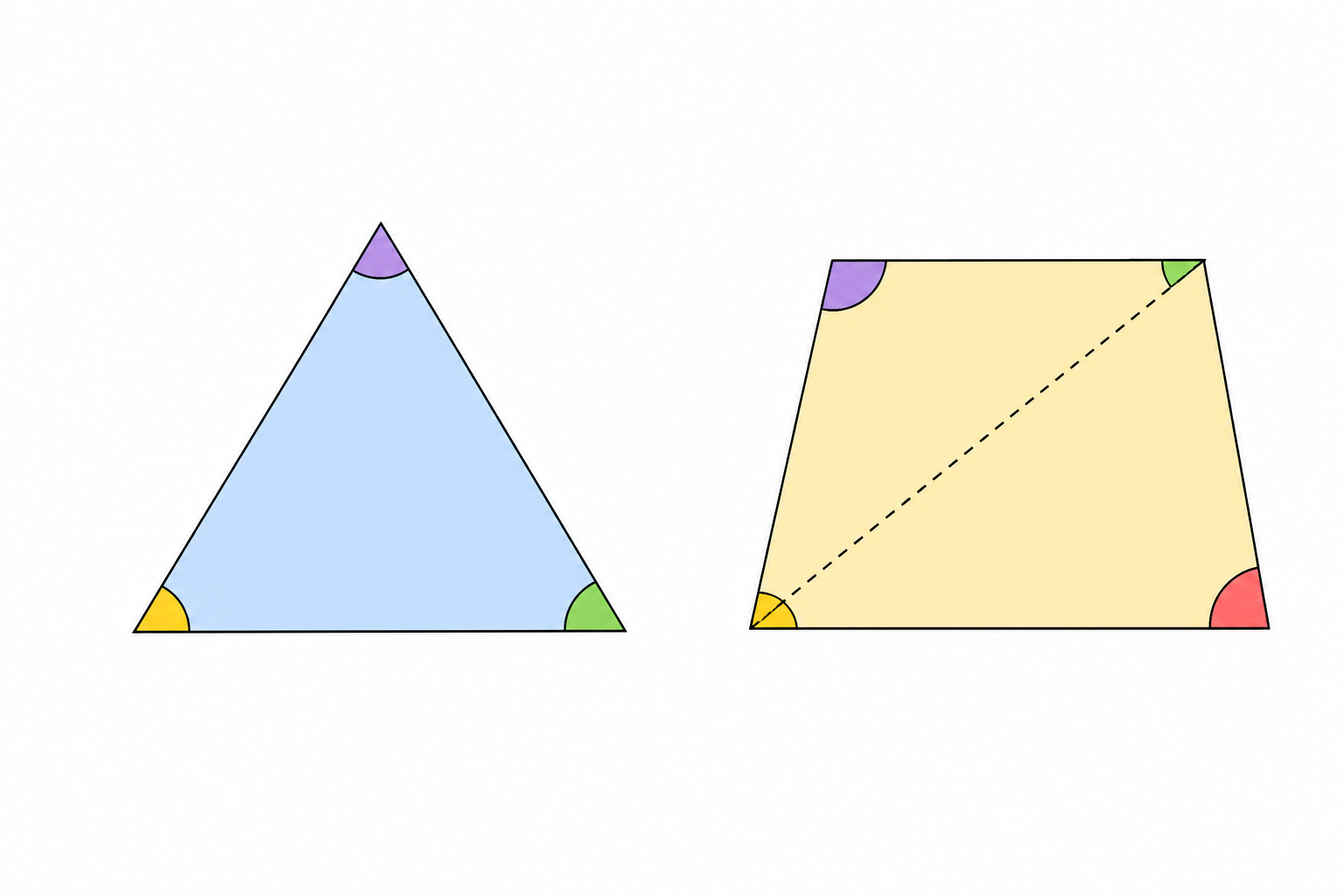
    A large triangle viewed straight on, each of its three corners marked with a small coloured angle arc, and beside it a four-sided shape with a dashed straight line running from one corner to the opposite corner so it is divided into two triangles, the two shapes arranged side by side on a plain background with generous white spaceHere is a triangle. Before we work anything out: if I told you two of its angles, do you think you could work out the third one without measuring it? Have a think.

    Key point

    Now look at the four-sided shape beside it, and the dashed line running corner to corner. It splits the shape into two triangles. Keep that in the back of your mind, because it is going to tell us something surprising about the angles of a four-sided shape.

    2 - Watch and Notice ~9 mins

    The interactive shows five shapes, one at a time: three triangles, then two four-sided shapes. Keep your eye on the total of the angles each time. What do you notice?

    3 - Try It Together ~9 mins

    Today we drag the corners of a triangle and watch its angles change on the board. We'll pull one vertex to make it tall and pointy, then squash it flat and wide, then twist it into a shape none of us have seen before. Each time, before the numbers settle, predict what the total of the three angles will do.

    Key point

    The three angles will keep changing as we drag, but keep your eye on the running total. However sharp or squashed the triangle gets, we're checking whether that total ever leaves 180°.

    Drag the corners: does the total ever leave 180°?

    4 - Sketch the Angles in Your Copy ~3 mins

    COPYBOOK MOMENT

    In your maths copy, sketch one triangle and one quadrilateral. For each shape, write its angles in a column, one under the other. Add them up and underline the total at the bottom — 180° for your triangle, 360° for your quadrilateral.

    5 - Class Challenge ~9 mins

    First, the paper part. Cut or tear out a paper triangle, tear off its three corners, and line the three points up against a ruler — watch them make one straight line. A straight line is 180°, so that is our rule proved with paper. If your torn corners don't quite make a perfect straight line, that is just our scissors and fingers wobbling — a real triangle can never truly disagree with the rule.

    Key point

    Now put the paper down and look at the board. We work these five triangles together: two angles are given each time and you work out the missing third. We'll go 40° + 80° + ?, then a right-angled one 25° + 90° + ?, then an isosceles one — isosceles means two of the angles are the same size, and we call those two the base angles, so here the base angles are 50° + 50° + ?. Take away the two you are given from 180° to find the last one.

    Before we finish, we do one four-sided shape together on the board so you see the same method with 360°. A quadrilateral has angles 85°, 100°, 70°, and one missing. Add the three you know: 85° + 100° + 70° = 255°. Then subtract that total from 360°: 360°255° = 105°. So the missing angle is 105°. Same idea as the triangles, just take the known angles from 360° instead of 180°.

    Find the missing angle

    Pupil practice
    Module 6 · 2D and 3D Shape, Angles, Symmetry Shape & Space
    Lesson 76 · Angle Sums in Triangles and Quadrilaterals
    Download Activity Book page (PDF)
    123learn · Online learning platform

    Unlock the full learning experience

    You're previewing this lesson. Get full access to this lesson and hundreds more — each one ready to teach, with interactive activities, printable resources and pupil progress tracking built in.

    Hundreds of curriculum-aligned lessons
    Interactive activities in every lesson
    Printable resources & progress tracking
    Copyright Notice
    This lesson is copyright of Coding Ireland 2017 - 2025. Unauthorised use, copying or distribution is not allowed.
    🍪 Our website uses cookies to make your browsing experience better. By using our website you agree to our use of cookies. Learn more
