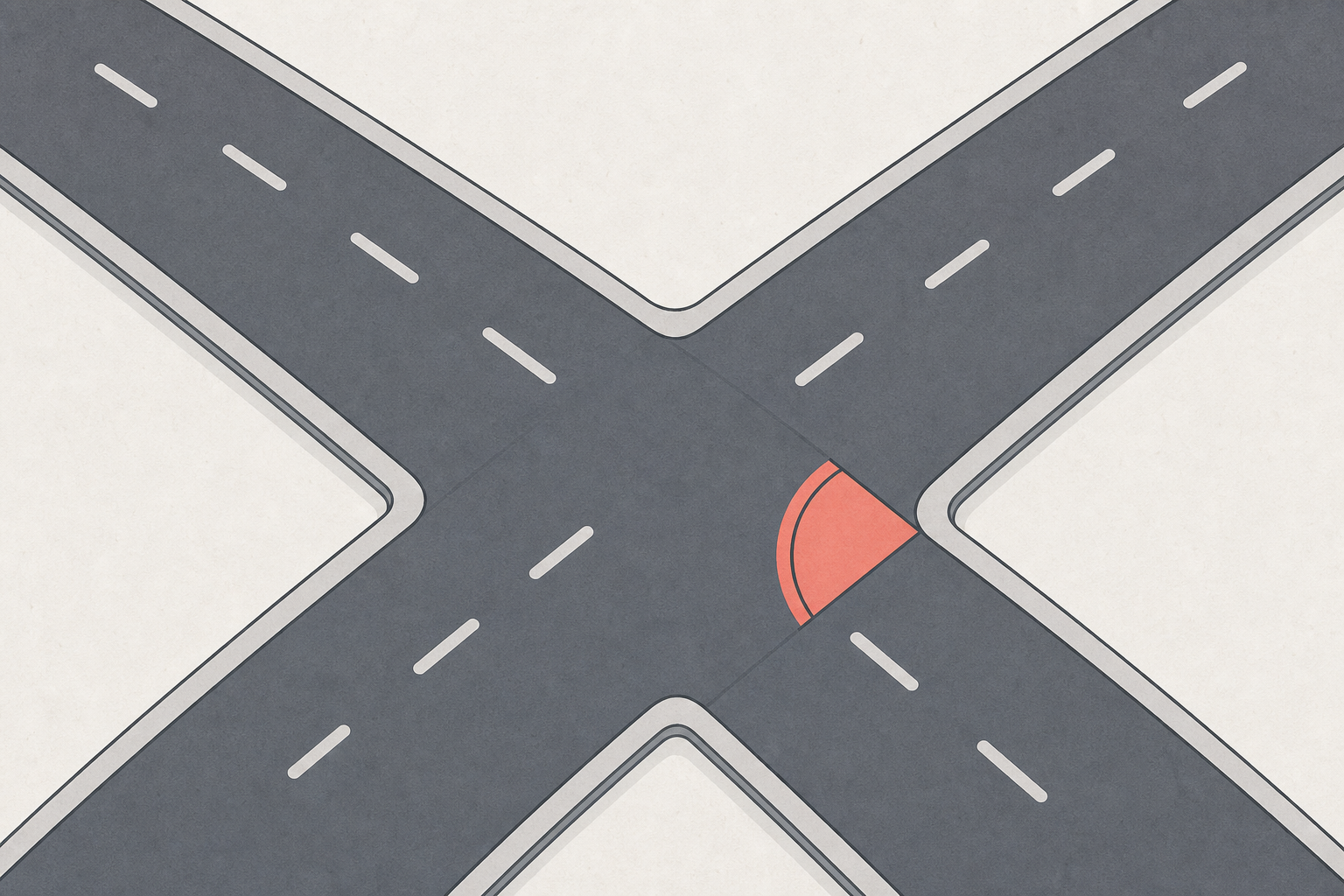
Look at the board: two straight roads cross each other, and one of the four angles is marked 70°.
What can we say about the other three angles just by looking? Which ones do you think are also 70°, and which are different?
Take three hands-up answers, not open call-outs. Give five seconds of quiet think-time first.
Do not confirm anything yet — the point is to surface a guess. Listen for pupils who spot that the angle straight across looks equal and the angle beside it looks bigger; that intuition is what Watch and Notice pays off.
Three angle facts come up on screen, one at a time: angles on a straight line, angles round a point, and two lines crossing. Watch what stays the same each time and work out each missing angle from the fact shown.
Line: angles fill 180° along it. Ask for the missing angle before revealing — hold out for 180° − 125° = 55°.
Point: full turn round a point is 360°, not a half — the fact pupils forget first. Marked angle 140°; take known angles from 360°.
Cross: two lines, marked angle 70°. Vertically opposite angles sit straight across and are equal. Point to one facing angle, then its shared neighbour on the line, then the other facing angle sharing that same neighbour. Each is 180° minus that neighbour, so both are equal.
Today we work these out together on the board. Predict each missing angle before we check it.
Talk this one through together — pupils take turns at the board and the class agrees or corrects out loud.
The named order builds a wrinkle each time: the line uses 180°, the point jumps to 360°, the cross needs both 180° (the neighbour) and equal-opposite reasoning. Hold the class on the point step — 360° not 180° is the slip to catch. On the cross, ask a pupil to name the angle that is 55° without a protractor and justify it as vertically opposite.
In your maths copy, sketch the three diagrams you just worked (line, point and cross). Under each one, write the calculation that finds the missing angle, for example 180° − 140° = 40°. Ring your answer.
Walk the room glancing at whether each pupil wrote the calculation, not just the answer — this is whole-class copybook practice, not marking. Look for anyone using 180° at a point instead of 360°.
Today we work through these angle problems together, each a little trickier: a road junction, a set of rays around a point, a clock-hand cross, and finally two angles on a line that are in the ratio 2:1.
For the ratio 2:1, the bigger angle is 2 parts and the smaller angle is 1 part. That is 2 parts + 1 part = 3 equal parts altogether. The line is 180°, so one part is 180° ÷ 3.
Spot the fact you need before you calculate: 180° on a line, 360° round a point, or equal opposite angles.
This is the practice round — pupils take turns at the board, check each answer, and the class confirms before moving on. Keep the board work brisk rather than over-explaining.
The ratio 2:1 is the stretch, and the 3-parts reasoning is now on the board: 2 parts + 1 part = 3 equal parts share the 180°, so one part is 60° and the two angles are 60° and 120°. Draw the split into three parts on the board as pupils talk it through. Watch for pupils treating the point problem as 180° — reroute them to a full turn.
You're previewing this lesson. Get full access to this lesson and hundreds more — each one ready to teach, with interactive activities, printable resources and pupil progress tracking built in.