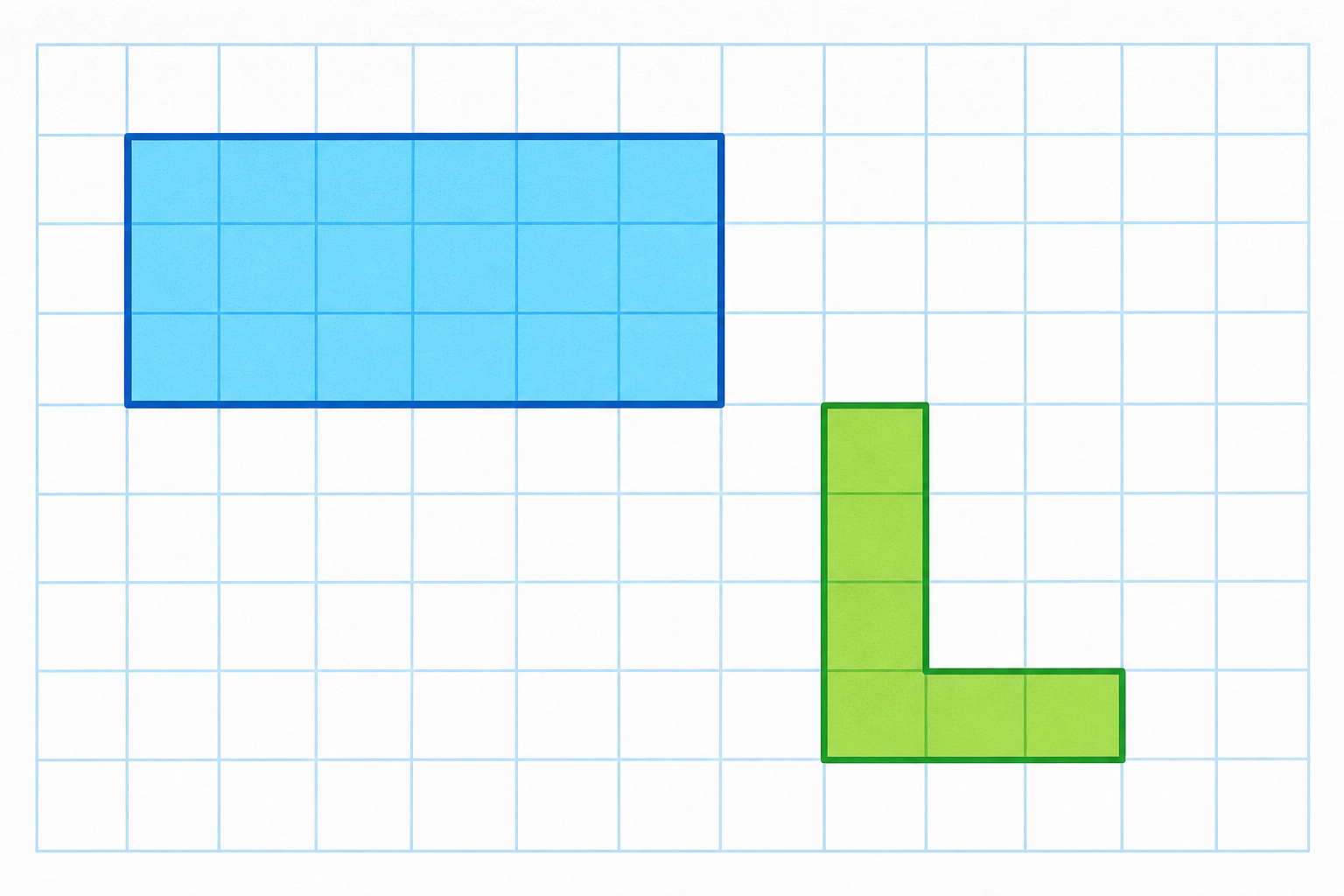
Here are two shapes on the yard drawn on the same square grid. One clearly covers more of the grid than the other. Which shape do you think covers more space on the page? How could we be really sure, without just guessing?
Watch two shapes get covered with square tiles on the grid, one tile in every cell (each little square of the grid). As each shape fills, count the tiles with me. One square tile is one square unit, and the number of tiles is the area, in square units. The one rule that matters: every tile is the same size, and we count each whole tile once.
Now a trickier one. This shape bends, so it is easy to skip a cell or count a corner twice. Watch how we work along it row by row so none is missed.
Now we cover shapes together on the grid and count the tiles to find the area. Tap a square tile into every cell inside the shape. Keep a running count as the tiles go in. When every cell is covered, say the area out loud in square units.
In your squared copy, draw any shape at all that covers exactly 7 squares. Then shade each square and count them to prove your shape covers 7 — no more, no less.
Now you try it at your desks with real tiles on printed outlines. Cover the 4-tile shape first. Then cover the 8-tile shape. Then cover the L-shape, counting along one row at a time. If you finish those, hunt for two differently-shaped outlines that take the very same number of tiles. Say each area aloud when the outline is full.
Why must all the squares we count be exactly the same size? What would go wrong if we counted a few big tiles in with the small ones?
Next we find the area of rectangles a faster way — by counting the squares in one row and then the number of rows. That is our first link from area to multiplication.
You're previewing this lesson. Get full access to this lesson and hundreds more — each one ready to teach, with interactive activities, printable resources and pupil progress tracking built in.