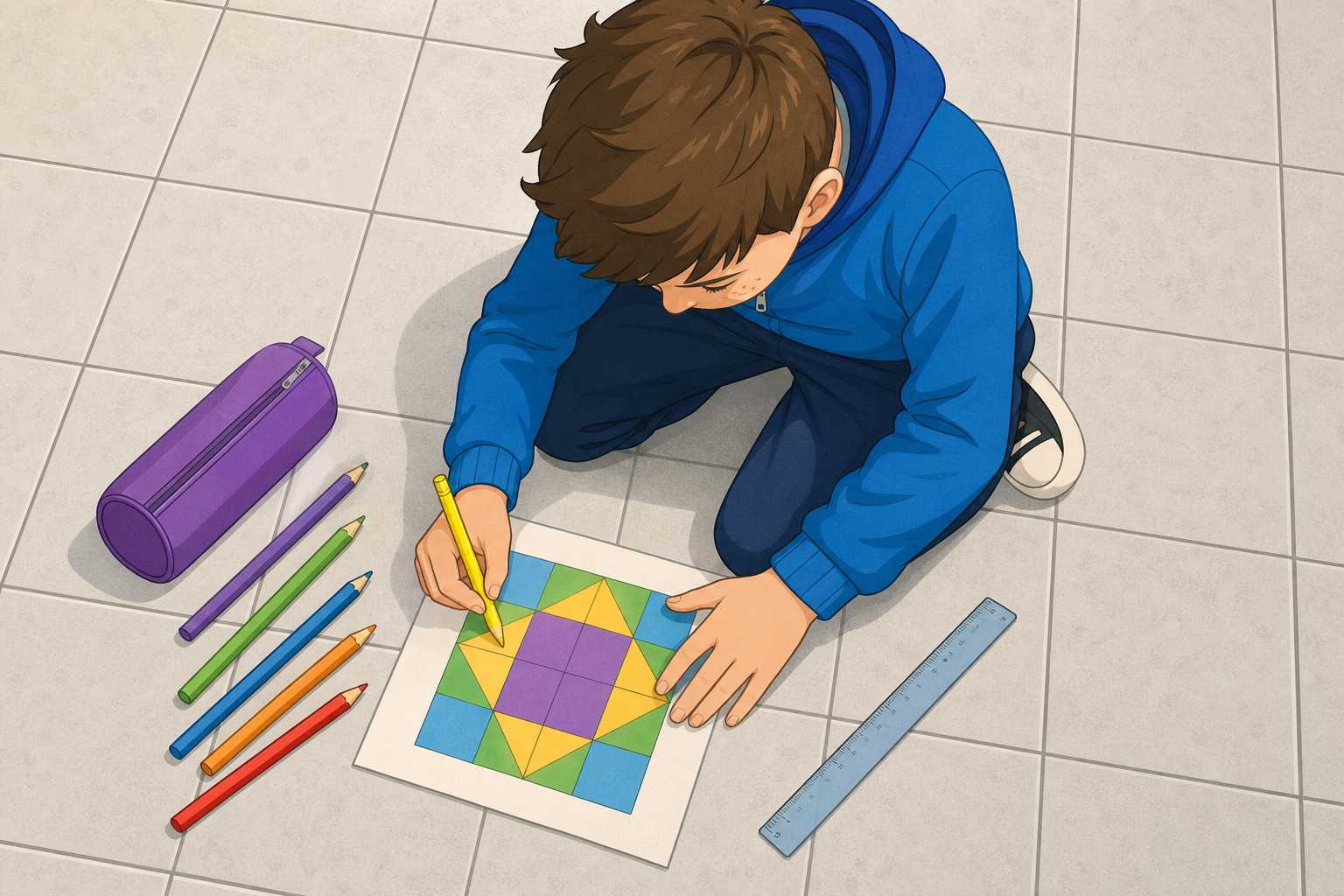
Look at this tiled floor. Every tile is the same size. How many tiles cover the whole floor? Would you count them one by one, or is there a faster way?
Take two or three hands-up answers. If a pupil says 'count the rows and multiply', revoice it: so we count along one row, then count the rows. Keep this to a minute — the multiply idea is the seed for the whole lesson.
Look at each shape on the interactive. We find area by multiplying the sides, not by counting every square. Keep an eye on the unit each time, and see what happens when the shape is an awkward L.
6 × 4 rectangle: point to one row of six, then the four rows, six fours. 6 × 4 = 24, so 24 cm². Stress the unit is squared.
5.5 m × 3 m floor: rule doesn't change for decimals. Estimate 5 × 3 = 15 first as a check. 5.5 × 3 = 16.5 m².
L-shape: the shape is split into two rectangles; find each, then add for the total. Split-and-add is the method we use from here. Optional if confident: show big rectangle minus the corner lands on the same total, but don't dwell.
Missing side: still area = length × breadth. Area 36 cm², one side 9 cm. Ask: nine times what gives 36? Make the link explicit, that's 36 ÷ 9 = 4, so the other side is 4 cm.
Hold the unit firm every time, cm² or m², never plain cm or m.
Today we work through this compound shape together: an L made of two rectangles. We'll drag and resize a rectangle to cover each part, read its area, then add the two parts for the total.
This round is for talking it through together — pupils take turns at the board and the class agrees or corrects out loud.
Cover one rectangle at a time. Ask the class to name its length and breadth before anyone multiplies. Then add the two part-areas aloud. Watch for the slip where a pupil uses a side from the wrong rectangle — point back at the dividing line. Keep every answer ending in the squared unit.
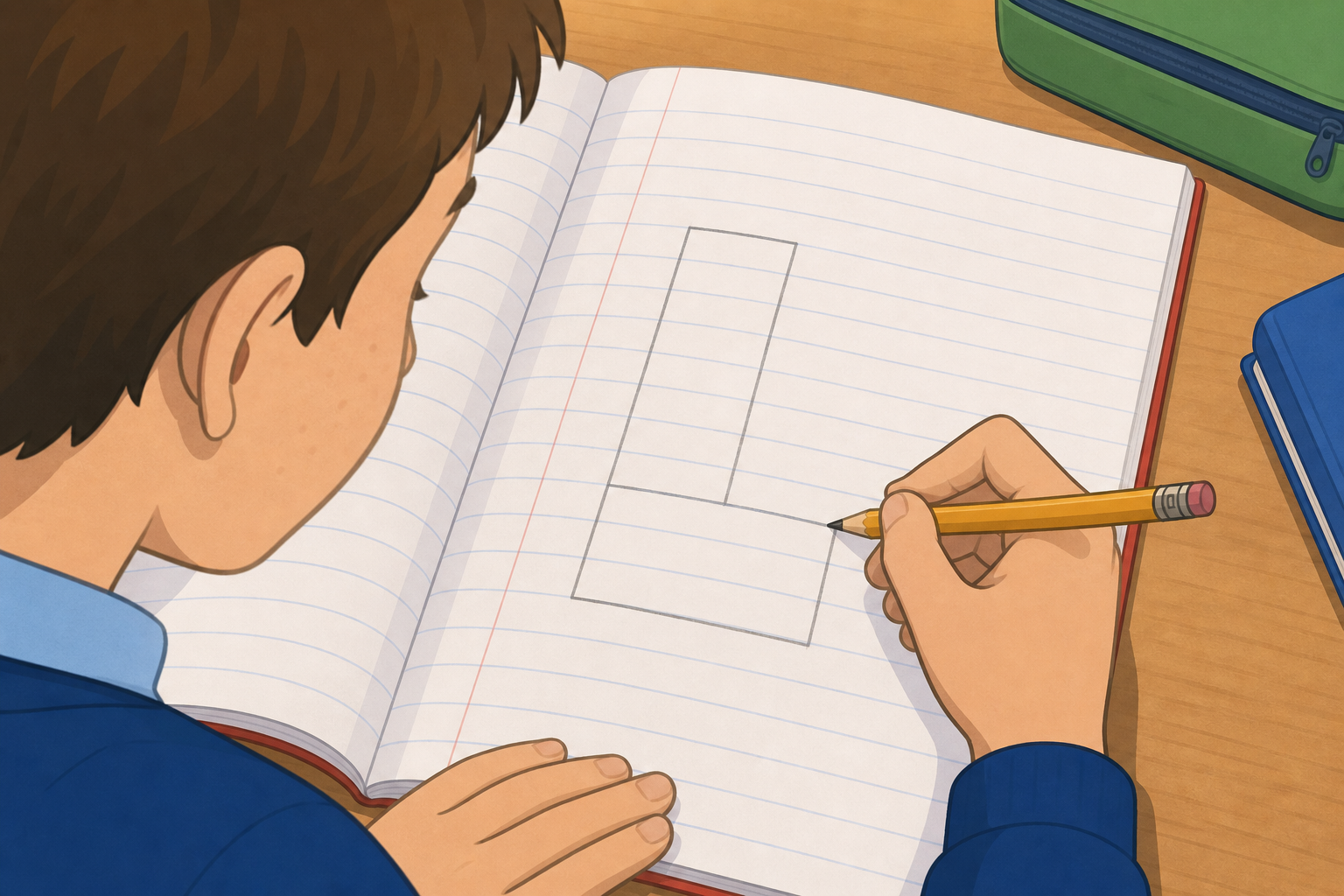
In your maths copy, sketch each compound shape. Draw the line that splits it into two rectangles. Label both rectangles' lengths and breadths, then write the total area underneath. Don't forget the unit (cm² or m²).
Walk the room glancing at the dividing line and the squared unit — this is whole-class copybook practice, not marking. Catch any answer written as plain m instead of m².
Today we work through these area problems together, each one a little harder than the last. First the area of a 7 m × 4 m rectangle. Then an L-shape and a T-shape, splitting each into rectangles and adding. Finally a reverse puzzle: a rectangle has an area of 36 cm² and one side is 9 cm — find the other side. Remember, the rule is still area = length × breadth, so knowing the area and one side lets us work out the other.
These are the practice questions — pupils take turns at the board, check each answer, and the class confirms before moving on. The on-screen figures are the rectangle, the L-shape and the T-shape; work them in order.
Keep every answer in its squared unit.
Why is area measured in squared units, like cm² and m², instead of plain cm and m? What is it about area that makes us square the unit?
Listen for pupils linking the squared unit back to covering the surface with little squares. Revoice a strong answer: so area counts squares, and each square is one centimetre by one centimetre — that's why it's centimetres squared. Head off the slip where pupils write plain m for an area.
Next we look at the area of triangles, and we will see that a triangle is exactly half of its surrounding rectangle.
A quick recap is enough here. Re-read the takeaways with the class and let the triangle preview hook their curiosity.
You're previewing this lesson. Get full access to this lesson and hundreds more — each one ready to teach, with interactive activities, printable resources and pupil progress tracking built in.