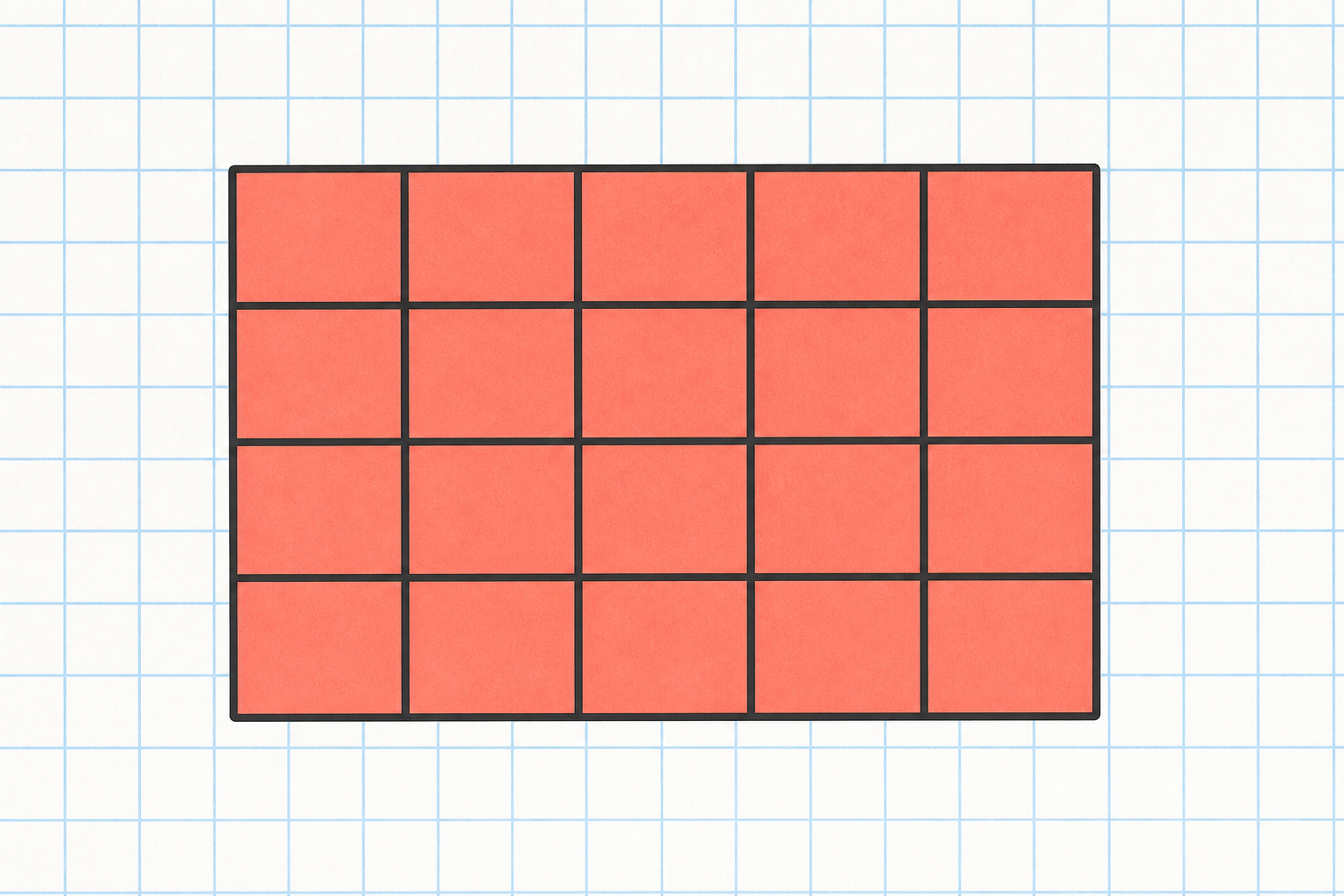
Here is a rectangle covered in equal squares. The top row has 5 squares, and there are 4 rows stacked up.
If each row has 5 squares and there are 4 rows, do we really have to count every single square to find how many there are? Or is there a faster way?
Show a 4-row, 5-column array on the IWB and cover all but the top row with your hand. Take two or three hands-up answers. Do not confirm the total yet — the point is to surface the idea that equal rows might be added or multiplied rather than counted one by one.
Each interactive shows a rectangle made of equal squares and its rows-by-columns multiplication. Count the squares with the class first, then check that rows times squares-per-row lands on the same area.
Take one at a time; pause before the multiplication and let them predict.
2 × 5: count all ten squares first, then reveal 2 × 5 = 10 cm² so both routes match. Name the words here, point across for the row, point upward for the column.
3 × 6: shortcut earns its keep. Ask would you rather count eighteen or say three sixes? 3 × 6 = 18 cm².
4 × 4: a square, equal rows and columns. 4 × 4 = 16 cm².
7 × 3 = 21 cm²: revoice the turnaround, 7 × 3 gives the same as 3 × 7, as with arrays.
Say cm² each time so the unit sticks.
Today we work through four rectangles one after another in the same board tool: 3 × 4, then 5 × 4, then 6 × 5, and finally 8 × 6. For each one, the pupil at the board builds the rows and columns and says the multiplication.
Everyone else has a job too: before each rectangle is built, predict the multiplication aloud with the class. Then we check that rows-times-columns matches counting the squares.
This round is for talking it through together — a different pupil takes each rectangle at the board while the class predicts aloud and agrees or corrects.
The tool now steps forward through all four rectangles in order, so you do not need to reset it by hand between them. For each one, ask the whole class to predict the multiplication before the board pupil builds it, then confirm the area. Ask each time: 'does rows-times-columns match the square count?' Watch for pupils who muddle which number is the rows and which is the columns — the answer is the same, but the language matters. Rotate a different pupil per rectangle.
In your maths copy, draw a 5 cm by 3 cm rectangle on the squared page. Count the squares to find the area, then write the matching multiplication underneath it:
Walk the room glancing for neat rectangles that match the squared grid and the correct cm² unit — this is whole-class copybook practice, not marking. Nudge anyone who counts squares one by one to check it against the multiplication.
Today we find the area of these rectangles in turn: 3 × 4, then 6 × 5, then 9 × 4, and finally 7 × 5. Each one is a little bigger, so the times-table fact does more of the work as we go.
These are the practice questions — pupils take turns at the board, check each answer, and the class confirms before moving on. Keep the board work brisk rather than over-explaining.
For each rectangle, ask the class to predict the multiplication before the pupil at the board builds it. Use the Check to confirm. The 9 × 4 and 7 × 5 are the stretch: strong pupils should reach for the fact rather than counting. Revoice how the rows-by-columns picture matches the times-table answer.
If the largest array crowds at IWB scale, swap the final rectangle for a cleaner large fact or draw it on squared paper alongside the tool so pupils still see the rows-by-columns structure clearly.
You're previewing this lesson. Get full access to this lesson and hundreds more — each one ready to teach, with interactive activities, printable resources and pupil progress tracking built in.