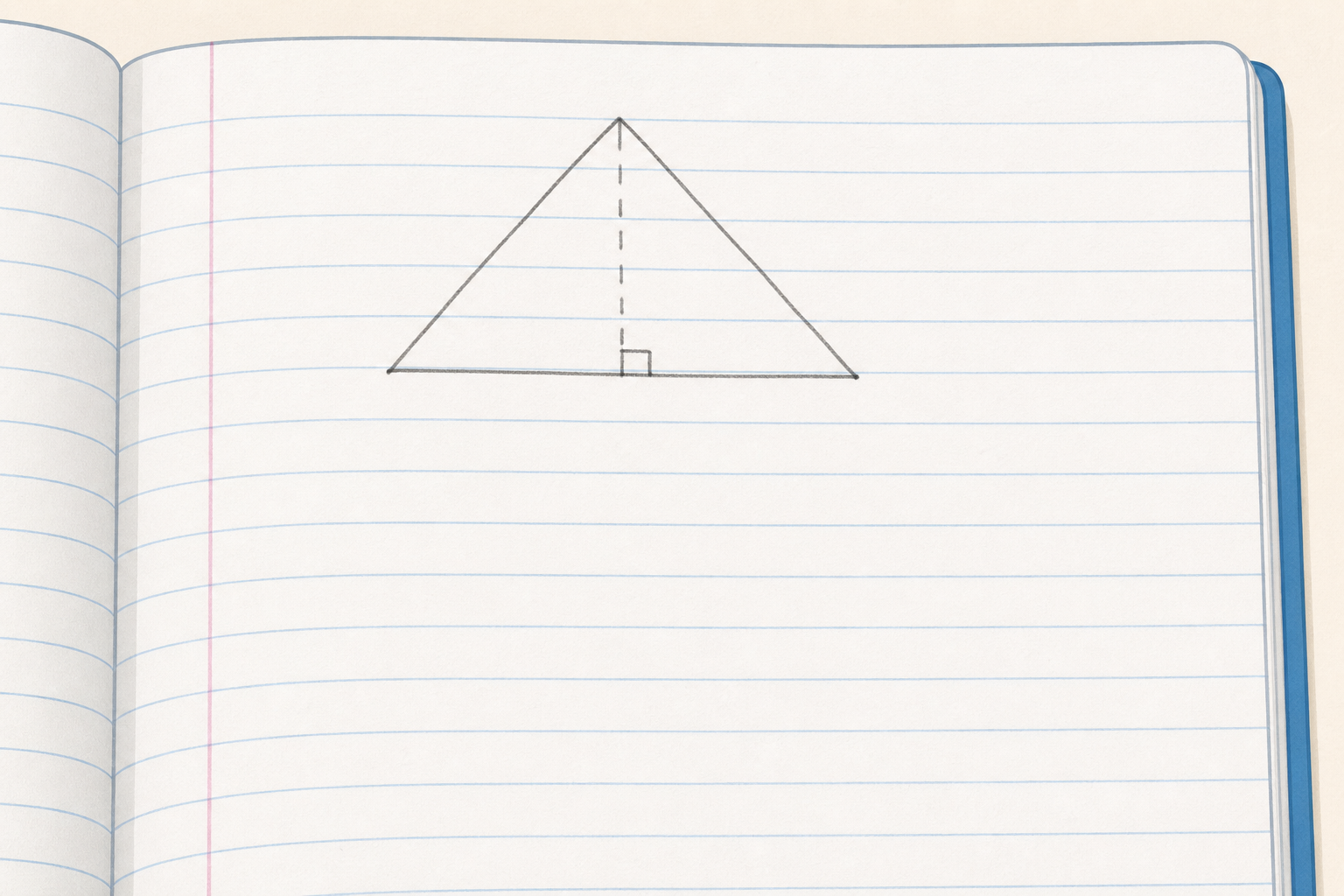
Here is a triangle on the board. In a moment we are going to see where it comes from.
Watch me fold a paper rectangle from one corner to the opposite corner. It falls into two matching triangles that sit exactly on top of each other. What fraction of the whole rectangle is each triangle?
Fold or cut a paper rectangle corner-to-corner in front of the class, then lay the two triangles on top of each other so pupils see they match exactly. Take three hands-up answers, not open call-outs. Hold out for the word half and, if a pupil offers it, the reason: the two triangles are identical, so each is one of two equal parts.
Three triangles are on the board, each drawn inside the rectangle that surrounds it. For each one, look at the rectangle's area first, then check the triangle covers exactly half. On the last one the tip leans over — say what the base is and what the height is before we work it out.
Work each one live; don't read the numbers in advance. Say squared units each time — area is cm², never plain cm.
First: base 8 cm, height 5 cm. Point to rectangle area 40 cm², then half — triangle 20 cm².
Second, right-angled: base 6 cm, height 4 cm. Rectangle 24 cm², triangle half 12 cm². Easiest to see as half a rectangle — the two shorter sides ARE base and height.
Third, leaning: base 10 cm, height 6 cm. Apex is offset so the slant is clearly longer than the straight-up height. Build the halving live — flip a matching copy in to fill the rest, so pupils SEE two equal triangles fill the whole 60 cm² rectangle; this triangle is 30 cm².
The slip: pupils reach for the slanted length. Ask which line meets the base with a right angle? before revealing. Point to the slant, then to the straight-up line.
Now we work through some triangles on the board together. For each one we name the base, name the perpendicular height, find the rectangle's area, then take half.
Then we turn the rule around and work backwards. A triangle has an area of 20 cm² and a base of 8 cm. What is its height?
The triangle is half a rectangle, so first we double the area to get the whole rectangle back: 2 × 20 = 40 cm². The rectangle is base × height, so we divide by the base: 40 ÷ 8 = 5 cm. That is the height. We will use exactly this move again in the challenge.
Talk this one through together — pupils take turns at the board and the class agrees or corrects out loud.
Resize the interactive to each set of dimensions in turn and let a pupil read the live area off the tool, then have the class confirm it by hand: rectangle area, then half. Exact resize targets: (1) base 8 cm, height 3 cm; (2) base 12 cm, height 5 cm; (3) base 10 cm, height 6 cm with the apex dragged to one side so the tip leans. Each time, ask the pupil to point to the perpendicular height before they compute.
Watch for anyone using the slanted side on the leaning triangle. Revoice a good answer: so the height is the straight-up distance, whatever way the tip leans.
Model the reverse move slowly on the board: read the on-screen working aloud — area 20 cm², double it to get the whole rectangle back (40 cm²), then divide by the base (40 ÷ 8 = 5 cm). Set the tool to base 8 cm, height 5 cm and check the area comes back to 20 cm². Have one pupil re-explain in their own words why we double first before you move on — this is the move the challenge reuses.
If the interactive is unavailable: draw each triangle inside its rectangle on squared paper or on the board and work the same numbers by hand, including the reverse example.
In your maths copy, sketch each of these triangles. Mark the base along the bottom and draw the perpendicular height straight up with a small right-angle square where it meets the base. Then write 'half of base × height' underneath and work out the answer.
Walk the room glancing at whether the height line is drawn straight up (right-angle square marked), not along the slant. This is whole-class copybook practice, not marking.
Today's challenge triangles, in order:
This is the practice round — pupils take turns at the board, check each answer, and the class confirms before moving on. Every move here has already been modelled in Try It Together, so keep the board work brisk rather than over-explaining.
Resize targets: (1) base 10 cm, height 6 cm; (2) base 7 cm, height 8 cm; (3) base 8 cm, height 5 cm with the apex offset so it leans (the config already renders it leaning). The third checks that pupils use the perpendicular height even when the tip leans and the slanted side looks tempting.
The last one reuses the reverse move from Try It Together: whole rectangle area is 2 × 30 = 60 cm², so height = 60 ÷ 12 = 5 cm — hold out for a pupil to explain they doubled the area first. This is the one that lands the whole rule.
If the interactive is unavailable: sketch each triangle on squared paper or on the board and work the numbers by hand, including doubling the area for the reverse puzzle.
You're previewing this lesson. Get full access to this lesson and hundreds more — each one ready to teach, with interactive activities, printable resources and pupil progress tracking built in.