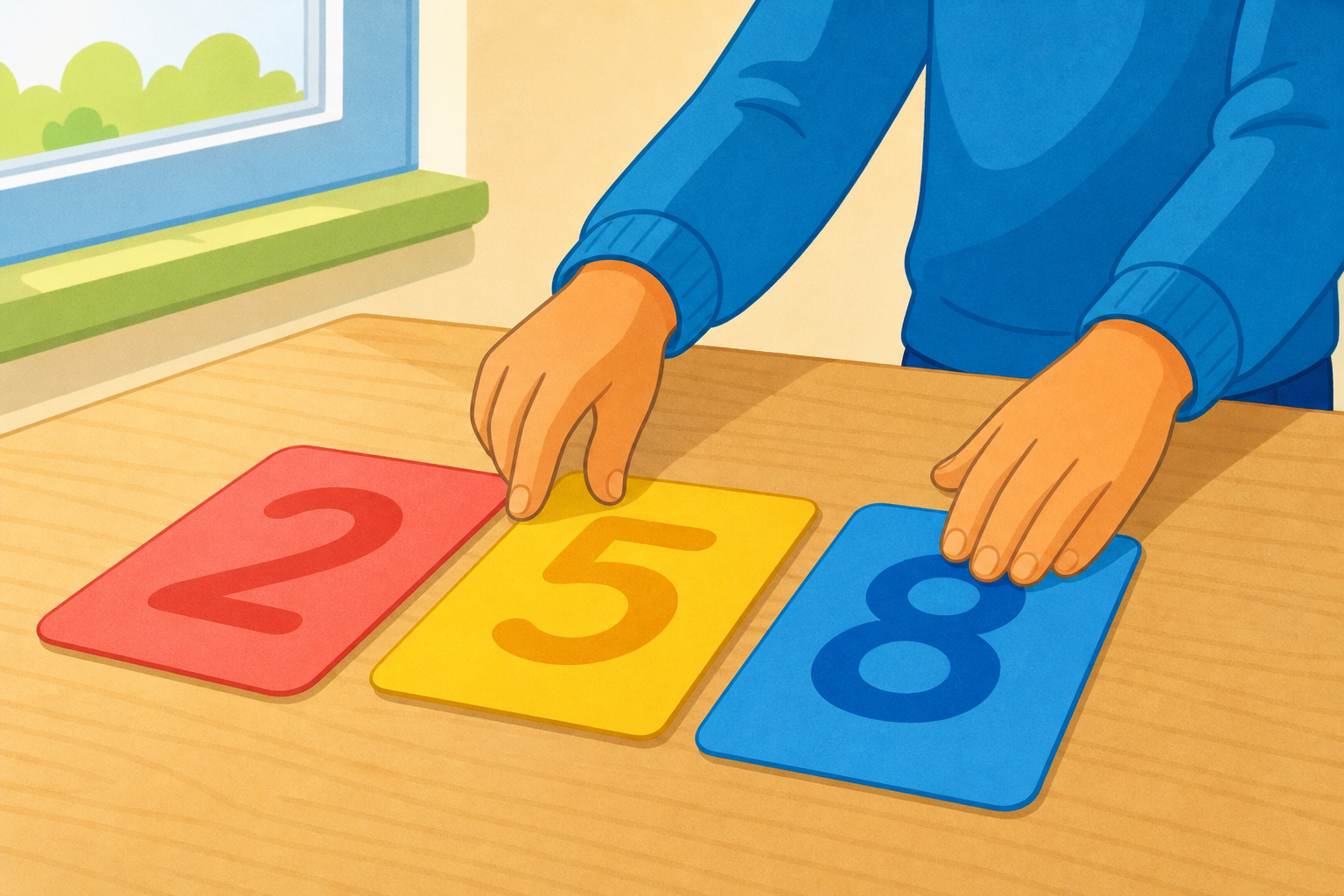
Here are three digit cards: 3, 7 and 5. Using each card once, what is the very biggest three-digit number you could make? And what is the very smallest?
Have a think, then hands up. See if the number you make beats the person before you.
Give ten seconds of quiet think-time before any hands go up. Take two or three hands-up answers for the biggest, then two or three for the smallest. Don't confirm the rule yet, that is what Watch and Notice is for. If a pupil offers 753, revoice it as a good guess to test, not the settled answer.
Here are three-digit numbers made from digit cards using place-value blocks. Notice where each card sits and how much it is worth in that column.
753 from 3, 7, 5: biggest card in the biggest column. Point at the 7 in the hundreds worth seven hundred. Biggest possible number.
357 from same cards: flip it. Smallest card 3 in hundreds, 5 tens, 7 in units. Stress the 7 losing almost all its value in the units.
406 from 4, 0, 6: the key one. Ask what goes wrong if we put the zero first, before revealing. Let them see 046 is just 46. So 4 hundreds, 0 tens, 6 units gives 406, the smallest three-digit number.
One at a time, don't rush to the third.
Now we build some together. For each set of digits, one pupil comes up to the board to build the number with the place-value blocks while the rest of the class watches and agrees or corrects aloud. We will make the biggest number and then the smallest number for each set: first 3, 7 and 5, then 8, 4 and 2, then 6, 3 and 1.
Before you build, say out loud which digit is the largest.
This round is for talking it through together — one pupil at the board per set and the class agrees or corrects out loud.
Send one pupil up per set. Ask them to say the largest card aloud before they place it, then build the biggest, then rebuild for the smallest. To keep the watching class with it through the middle set, turn-and-name: point at a seated pupil and ask which card goes in the hundreds and why, or revoice the board pupil's placement back to the room. Watch for pupils who put cards down in the order they were called rather than sorting by size — prompt which card is worth the most, and which column should it go in?
In your maths copy, for each set of three digits the teacher gives, write the biggest number you can make and the smallest number you can make, one under the other. Circle the digit in the hundreds place each time.
Call out one set of three digits at a time and give thinking time. Walk the room glancing at the circled hundreds digit — this is whole-class copybook practice, not marking. Look for pupils circling the largest digit for the biggest number and the smallest (non-zero) digit for the smallest.
Now we take on four sets of cards, one at a time, and find the biggest and smallest three-digit number for each: first 2, 6 and 9, then 5, 1 and 4, then 7, 0 and 3 where the zero is the tricky one, and last of all 8, 8 and 1 where two cards are the same. Two cards can be the same, that is fine.
Before we build each set, hands up and say where each card must go.
These are the practice questions — pupils take turns at the board, check each answer, and the class confirms before moving on. Keep the board work brisk rather than over-explaining.
For each set the whole-class task is two numbers: build the biggest, check with the ✓, then rebuild for the smallest and check again. The practice set below holds the biggest and smallest for each set. The 7, 0 and 3 set is the pause — ask where the zero can and cannot sit before the smallest is built. The 8, 8 and 1 set surprises pupils who expect three different digits; agree aloud that a repeated digit is fine.
You're previewing this lesson. Get full access to this lesson and hundreds more — each one ready to teach, with interactive activities, printable resources and pupil progress tracking built in.