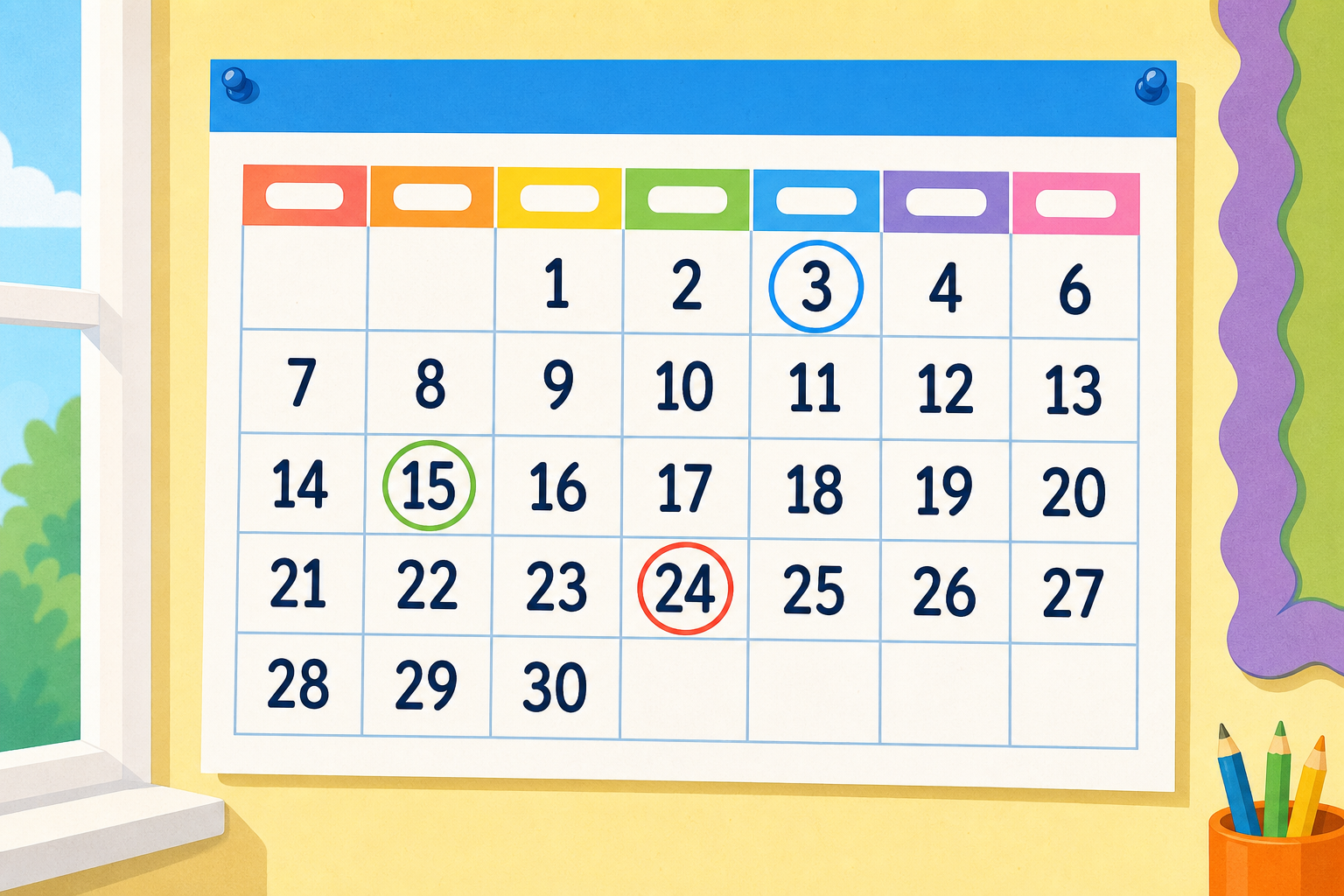
Today's date is circled on our calendar. Hands up: what day of the week will it be one week from today? See if you can say it without counting every single day in between.
Circle today's date on the displayed month grid before you ask. Take two or three hands-up answers, not open call-outs. Listen for anyone who says the same weekday straight away — that noticing is the whole lesson. Don't confirm the reason yet; the class builds it in Watch and Notice.
Three calendar problems on the board, each already worked. Watch how the counting moves: along the rows for days, straight down for weeks. Keep your eye on where the counting lands each time.
The last one is different. Instead of counting on, we count the gap between two dates. Be ready to say how many squares apart they are.
First snapshot: run a finger along the rows so pupils see the 10 single days. Ask what happens at the end of a row before you turn the corner.
Second snapshot: this is the one that pays off the hook — one week is one row straight down, and it stays the same weekday. Hold on this one.
Third snapshot: the counting changes here — we count the jumps between the two dates, not on from one. Ask pupils to predict the gap before you point to it. Stress that we count the jumps from the 3rd to the 17th, not the dates themselves, so the answer is 14, not 15. Fourteen days is exactly two weeks, so it is also two rows down; let someone notice that.
We'll work these three together. Tap the start date, then use the day or week and forward or back buttons to count along the grid.
Talk this one through together — pupils take turns at the board and the class agrees or corrects out loud.
For the 12th-plus-6 problem, ask the class to predict what happens at the end of a row before you turn the corner into the next one, so they track the count square by square. For the 6th-to-20th gap, remind pupils to count the jumps between the dates, giving 14, not the dates themselves. The two-weeks and the 14-day-gap problems both land 14 days apart — a good moment to revoice: two weeks and a fortnight are the same jump.
Use your own printed month calendar and write the answers to these three questions in your maths copy. Point and count along the rows on your paper grid as you go.
Walk the room and glance for pupils counting week-jumps straight down rather than one day at a time — this is whole-class copybook practice, not marking. Nudge anyone still ticking single squares for the two-week question toward the two-rows-down shortcut. Note the answers to questions 2 and 3 depend on the pupil's own printed month, so they will differ from the March grid on the board — that is expected.
We'll work these in order. Count on the grid, type your answer and press Check.
This is the practice round — pupils take turns at the board, check each answer, and the class confirms before moving on. Keep the board work brisk rather than over-explaining.
The 14th-to-21st question asks for the gap between the two dates, counted as jumps: from the 14th to the 21st is 7 jumps, so the answer is 7, not 8. Because it is exactly seven days, it also lands back on the same weekday, tying off the hook one more time. Remind pupils to count the jumps between the dates, not the dates themselves. For the day-count problems, remind them to turn the corner at the end of a row and keep counting square by square along the next one.
You're previewing this lesson. Get full access to this lesson and hundreds more — each one ready to teach, with interactive activities, printable resources and pupil progress tracking built in.