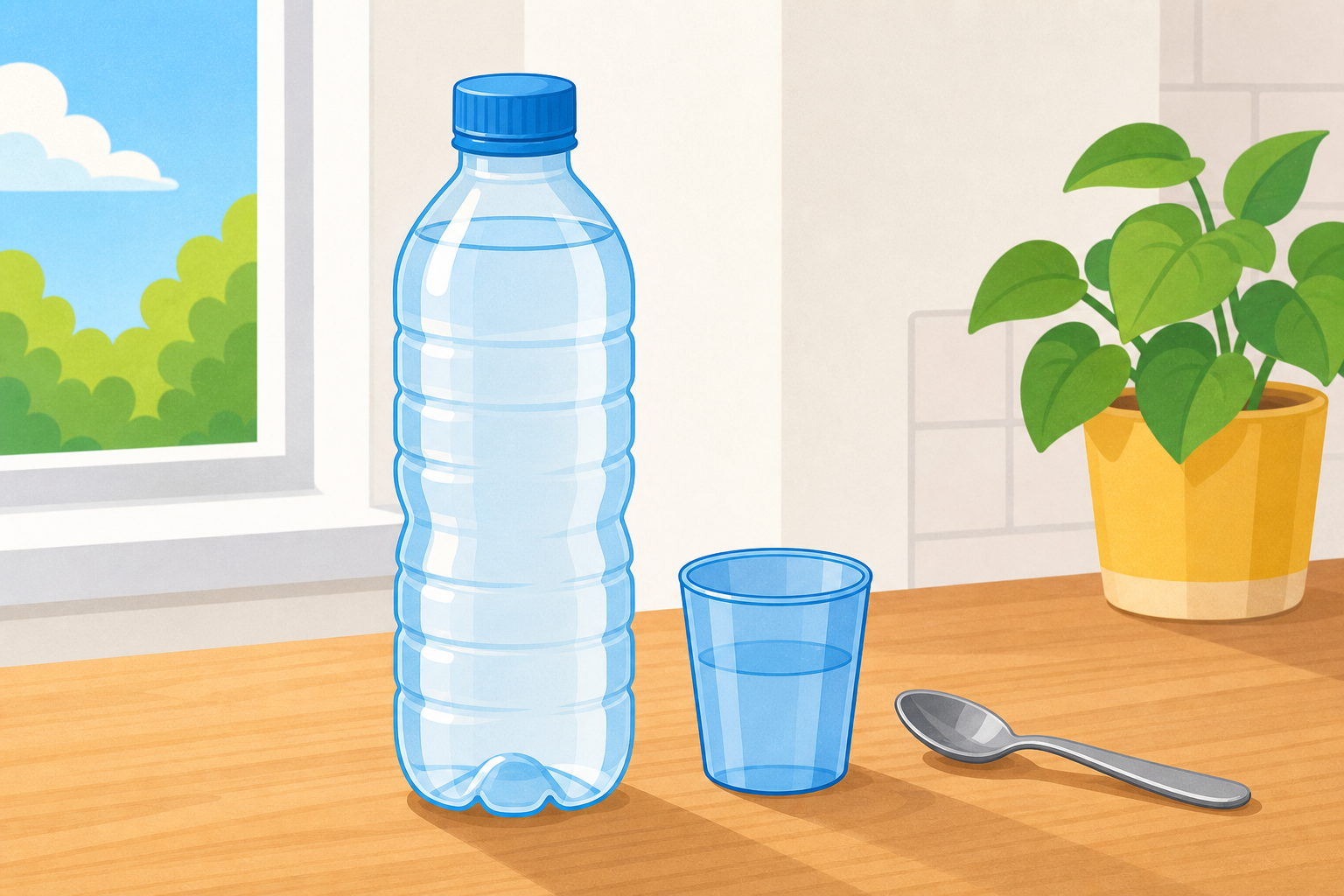
Here is a one-litre bottle, a cup and a teaspoon.
About how many cups of water do you think it takes to fill the whole bottle? More than five? More than ten?
Take three hands-up estimates, not open call-outs. Don't settle on the right answer yet — the wide spread of guesses is the hook.
Draw out the idea that a bottle takes many cups, and a cup takes many spoons — capacity comes in big amounts and small amounts, which is why we need two units.
A millilitre is a tiny amount — about one drop from a spoon. A litre is a big amount — a full bottle of water.
If you poured one whole litre out drop by drop into tiny millilitre cups, you would fill one thousand of them. So one litre and one thousand millilitres are the very same amount of water. We just measure it with the big unit or the small unit.
We use litres for big amounts, like bottles and jugs. We use millilitres for small amounts, like spoons and medicine cups.
Point at the litre reading, then the millilitre reading: same water, two names — one litre, one thousand millilitres. If you want to show the digits shifting from 1 to 1,000, tap along the chain on the board yourself; that is a teacher move, not something the class needs to read.
The trap is thinking a bigger number means more water. 1,000 ml is not more than 1 l — it is exactly the same. Ask the class which everyday things they would measure in litres and which in millilitres before moving on.
In your maths copy, write the fact at the top of a fresh page:
Then rule three columns headed container, my estimate and jug reading. You will fill in four containers as we measure them.
Walk the row glancing that the fact is written and the three columns are ruled — no marking, this is whole-class copybook practice. Have the estimate column ready before any pouring starts so pupils commit to a guess first.
Today we measure four containers together at the water tray, one at a time: a cup, then a mug, then a yoghurt pot, then a small flask.
For each one we estimate first — write your guess in millilitres in your copy — then we pour the water in, read the jug at eye level, and check how close we were.
Pupils measure at the water tray — circulate and catch reading slips on the spot. The class reads each jug aloud and you reconcile any disagreement as you circulate.
Take the four in that order on purpose: the cup and mug are close, so pupils learn a cup usually holds less than a mug; the yoghurt pot is smaller again; the flask is the biggest and closest to half a litre. Hold out for the estimate before any water is poured — the learning is in the gap between guess and reading.
Read the jug at eye level, not from above — model bending down to the line. If a reading lands between two marks, ask the class what each little step is worth before they say the number.
Now for the practice round. Estimate then measure how much four more containers hold, biggest worth most:
an egg cup, then a mug, then a yoghurt pot, then a small lunch flask. Record each in millilitres.
Stretch: which two of your containers together would just fill the one-litre bottle?
This is the practice round — real containers circulate around the room (or sit at stations) and pupils measure each one with their own jug. Keep the pass-on rhythm brisk; the class confirms each reading aloud at the end.
The order rises in size: the egg cup is tiny (tens of millilitres), the mug and yoghurt pot land in the low hundreds, the flask is the biggest. The stretch is the key one idea — that two smaller amounts can add up to one litre (1,000 ml). Prompt with: your flask is about 400 ml — what would you need to add to reach 1,000?
Watch for pupils reading from above the jug rather than at eye level, and for skipping the estimate. Every pour needs a guess first.
You're previewing this lesson. Get full access to this lesson and hundreds more — each one ready to teach, with interactive activities, printable resources and pupil progress tracking built in.