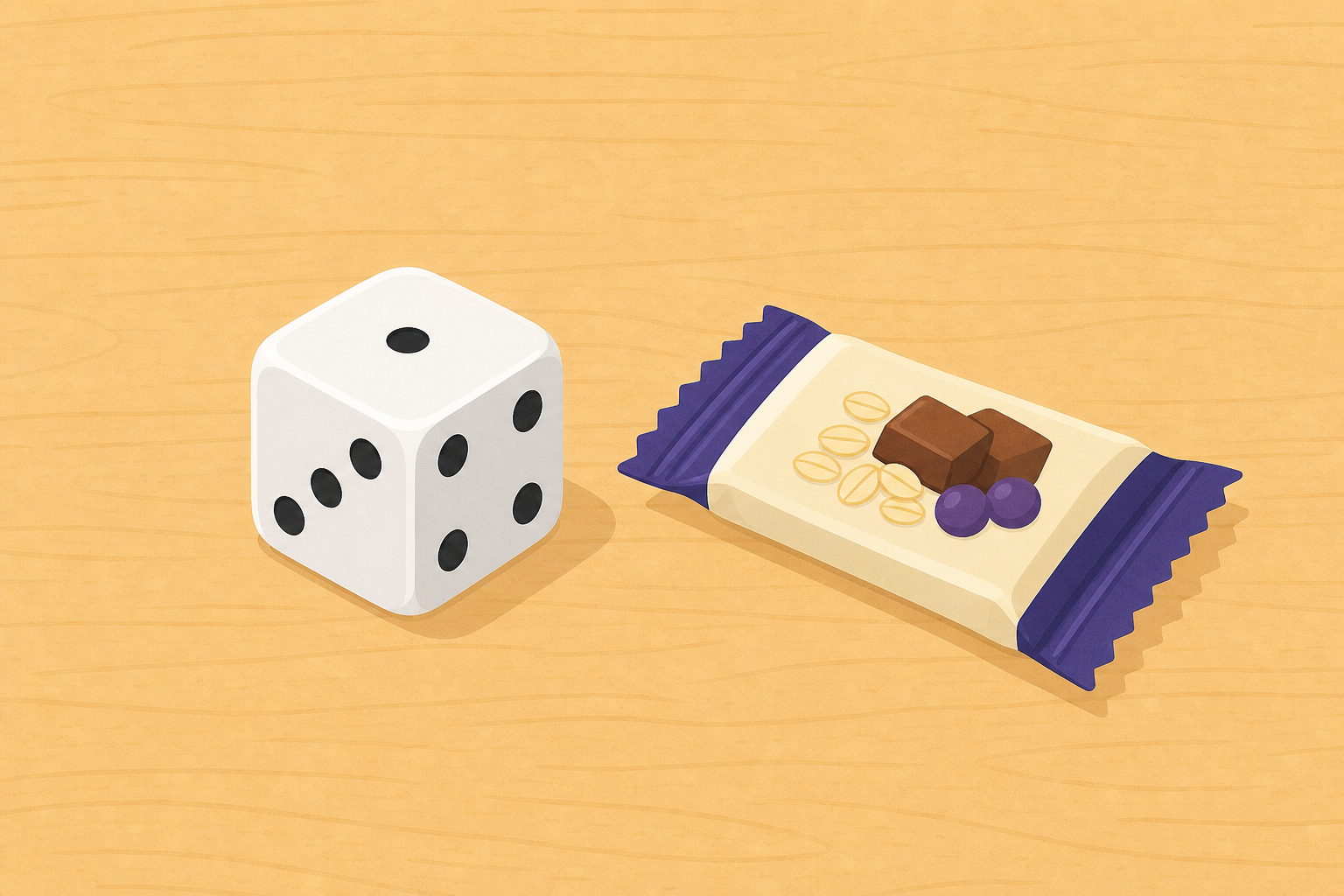
Hands up: if I roll this die once, how sure are you that a 6 comes up? Would you bet your break-time snack on it?
Some things always happen. Some never happen. Most things sit somewhere in between. Today we sort them.
Roll a real die (or the on-screen one) once as pupils settle. Take three hands-up answers, not open call-outs. Do not settle the maths yet — the point is to surface the words maybe, probably not, no chance, which we sharpen into likely / unlikely / impossible over the lesson.
Look at each one on the board. As the die is rolled again and again, watch the bars for each face grow. If the die is fair, no single face runs away with the game.
Now a spinner with four equal parts. Every part is the same size, so landing on any one is equally likely.
Last, a spinner with one giant part. Is that a fair spinner? Watch where it wants to land.
Point at each face's bar as it grows on the die histogram: see how no single bar pulls far ahead over a long run. On the four-part spinner, hold out for a pupil to name equally likely. On the last spinner, ask what a pupil would pick if a prize depended on it — the class should spot the big part is the smart bet, so it is not fair.
Do not tell them the last spinner is unfair before asking — let a pupil call it.
In your maths copy, write each of these events on its own line. Beside each one, mark it with a letter: C for certain, L for likely, U for unlikely, or I for impossible. Underline any you were unsure about.
Walk the room glancing at the letters, no marking — this is whole-class copybook practice, not assessment. Watch for pupils marking the coin toss as likely instead of an even chance; note it to revisit in the wrap.
Today we explore an unfair spinner. Half of it is red. A quarter is blue. A quarter is green.
We'll spin it many times and watch which colour grows the tallest bar. Before each run, say aloud which colour you think will win most.
Talk this one through together — pupils take turns at the board and the class agrees or corrects out loud.
Have a pupil come up and spin several times, then read the bars: which colour has the tallest bar, and does that match its size on the wheel? Revoice a strong answer: so the bigger the slice, the taller its bar grows over time. Keep pupils predicting before each run — the prediction is where the reasoning lives.
We work through two chance jobs together at the board.
Place each event on the certain-to-impossible scale.
Sketch a fair spinner for red, blue and green so every colour has the same chance, then talk through a quick prize game on it.
If there is time, the stretch is to explain why, even after thirty rolls of a fair die, the six bars are almost never perfectly level.
Where does each event sit on the certain-to-impossible scale, and can you build a fair spinner?
['Task 1: sort the four events onto a certain → likely → unlikely → impossible line.', 'Task 2: design a spinner with three equal parts so each colour is equally likely, then play a quick prize game and check every player has the same chance.', "Stretch (if time): explain why a fair die's six bars are almost never perfectly level after thirty rolls."]
Ways to start:
Stretch:
Record: Sort cards on the board's scale line; sketch the fair spinner in the copy.
This is the practice round — pupils take turns at the board, check each answer, and the class confirms before moving on. Keep the board work brisk rather than over-explaining.
Run Task 1 first: pupils sort the four events onto a certain-to-impossible line drawn on the board. Only when the sort is agreed move to Task 2, the three-part spinner design and fairness reasoning. Treat the thirty-roll idea as an optional stretch, not a required task — only reach it if time is left. For the stretch, listen for the idea that chance is not the same as a guarantee — a fair die does not owe you an even split after only thirty rolls; the bars level out only over a very long run.
Use the die-roller histogram from Watch and Notice to demonstrate the wobble live if the class needs convincing.
You're previewing this lesson. Get full access to this lesson and hundreds more — each one ready to teach, with interactive activities, printable resources and pupil progress tracking built in.