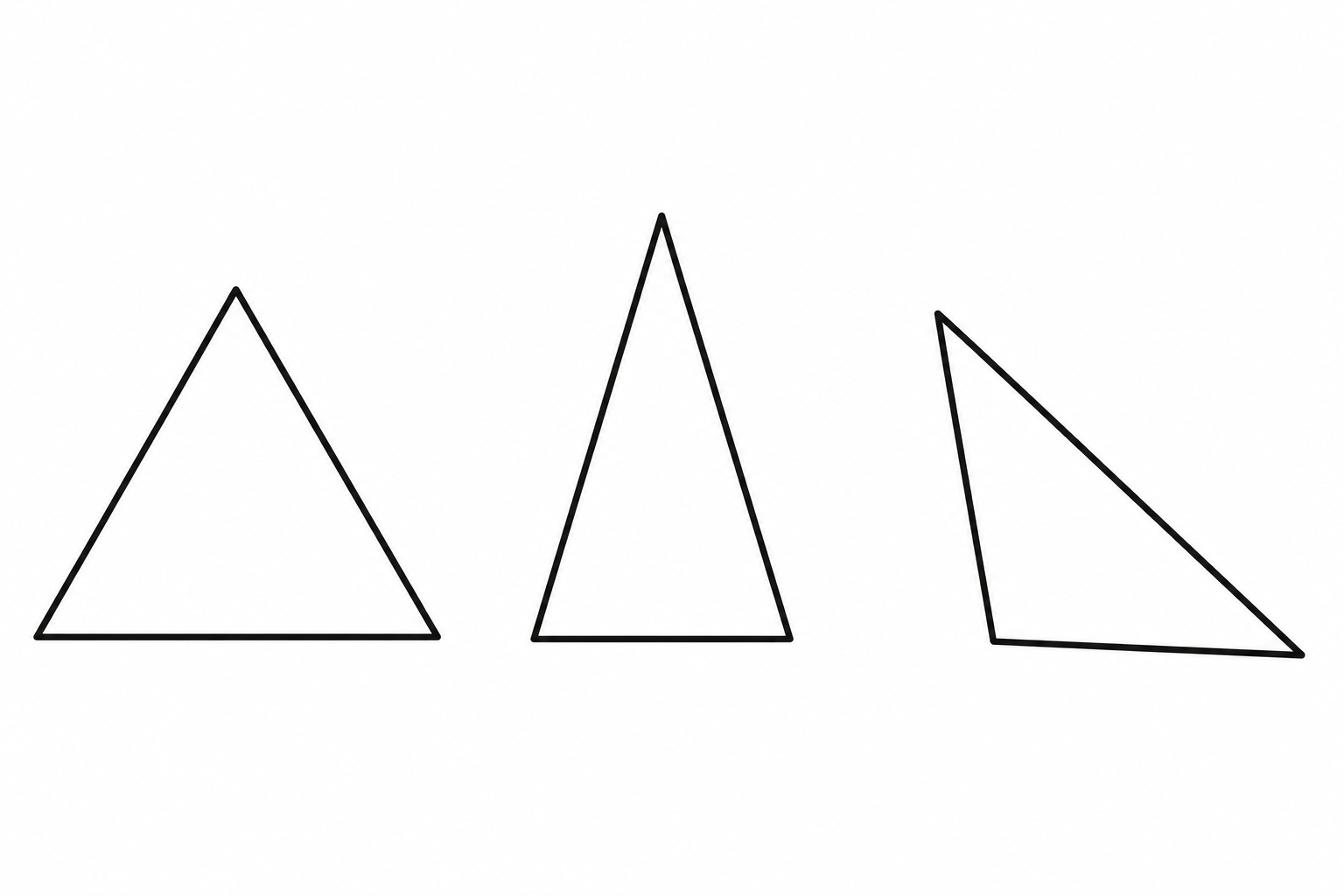
Here are three triangles. One has all its sides the same length, one has two sides the same, and one has no two sides the same.
What is the same about all three of them? And what is different?
Hold up (or display) three real triangle cut-outs — one all-equal, one with two equal sides, one with none equal. Take two or three hands-up answers, not open call-outs. Steer the class toward noticing that all three have three straight sides and three corners (same) but the side lengths differ (different) — this is the idea the whole lesson hangs on.
Three triangles are shown sorted into their families by the length of their sides. Notice how many sides match each time, and that the last one is still the same family when turned on its side.
Equilateral (5, 5, 5): all three sides match. A strip laid along one side reaches exactly along the other two. Like a yield sign.
Isosceles (6, 6, 4): exactly two match. Find the pair, then the odd one out. Say it slowly, eye-SOSS-uh-leez, and have the class echo it once.
Scalene (3, 5, 6): no two line up, all three different. Say SKAY-leen.
Tilted scalene: same triangle turned. Ask whether anything about the sides changed just because you turned it. It hasn't, so still scalene. Turning never changes the family.
Today we sort triangles into their three families. One pupil comes to the board to drag a triangle. Before they drag, everyone watching says which sides they think match — then the pupil drags it to the right family: equilateral, isosceles or scalene.
This round is for talking it through together — pupils take turns at the board and the class agrees or corrects out loud.
Before each pupil drags, have the class say which sides they think match. Use the paper-strip check on screen if a triangle is hard to judge by eye. Rotate enough pupils to work through the practice set briskly. Watch for the common slip of counting an equilateral as isosceles (all-equal triangles also have 'two equal sides', but we name them by the strongest match — all three equal).
In your maths copy, draw one triangle of each kind. Label one equilateral, one isosceles and one scalene.
Walk the room and glance for three clearly different triangles and the right labels — no marking, this is whole-class copybook practice. Look for the equilateral being drawn too lopsided and the scalene being drawn with two sides that look equal.
Now we make triangles with strips of paper or lollipop sticks. Work through these in order:
These are the practice questions — pupils work the four builds at their desks with strips or sticks, and the class confirms each result aloud before moving on. Keep it brisk rather than over-explaining.
Differentiation: pair a pupil who is less secure with a peer who can model laying the strips end to end carefully (teacher's grouping choice).
Can a triangle ever belong to two families at once? Think about a triangle with all three sides equal — does it also have two sides equal?
Listen for the insight that an equilateral triangle does have two equal sides (it has three) — but we give it the strongest name, equilateral, not isosceles. Revoice a good answer: 'so all-equal beats two-equal — we name it by the most that matches.' Head off the idea that turning a triangle could move it between families.
Next we look at four-sided shapes — squares, rectangles, rhombuses and more — and sort them by their sides and corners too.
Close briskly. A quick whole-class recall of the three family names by their side rule is enough.
You're previewing this lesson. Get full access to this lesson and hundreds more — each one ready to teach, with interactive activities, printable resources and pupil progress tracking built in.