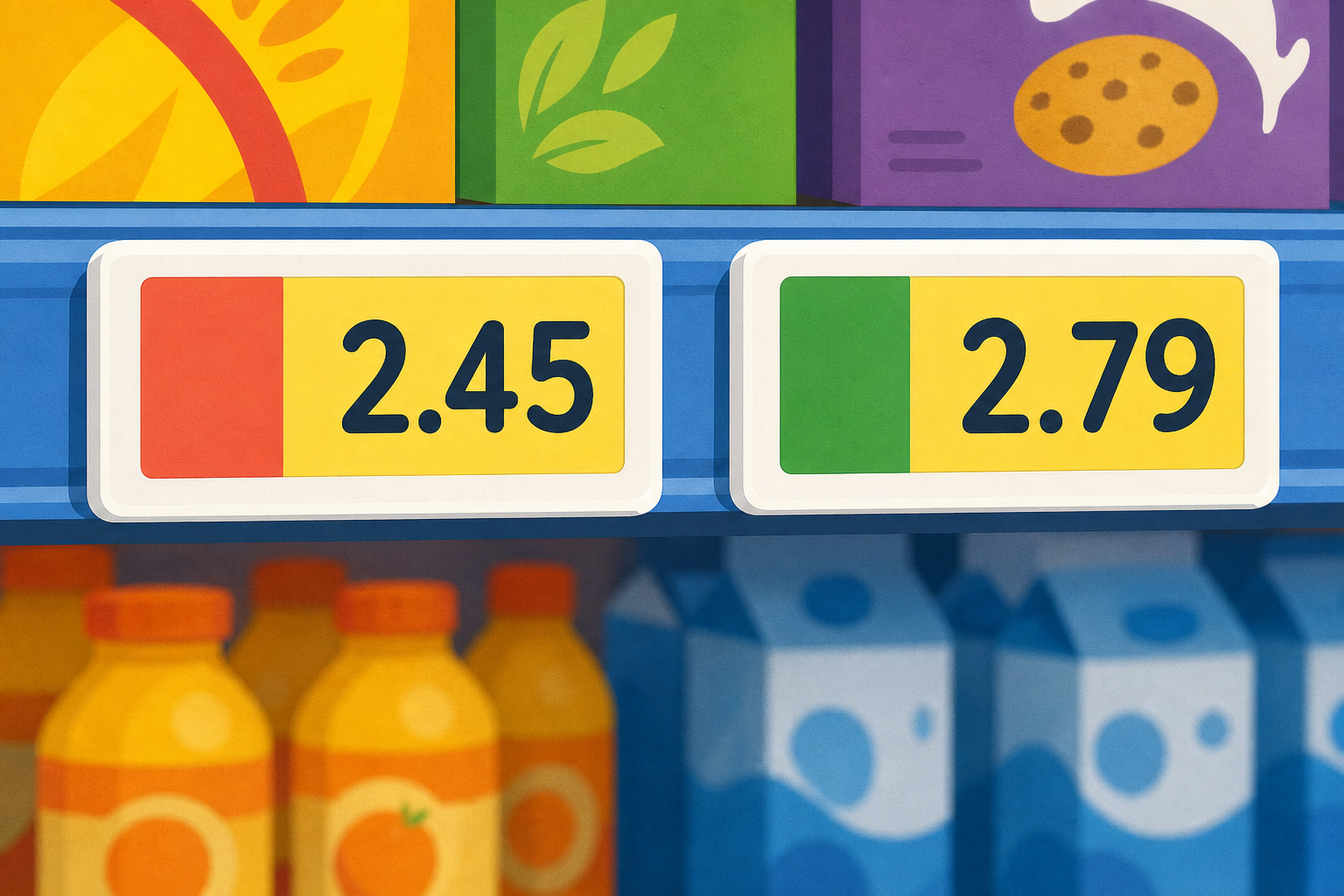
Two price tags are on the shelf: one reads €0.30 and the other reads €0.03. Is this a spot-my-mistake? Have a look: are these two prices the same amount of money, or is one of them dearer?
And here is a trickier one to keep in your head: 0.25 and 0.5. One of these has more digits after the point. Does that automatically make it the bigger number? Hands up when you have a hunch.
Two fraction strips at a time, each shaded to show one decimal. The longer the shaded part, the bigger the decimal. Look at each pair and decide which reaches further.
Today we work through these together on the fraction strips, shading each decimal and reading which reaches further. We start easy and build: first 0.2 against 0.5, then 0.7 against 0.4, then the tie-breaker 0.4 against 0.45 where the tenths are equal, and finally 0.05 against 0.5 — the tricky one, so we say each aloud before we check it.
In your maths copy, write these three pairs one under the other and put the correct sign between each pair — more than, less than, or equals:
Underline the digit that decided each one, and think about the last pair carefully before you choose your sign.
Today we order these sets of decimals from smallest to largest, shading each on the strips to check. We build up: first just two, then three, then the tricky set with 0.05 hiding among the tenths, and finally a mixed set of four.
You're previewing this lesson. Get full access to this lesson and hundreds more — each one ready to teach, with interactive activities, printable resources and pupil progress tracking built in.