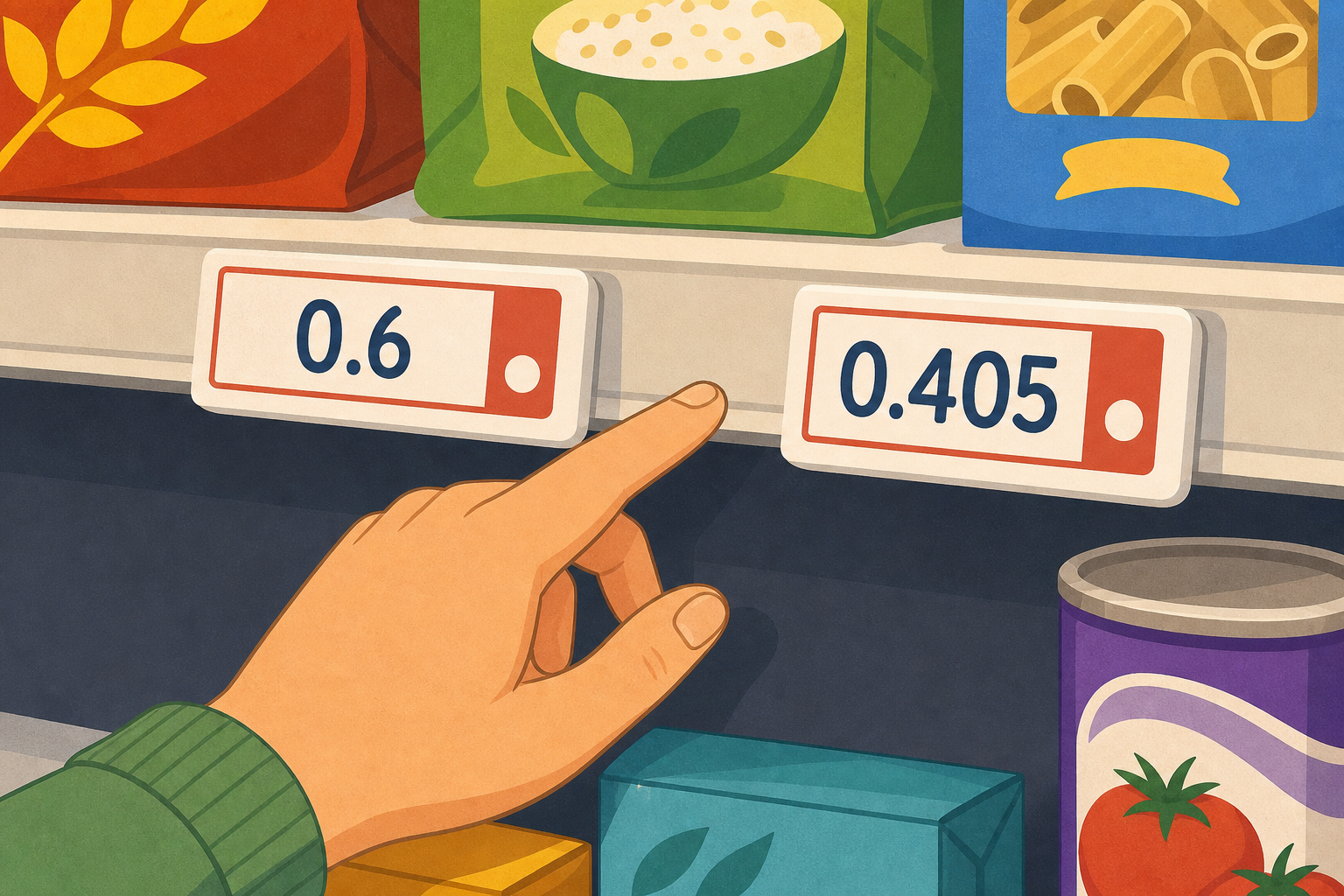
Here are two decimals: 0.6 and 0.405.
Hands up: which one do you think is bigger? Trust your first gut answer, then hold that thought. Some people's gut says 0.405, because it has more digits. Is a longer decimal always the bigger one?
Take three hands-up answers, not open call-outs. Deliberately draw out the wrong instinct ("0.405 looks bigger because it's longer") without correcting it yet, then say let's line them up and find out.
Display 0.6 and 0.405 side by side as pupils settle.
The place-value chart lines each pair of decimals up column by column. Watch which column decides the winner each time. Longer is not always bigger.
0.6 vs 0.405: tenths decide it. 6 tenths beats 4 tenths, so 0.6 wins. The extra digits in 0.405 never count.
Point to each column and read it aloud.
0.07 vs 0.070: identical. 0 tenths, 7 hundredths, then nothing. Trailing zero on 0.070 changes nothing.
Cover the trailing zero with a finger. Ask: does hiding that zero change anything?
1.234 vs 1.24: units and tenths agree, so read on. 1.234 has 3 hundredths, 1.24 has 4, so 1.24 wins.
Pause before the reveal and take a prediction: which wins?
This is the key one. Revoice a strong answer: we only compare the column where they stop matching.
Today we sort a set of decimals into order from smallest to largest: 0.4, 0.404, 0.44 and 0.044. They all use the same digits, so we cannot judge by looks. We line up the point and read from the left, column by column, until we can place each one.
Predict where each card lands before we drop it in. Do not judge by how many digits each one has.
This round is for talking it through together — pupils take turns at the board and the class agrees or corrects out loud.
Drag one card at a time into the ordered buckets. Start with 0.044 (fewest tenths) so the class sees straight away that digit count does not decide it. Ask the class to compare in the tenths column first every time, and only move to hundredths when the tenths tie (0.404 vs 0.44).
Watch for the pupil who ranks 0.404 above 0.44 because it is longer — pause there and read both in the hundredths column aloud: zero hundredths versus four hundredths.
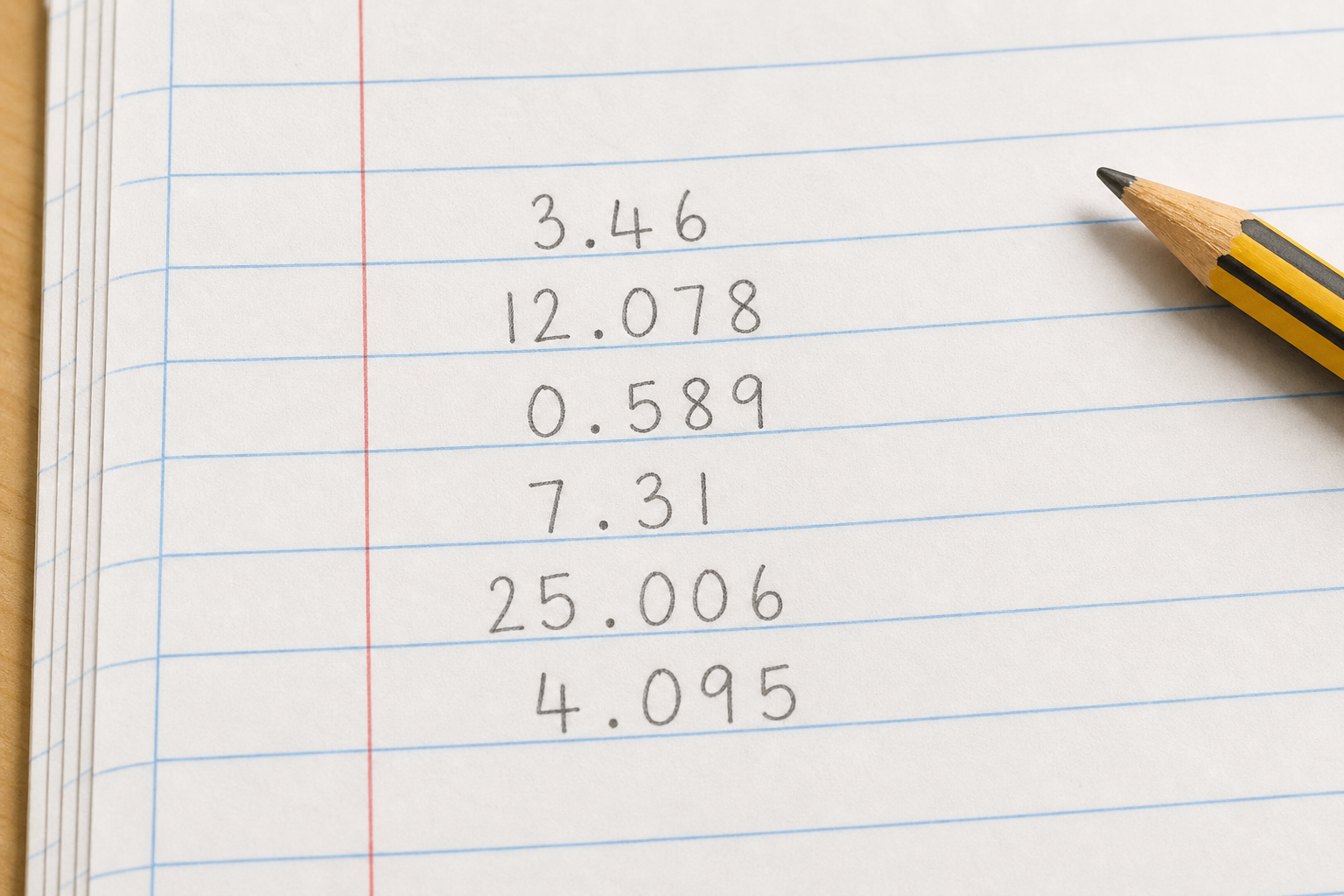
In your maths copy, write each set of decimals in a column with the decimal points aligned, one under the other. Then number them from smallest to biggest.
Write these two sets:
Keep every decimal point directly under the one above it — that lining-up is what makes the comparison easy.
Walk the room glancing at whether the decimal points sit in a straight vertical line — this is whole-class copybook practice, not marking. A crooked column is the usual cause of a wrong order.
Today we work through these ordering rounds together, each one a step trickier than the last: first a set with clear tenths, then a set where the tenths tie and we must read the hundredths, then a set with a trailing-zero trap, and finally we order a set right down to thousandths: 0.452, 0.4, 0.45, 0.455.
After Round 4, we pause on two neighbours from that set, 0.45 and 0.455, and find a decimal that sits strictly between them.
These are the practice questions. Pupils take turns at the board, check each answer, and the class confirms before moving on. Keep the board work brisk rather than over-explaining.
Round 1 sorts on tenths alone. Round 2 forces a read into hundredths (tenths tie). Round 3 hides the trailing-zero trap (0.3 equals 0.30). Round 4 orders to thousandths.
After Round 4, teach the between skill with one worked pair on the board: 0.45 and 0.455. Cue the steps: (1) align points, (2) pad 0.45 to 0.450, (3) scan left to right until the digits differ, (4) pick a thousandths digit strictly between 0 and 5. Write 0.452 as the class example, then take other valid answers (0.451, 0.454, 0.4505) and have pupils prove each one sits between by the same column read. Slip to watch: a pupil offers an endpoint (0.45 or 0.455) or a number outside the gap such as 0.456.
You're previewing this lesson. Get full access to this lesson and hundreds more — each one ready to teach, with interactive activities, printable resources and pupil progress tracking built in.