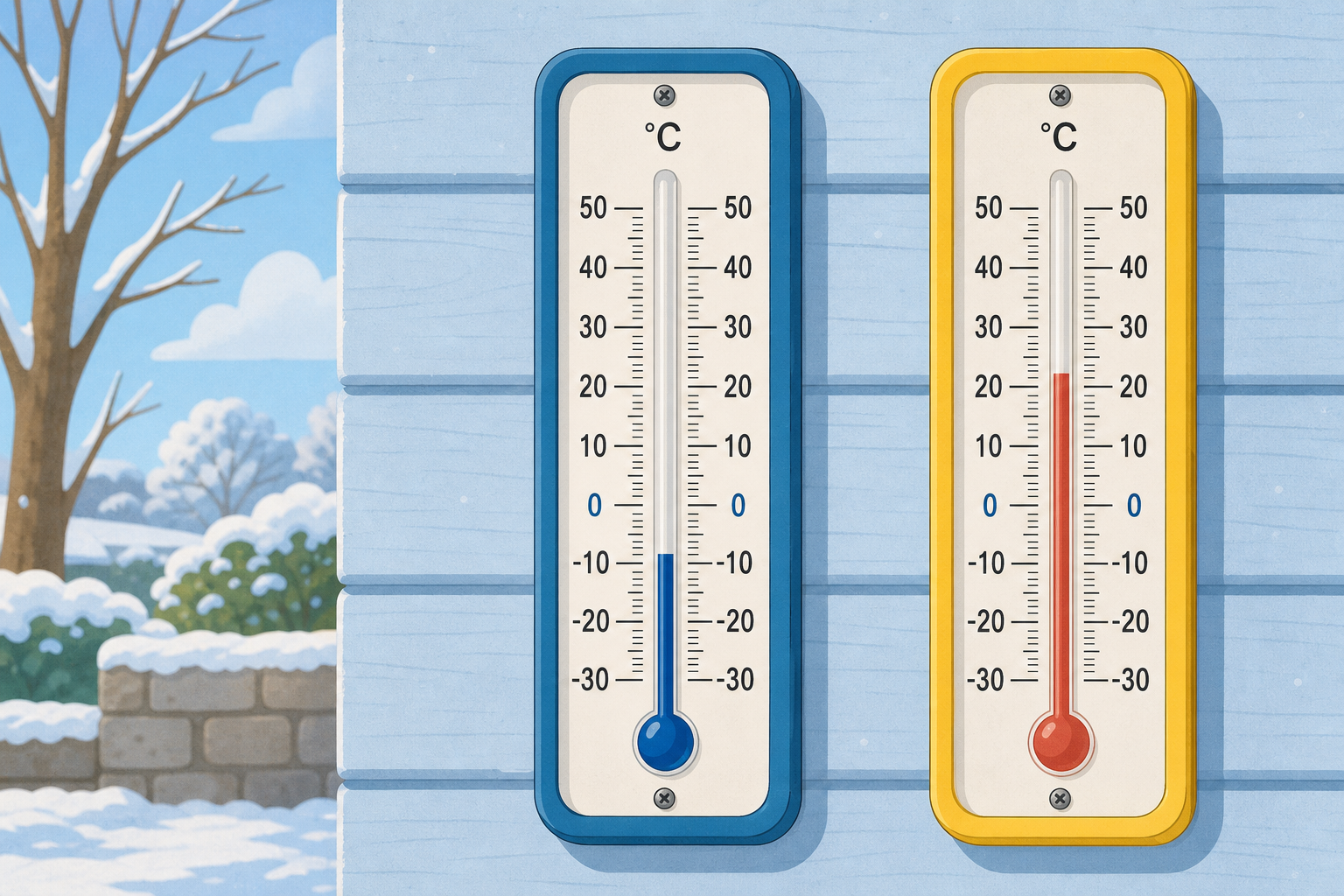
Here are two winter mornings. In one town the thermometer reads −7 °C. In another town it reads −3 °C.
Hands up: which town is colder? And here is the tricky part — which number is actually the bigger number, −7 or −3?
Show the two thermometer readings −7 °C and −3 °C side by side as pupils settle. Take three hands-up answers, not open call-outs. Expect a split: many will say −7 is bigger because 7 > 3. Do not resolve it yet — say "we'll settle this on the number line in a minute" and move on.
The number line shows two markers at a time. Watch where each one sits: the number further to the left is always the smaller one. See if you can call the bigger number before it's confirmed.
−7 and −3: the counter-intuitive one. Trace left with your finger; −7 is smaller, −3 is bigger. Head off the slip that the bigger digit means the bigger number once there's a minus sign. Ask: is −3 warmer or colder than −7?
−5 and +2: the easy win. Any positive beats any negative. +2 is bigger. Let them call it before you point.
0 and −1: close one. −1 is one step left of zero, so 0 is bigger. Pause on zero as the fence, neither positive nor negative, beating every negative.
−10 and −1: the key one, catches people out. Ask which is further left, let them predict, then confirm −10 is smaller, −1 is bigger. Bigger digit after the minus means further left and smaller.
Now we work through five pairs together on the board, deciding the bigger number in each one. For every pair we drag the two markers onto the line and read which one sits further right — that one is the bigger number. First predict, then place, then check as a class.
This round is for talking it through together — pupils take turns at the board and the class agrees or corrects out loud.
Work the five prompts in order. For each one, ask the class to predict which number sits further left before the markers land. The order builds: −4 vs −9 (two negatives), +3 vs −6 (positive beats negative), 0 vs −4 (the zero fence), −2 vs −8 (two negatives again, bigger gap), and −6 vs −1 as the pause where the further-left rule really pays off — many will still want to say −6 is bigger. Revoice: "−6 is further left, so it is the smaller one."
First we will work one pair together on the board so everyone sees how to write the comparison sign. We take −5 and −2: decide which sits further left (that one is smaller), write the correct < or > between them, and underline the larger number.
Then, in your maths copy, write each pair of numbers and place the correct < or > sign between them. Then underline the larger number in each pair.
Model one pair on the board before anyone opens a copy. Use −5 and −2.
Worked steps: (1) Ask which is further left, −5 or −2. (2) Confirm −5 is further left, so −5 is smaller. (3) Write on the board: −5 < −2. (4) Underline −2 as the larger number. Point out the open end of the sign faces the larger number.
Then release the four copybook pairs. Walk the room glancing at which number pupils underline and whether the sign points to the smaller number, this is whole-class copybook practice, not marking. Watch for the −9 vs −1 pair; that is where the further-left rule is easiest to slip on.
Now we work through five more together on the board, placing the bigger number of each pair: the bigger of −3 and −8, then the bigger of +1 and −5, then the bigger of −7 and −2, then the bigger of 0 and −9, and finally the bigger of −4 and −6. Predict where the answer lands before each marker goes down.
These are the practice questions — pupils take turns at the board, check each answer, and the class confirms before moving on. Keep the board work brisk rather than over-explaining.
Each challenge asks the pupil to place the bigger number of the pair, so the value they place is the one they work out. The practice set rises in difficulty: two negatives close together, a positive against a negative, a wider negative gap, the zero fence, and finally −4 vs −6 where the further-left rule earns its keep. Have the class call the prediction, place the marker, then Check.
You're previewing this lesson. Get full access to this lesson and hundreds more — each one ready to teach, with interactive activities, printable resources and pupil progress tracking built in.