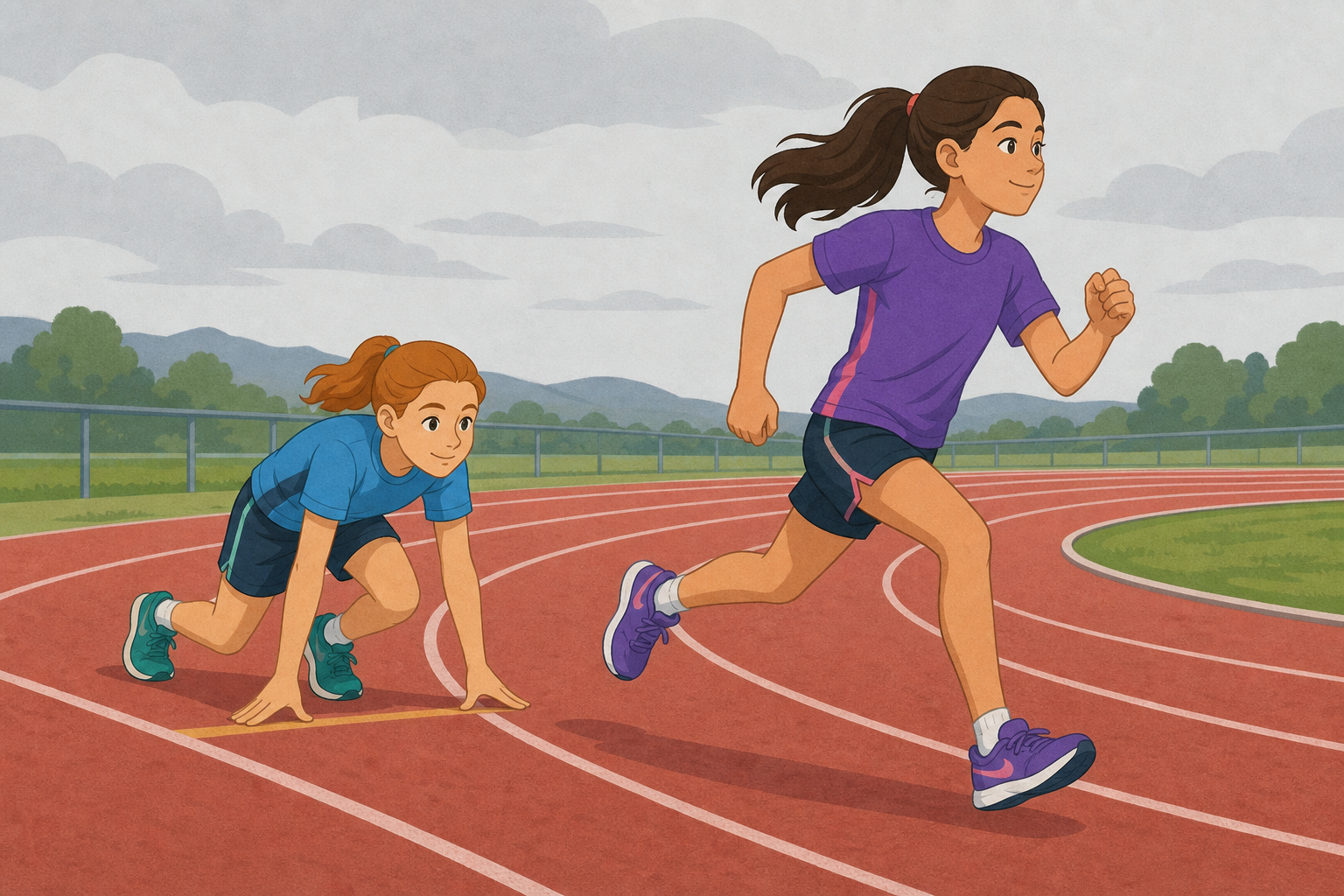
Two runners each ran part of a lap: one ran 0.6 of the lap, the other ran 0.45 of the lap. Who ran further?
Trust your gut first. Then think again: 0.45 has more digits written down. Does having more digits always make a number bigger?
Write 0.6 and 0.45 side by side on the IWB. Take three hands-up answers, not open call-outs. Expect a split: some pupils will say 0.45 because it is longer — that misconception is exactly what this lesson tackles, so don't correct it yet. Just note both answers on the board and say "we'll settle this by the end."
Each pair of decimals is shown as markers on the same number line. Before each pair, predict which one sits further to the right. Notice what is true when a number looks longer or has an extra zero.
0.6 vs 0.45: further right wins. Tenths decide it, 6 beats 4, so 0.6 is bigger even though it looks shorter written down. Hundredths not needed.
0.07 vs 0.7: seven hundredths hugs zero, seven tenths sits near the middle. Ten times bigger, far apart on the line.
1.34 vs 1.4: zoomed to 1 to 1.5. 1.34 sits between 1.3 and 1.4, 1.4 a little further right, so 1.4 wins. Pause for a prediction first, this is the key one where more digits does not mean bigger.
0.5 vs 0.50: both land on the same point, they are equal. The extra zero on the right changed nothing. This heads off the longer-means-bigger habit.
Keep asking which sits further right rather than counting digits.
Today we work through these pairs together, one pair at a time on the board, dragging both markers onto the same line and reading which one sits further right: 0.32 and 0.4, then 0.08 and 0.8, then 0.65 and 0.6, then 0.9 and 0.90. Your teacher loads each pair in turn, so watch the board for the next one. That last pair is the one to watch. Before each reveal, predict out loud which marker will land further right.
This round is for talking it through together — pupils take turns at the board and the class agrees or corrects out loud. The board starts on the first pair (0.32 and 0.4); after each pair, reset the markers to the next pair's values so the class only ever sees one pair at a time.
Call a pair, invite one pupil up to drag both markers, and have the class say "further right wins" before reading off the answer.
In your maths copy, write each pair of decimals one above the other with the decimal points lined up straight. Then place the correct sign between them (< , = or >) and circle the bigger one. If a pair is equal, write the equals sign and don't circle either.
Walk the room glancing for lined-up decimal points and the correct sign direction — this is whole-class copybook practice, not marking. Watch for the 0.9 / 0.90 pair: pupils should write an equals sign and circle neither.
Today's challenge round: place the bigger of each pair on the line. We build up: 0.3 and 0.7, then 0.08 and 0.1, then 1.45 and 1.5, then the stretch, place a decimal that is bigger than 0.4 but smaller than 0.45.
Each prompt sets its own line, so read the numbers under the line before you drag. Predict where your marker lands before you check.
These are the practice questions — pupils take turns at the board, check each answer, and the class confirms before moving on. Keep the board work brisk rather than over-explaining. Each prompt zooms the line to a helpful range, so point out the labelled ticks before each drag.
You're previewing this lesson. Get full access to this lesson and hundreds more — each one ready to teach, with interactive activities, printable resources and pupil progress tracking built in.