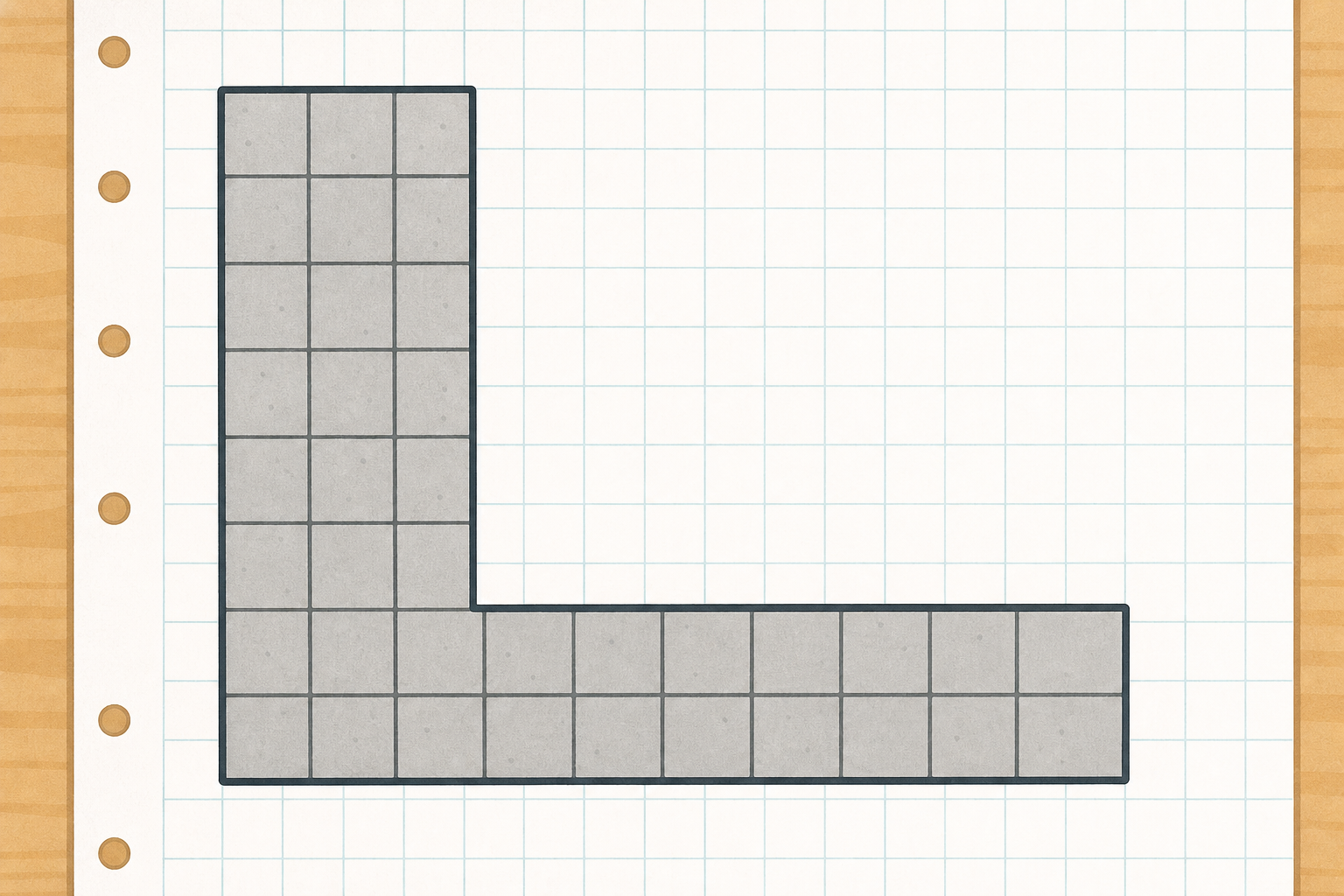
Here is an L-shaped patio. It is not a rectangle, and it is not a triangle, so our area rules don't fit it straight away.
Have a look: how could you break this shape into pieces you already know how to measure?
Show the L-shape and give five seconds of quiet think-time before hands up. Take two or three answers. Do not confirm the best split yet — that lands in the next step.
Composite shapes are not single rectangles or triangles, so one area rule will not fit the whole shape. We draw a straight split line to break the shape into pieces we already know, work out each sub-area, then add those sub-areas for the total.
Worked example: an L-shape
Here is an L-shaped patio. One straight split line turns it into two rectangles:
Add the sub-areas: 24 + 6 = 30 cm². That is the area of the whole L-shape.
The same method works when a piece is a triangle. A triangle fills exactly half of the rectangle that encloses it on the same base and height, so a triangle's area is base × height ÷ 2. That half can be a decimal, and that is fine.
On the interactive, build a rectangle or a triangle on the grid and read its area. Notice how two sub-areas add to make the whole composite total.
Board demo with your pen, not a live interactive reveal. Draw the L and the numbers yourself, then let the class compute.
Slip to watch: adding side lengths instead of areas, or dropping the cm² unit.
After the worked example, open the interactive in 2D mode only so pupils can drag a rectangle or triangle and read its live area. Do not treat it as the source of the worked numbers.
We work through these composite shapes together on the board. One pupil comes up and works the shape; everyone else watches and agrees or corrects out loud.
Each time, we draw the split line, name the two pieces, and add the sub-areas.
Try Together board. You draw the split line with the board pen, then the pupil at the board works out each sub-area and the class checks.
For each shape, ask where should the split line go? before you draw it. Then have the class read each sub-area and add them. On the house-shape, hold out for the triangle rule: base × perpendicular height ÷ 2, not the slanting side.
In your maths copy, sketch each composite shape and draw the split-line that breaks it into its known parts. Label each sub-area with its dimensions, then total at the bottom.
Walk the room glancing at where the split line is drawn and whether sub-areas are labelled with units — this is whole-class copybook practice, not marking.
Take your paper L-shape. Draw one straight split line so you have two rectangles you can cut apart.
Cut along the line, measure the sides of each rectangle in centimetres, work out the two areas, then add them for the whole L-shape.
This is a hands-on beat, not the IWB. Hand each pupil (or table) a paper L-shape on squared paper and scissors. Circulate: check the split line is straight and meets a corner, and that sub-areas carry cm² units. Ask a few pupils to show a different split line that gives the same total.
Differentiation: give less confident pupils an L-shape with side lengths already marked; stretch pupils get an unlabelled one they must measure. Fast finishers try a T-shape cut-out (two cuts).
You're previewing this lesson. Get full access to this lesson and hundreds more — each one ready to teach, with interactive activities, printable resources and pupil progress tracking built in.