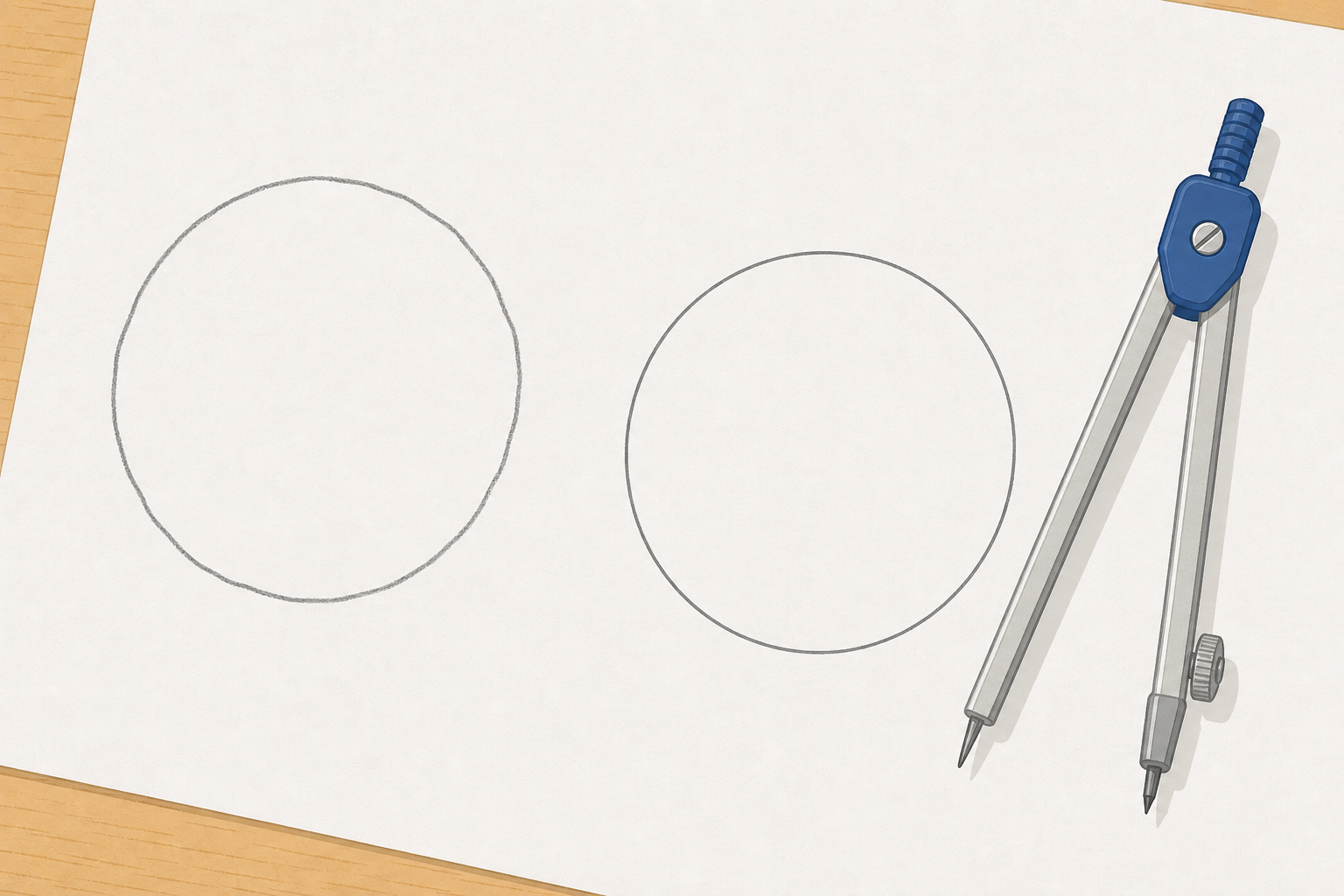
Here are two circles. One was drawn freehand with a pencil. The other was drawn with a compass.
Look closely: which one is a true circle, and what makes it perfect all the way round?
Watch three circles on the board, each labelled with its parts. Look for where the centre sits and how far the radius reaches. The circumference is the whole distance all the way around the edge. The diameter goes right across through the centre, and it is made of two radii laid end to end, so it is always exactly twice the radius.
Now a second circle, smaller than the first. The radius is shorter this time. Notice what has happened to the diameter now that the radius is shorter.
This last one shows the centre, radius and diameter again. Notice that the diameter does pass through the centre.
Today we work through these circles together. One pupil sets each circle at the board while the rest of the class predicts the answer aloud. First a radius of 6 cm. Then a radius of 2 cm. Then one where only the diameter of 8 cm is given, so we work the radius back out. Before each one, say what the diameter (or the radius) will be before we check.
In your maths copy, construct a circle of radius 5 cm with your own compass. Label the centre, the radius, the diameter and a chord. Then write down the length of the diameter.
Work out the radius the compass needs each time before you set it.
Today we build circles to match a target. First a radius of 3 cm. Then a radius of 7 cm. Then a circle whose diameter must be exactly 10 cm. Finally a circle whose diameter must be 6 cm.
You're previewing this lesson. Get full access to this lesson and hundreds more — each one ready to teach, with interactive activities, printable resources and pupil progress tracking built in.