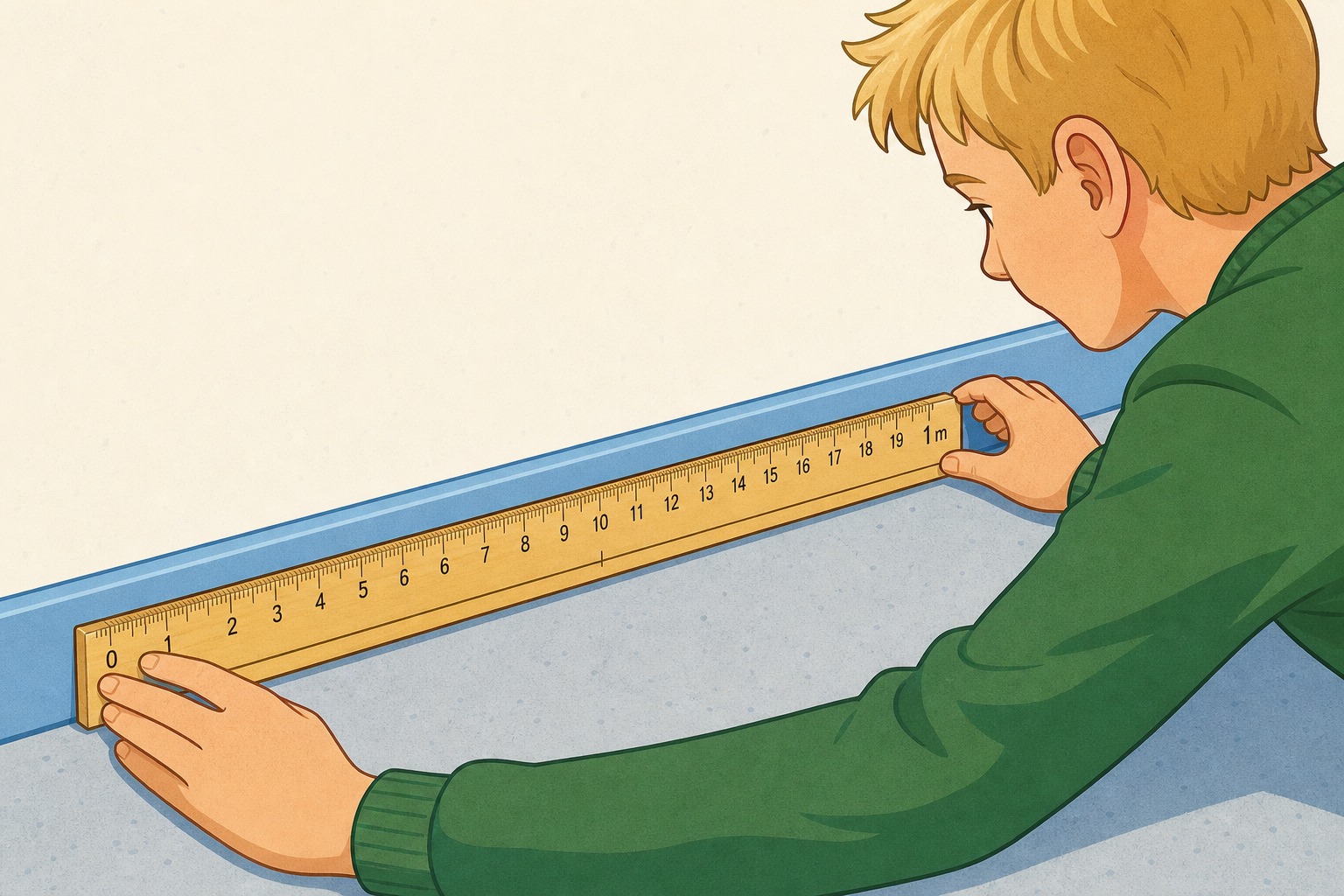
Here is our real classroom. It is about six metres long and four metres wide. We could never draw it at full size on one page. So how do we shrink a whole room down until it fits, and still keep it looking like the right shape?
Take two or three hands-up answers, not open call-outs. Steer toward the idea of shrinking every length by the same amount. Do not reveal the words 'scale' or 'scale drawing' yet — that lands in the next step.
Watch three worked plans on the board. Each real room or object has been shrunk to fit the page using a scale, written at the top of the drawing. The first uses 1 cm on paper for every 1 m in real life, so a 6 m wall becomes a 6 cm line. The second and third use a larger scale factor, 1 cm = 2 m, where you divide the real length by 2 to find the drawn length. Look for what the scale does to every length, not just one.
Read the first scale aloud: one centimetre on the page stands for one metre in the room. Point at the 6 m wall, then the 6 cm line, and ask what stayed the same. The 1 cm = 1 m case is deliberately the easy anchor. On the 1 cm = 2 m plans, hold out for the divide by the scale step and run it twice (8 ÷ 2, then 6 ÷ 2) so the class sees the method more than once — this is where pupils slip, expecting the number to stay the same again.
Today we agree a scale for our real classroom, then measure one wall together and shrink it for the drawing. The whole class follows each calculation aloud while one pupil measures at the front and another marks the line on the board. We start with 1 cm = 1 m because the numbers stay the same, then we try the same wall at 1 cm = 2 m and work out the drawn length by dividing by 2.
Talk this one through together — one pupil measures the long wall with the metre stick at the front while the whole class follows aloud; a second pupil marks the line, and the class agrees or corrects. Circulate is not needed here; stay at the front. The width and doorway are given ready-made so you only measure once and protect the time budget. Name the actual lengths as they are found — the long wall is about 6 m, so 6 cm at 1 cm = 1 m — then run the same wall at 1 cm = 2 m so the class rehearses dividing by the scale before the challenge. Keep the board work brisk.
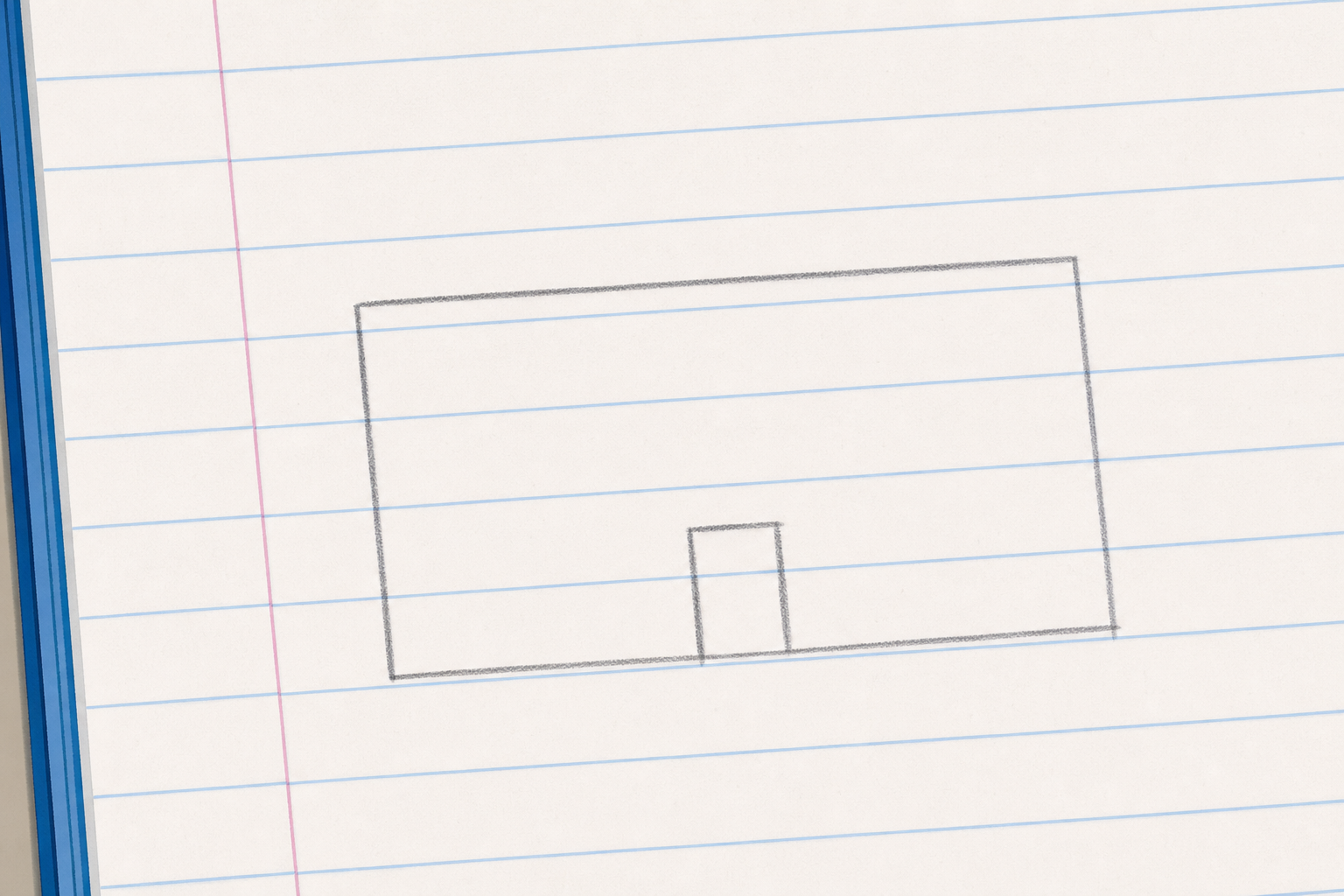
In your maths copy, write the scale 1 cm = 1 m at the top of the page. Then draw our classroom to scale using the lengths we just worked at the board: the long wall 6 m, the width 4 m and the doorway 1 m. Label each drawn line in centimetres and, beside it, the real length in metres it stands for.
Pupils reuse the class classroom lengths — no fresh measuring, so the 3 minutes is spent drawing and labelling only. Walk the room glancing for the scale written at the top and for two labels on each line (drawn length and real length). Prompt any pupil who has forgotten the scale line to add it before drawing.
Today we work through these to-scale drawings on the board together, each a step bigger than the last. First, draw a single 5 m wall at 1 cm = 1 m. Next, draw a 3 m by 2 m rug at the same scale. Then draw an 8 m by 4 m hall at 1 cm = 1 m and check it still fits your page. Finally, redraw that same 8 m by 4 m hall at 1 cm = 2 m: divide each length by 2 and see what happens to the whole drawing when the scale changes.
Draw a series of classroom features to scale on the board, each larger than the last, finishing with a rescale that shows what a bigger scale does to every length.
Ways to start:
Stretch:
This is the practice round — pupils take turns at the board, the class checks each answer, and confirms before moving on. Keep the board work brisk rather than over-explaining. The last one is where the class sees what the sequence was building to: at 1 cm = 2 m you divide each length by 2, so 8 ÷ 2 = 4 cm and 4 ÷ 2 = 2 cm, halving every drawn length. Show the division on the board, not just the answer. Ask the class to predict the new hall size before revealing it; waiting pupils watch the board and call the prediction.
You're previewing this lesson. Get full access to this lesson and hundreds more — each one ready to teach, with interactive activities, printable resources and pupil progress tracking built in.