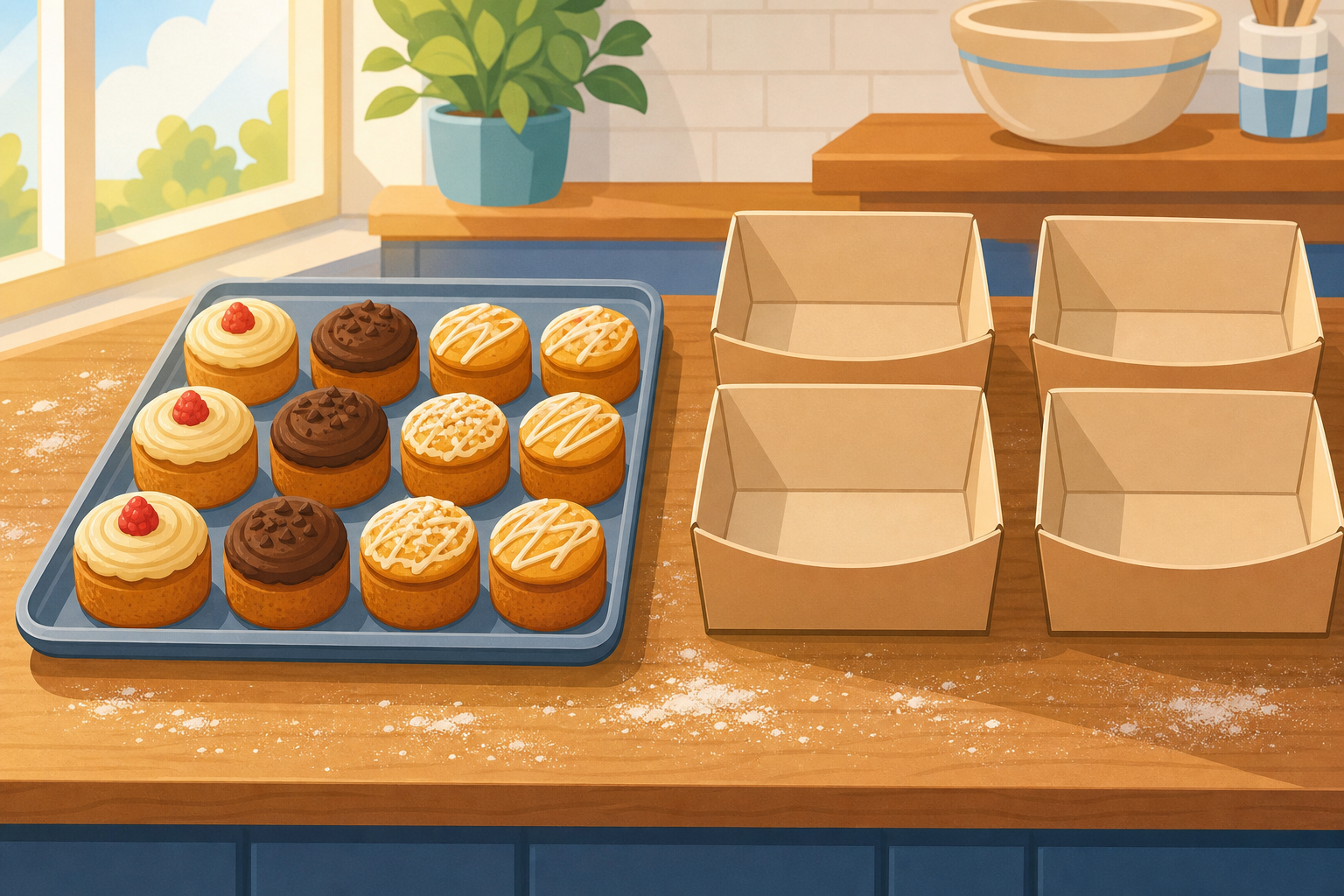
Here is a real problem from the shop. A tray holds 84 fairy cakes and they are being packed equally into 4 boxes for a bake sale. Roughly how many cakes go in each box, and where would you start working it out?
Take two or three hands-up estimates, not open call-outs. Give five seconds of quiet think-time first.
Listen for whether pupils reach for the tens first or the units first — the whole method rests on starting with the tens, so hold that thought for Watch and Notice.
We will work these on the board one at a time, so only one sum is in focus at a moment. Watch the bus-stop bracket as we share the biggest place first, then work down through the columns. Notice what happens each time something is left over.
Work each one live on the bracket, keeping only the current sum in focus. Start every one with the biggest place, not the units.
84 ÷ 4: the clean case, no carrying or zero. 8 tens share as 2 tens each, 4 units as 1 each, answer 21.
96 ÷ 6: 9 tens give 1 ten each with 3 tens left over. Pause here, quiet think, then take together where the 3 leftover tens go. They carry down: 30 joins 6 units to make 36, shared by 6 is 6, answer 16.
372 ÷ 3: three places, keep the running answer visible. 3 hundreds give 1 each; 7 tens give 2 each with 1 ten over; that 10 joins 2 units to make 12, shared by 3 is 4, answer 124.
420 ÷ 4: the key beat, give it extra dwell. 4 hundreds give 1 each. Ask can 2 tens be shared by 4, let them say no, then write 0 in the tens. Carry the 2 tens down: 20 shared by 4 is 5, answer 105. Skipping the 0 gives the wrong 15.
95 ÷ 4: the remainder case. 9 tens give 2 each with 1 ten over; 10 joins 5 units to make 15, shared by 4 is 3 with 3 units left. Those 3 cannot split further, so write 23 r3 and say r means remainder.
Today we work these on the board together: 68 ÷ 4, then 78 ÷ 6, then 255 ÷ 5, and finally 615 ÷ 5. Each one is a bit trickier than the last, adding a new step — first a clean carry, then a bigger leftover, then a three-digit number, and last a case where the leftover has to be carried twice. We start on screen with 68 ÷ 4, then move to the others on the board. We share the biggest place first every time.
This round is for talking it through together — pupils take turns at the board and the class agrees or corrects out loud.
The interactive drives the first number, 68 ÷ 4; the other three (78 ÷ 6, 255 ÷ 5, 615 ÷ 5) are worked on the board only. Rotate four pupils. For each number, the pupil at the board shares the biggest place first, then carries the leftover down; the class confirms each step aloud.
Revoice any strong step: so the leftover never stays put — it always moves down to the next column.
In your maths copy, work these two divisions, setting out each step from the left. Write any remainder at the end after r.
Share the biggest place first each time, and carry any leftover down to the next column before you share again. The second one does not share evenly, so it leaves a remainder.
Walk the room glancing at whether pupils start from the left and line the carried digit up correctly — this is whole-class copybook practice, not marking. Watch for anyone starting from the units. Expected answers: 96 ÷ 4 = 24 (exact); 97 ÷ 4 = 24 r1 — the extra unit is the remainder.
Today we solve these division problems from around town together: 48 medals shared into 4 boxes; then €92 shared between 4 friends; then 246 steps split over 3 days; then 365 cans packed into 5 crates. The last two are three-digit numbers. Read the words carefully to spot that each one means sharing equally.
These are the practice questions — pupils take turns at the board, check each answer, and the class confirms before moving on. Keep the board work brisk rather than over-explaining.
Ask pupils to name the operation from the story words before working each — shared into and split over both signal division.
You're previewing this lesson. Get full access to this lesson and hundreds more — each one ready to teach, with interactive activities, printable resources and pupil progress tracking built in.