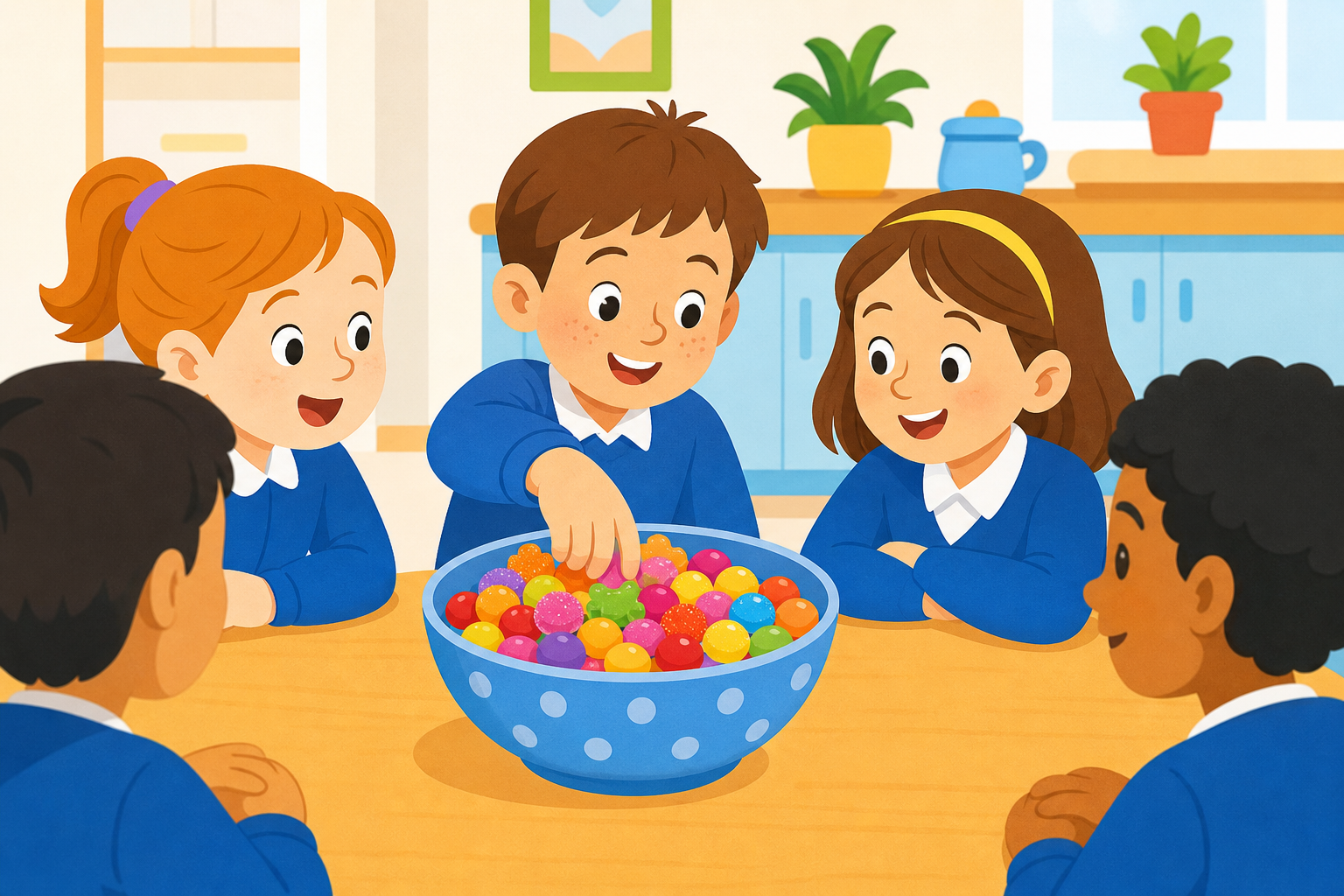
Twenty-four sweets, four children, and everyone wants a fair share. How many sweets does each child get? And here is the trickier question: which times-table fact could help you work it out in your head?
Take three hands-up answers, not open call-outs. Give five seconds of quiet think-time first.
Listen for pupils who already reach for 4 × 6 = 24 — flag that idea as one you'll come back to, but don't confirm the answer yet.
The interactive shows the same 24 counters divided by 4 in two different ways, then links it to a times fact. Look at how the counters are arranged in each display, and keep an eye on the answer.
First: 24 shared between 4. Counters dealt one at a time round the circles; each circle ends on 6, none left over. Stress we knew the number of groups and found how many in each. 24 ÷ 4 = 6.
Second: keep the same 24 shared between 4 on the board. Ask how many groups of four the counters would make. Talk it through to six groups, none left over. Here we knew the group size and found how many groups. Same answer, same 24 counters, different question that's the point.
The link, the take-away: 4 groups of 6 make 24, so 4 × 6 = 24. Point to the four full groups: if 4 sixes make 24, then 24 shared into 4 gives 6. The times table you know answers the division.
Pause the class on each before moving on.
Now we work through four divisions on the board, one at a time. A pupil deals the counters into equal groups for the first share, we agree the answer, then the board moves on to the next share. The four we will do are: 15 into 3 groups, then 24 into 4 groups, then 35 into 5 groups, and finally 48 into 6 groups. Each time, once the groups are full, we say the matching times-table fact aloud before we agree the answer. While a classmate is dealing at the board, give a thumbs up when you agree the groups are equal.
This round is for talking it through together — pupils take turns at the board and the class agrees or corrects out loud. Rotate four pupils, one per division.
Keep every pupil with each share, not just the last. Use one quick lever on all four:
After each share, insist the class states the matching multiplication (3 × 5 = 15, etc.) — that verbal link is the point of the round, not the counting.
In your maths copy, write 36 ÷ 6. Beside it, write the multiplication fact that matches: 6 × ☐ = 36. Then write the answer for both, so your page shows how one fact answers the other.
Walk the room, glance for the paired sentences lined up beside each other — no individual marking, this is whole-class copybook practice.
Watch for pupils who fill in the box but forget to write the division answer too — both should read 6.
Now we practise on fresh numbers. We work through these shares together, one at a time: 18 into 2 groups, then 28 into 4 groups, then 40 into 5 groups, and finally 54 into 6 groups. Deal the counters, check the answer, and say the matching times fact for each one.
These are the practice questions — pupils take turns at the board, check each answer, and the class confirms before moving on. Keep the board work brisk rather than over-explaining.
Each Check confirms the share is even; use the ✓ as part of your narration (yes — that's it, and the fact is 5 × 8 = 40).
These all divide evenly on purpose — remainders come in the next lesson, so keep the focus on the sharing-grouping-times-fact link, not on leftovers.
You're previewing this lesson. Get full access to this lesson and hundreds more — each one ready to teach, with interactive activities, printable resources and pupil progress tracking built in.