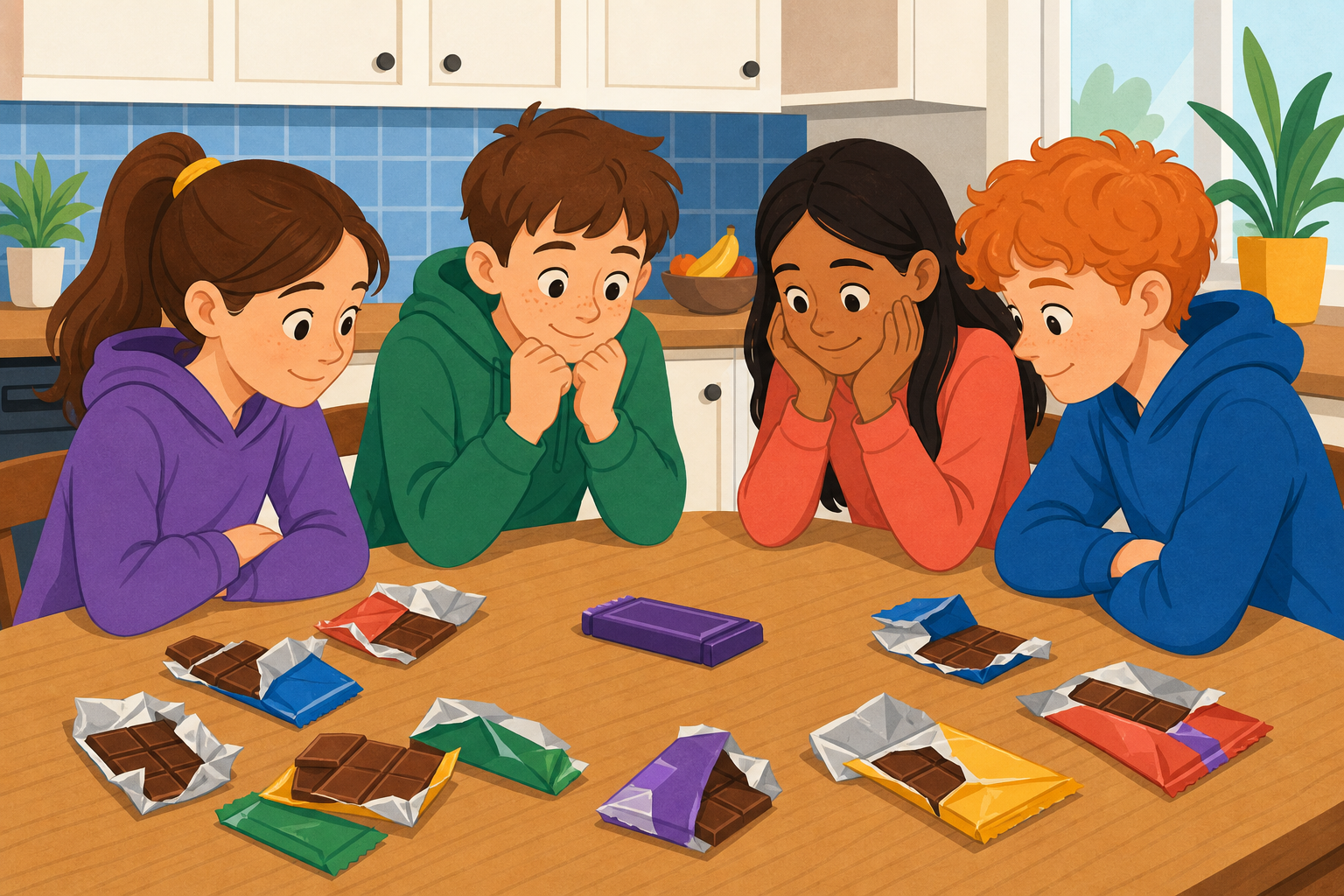
Here is a sharing problem with a twist. Four friends want to share 9 chocolate bars completely fairly, with nothing thrown away and nobody left short. Each friend gets 2 whole bars, but that leaves 1 bar over. What do you think happens to the last bar?
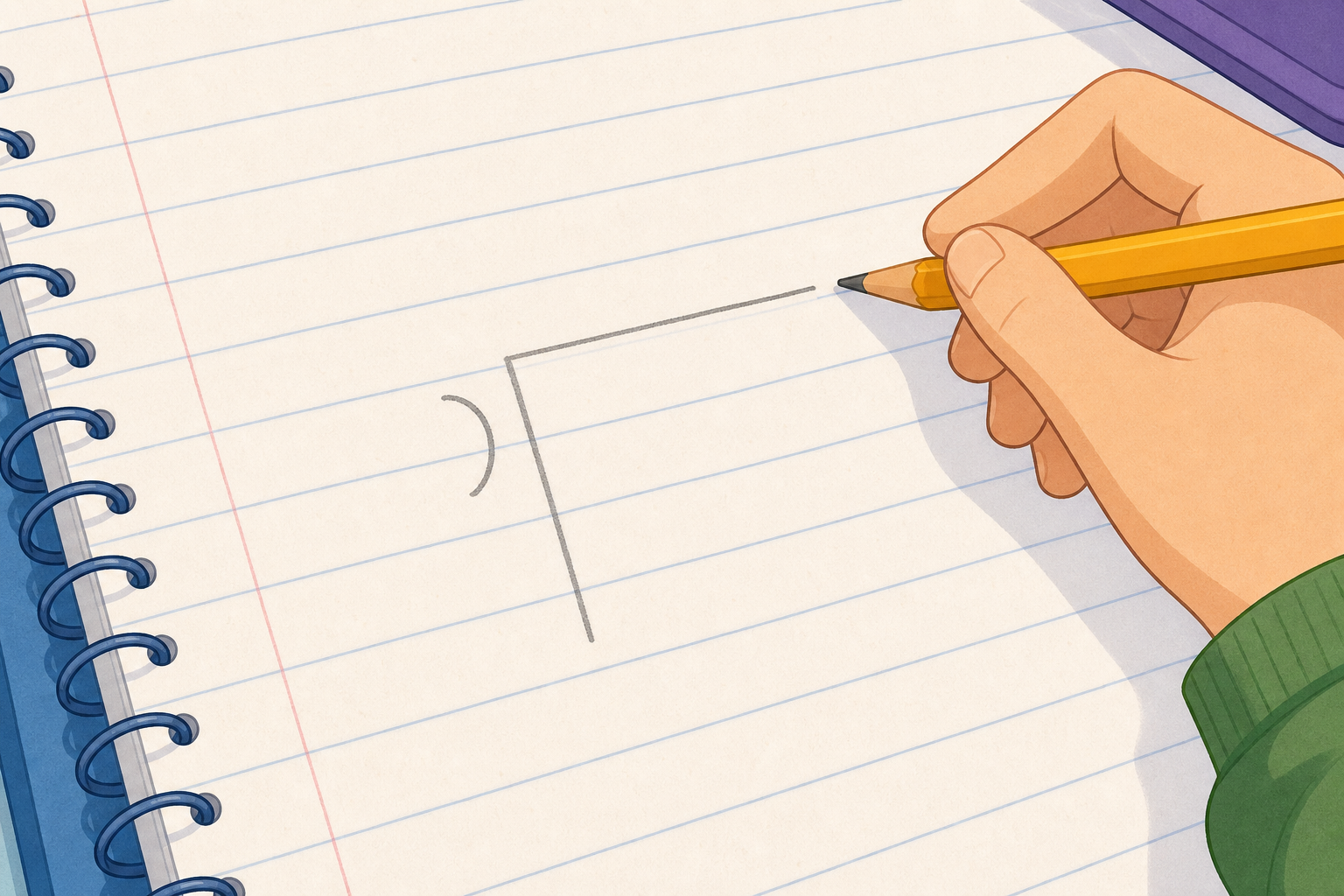
Take two or three hands-up answers. Listen for the idea of breaking the last bar up rather than leaving it whole. Do not resolve it yet — the point of the lesson is that the leftover 1 becomes tenths.
Each display shows counters already shared into equal groups. When a whole was left over it has been broken into tenths, then hundredths. Notice where the counters broke, and where the decimal point sits in each answer.
9 ÷ 4: 2 wholes each, 1 over. Break into 10 tenths, share 2 each, uses 8, 2 tenths over. Those become 20 hundredths, 5 each. Answer 2.25. Dwell on both breaks, hundredths step is the whole idea, do not skip it.
Bracket: 9 has no point of its own. The moment you cross from wholes into tenths, write the decimal point in the answer yourself, then 2 tenths, 5 hundredths. Say plainly that we put the point in when sharing starts on the tenths.
7 ÷ 4: before revealing, ask how many wholes each and how big the leftover, and pause. Then: 1 whole each, 3 over. 3 wholes make 30 tenths, 7 each uses 28, 2 tenths over. 20 hundredths, 5 each. 1 + 0.7 + 0.05 = 1.75.
5 ÷ 8: the key one, not enough wholes for one each. Write 0 and the point straight away. 5 wholes become 50 tenths, 6 each, 2 over. 20 hundredths, 2 each, 4 over. 40 thousandths, 5 each, none left. Answer 0.625.
Today we work through these divisions together on the board, each a little harder than the last: 13 ÷ 5, then 3 ÷ 4, then 9 ÷ 8. For each one we deal the whole counters first, then break every leftover into tenths and keep sharing, breaking again into hundredths and thousandths if any tenths are still left. Predict where the decimal point will land before we check.
This round is for talking it through together — pupils take turns at the board and the class agrees or corrects out loud.
Set the interactive to explore mode with decimal remainder on. The config pre-loads the first division (dividend 13, groupCount 5). For the next two, reconfigure the interactive on the board: set dividend 3, groupCount 4 for 3 ÷ 4, then dividend 9, groupCount 8 for 9 ÷ 8. For each division, ask a pupil to deal the whole counters, then break the leftover to expose the tenths and continue.
Have pupils say the answer aloud each time, pointing to where the decimal point sits above the bracket.
In your maths copy, set up each of these divisions using the bus-stop bracket. Break the remainder into tenths when you need to, and write the decimal answer above the bracket with the point lined up. Remember: the number inside the bracket has no point of its own — you add the point in the answer when you start sharing tenths.
Check each answer stops neatly — nothing thrown away.
Walk the room glancing at where each pupil places the decimal point above the bracket — this is whole-class copybook practice, not marking. A common slip is forgetting to write a zero above the bracket when the first digit shares to zero (as in 3 ÷ 8).
Today we work through these together, each one a step harder: 8 ÷ 5, then 9 ÷ 6, then 7 ÷ 8, then 11 ÷ 4. Deal the wholes, break every leftover into tenths, and read off the decimal answer. Predict how many decimal places each one will need before we check.
These are the practice questions — pupils take turns at the board, check each answer, and the class confirms before moving on. Keep the board work brisk rather than over-explaining.
The class predicts before each Check; use the ✓ as part of the narration — 'yes, that's it.'
You're previewing this lesson. Get full access to this lesson and hundreds more — each one ready to teach, with interactive activities, printable resources and pupil progress tracking built in.