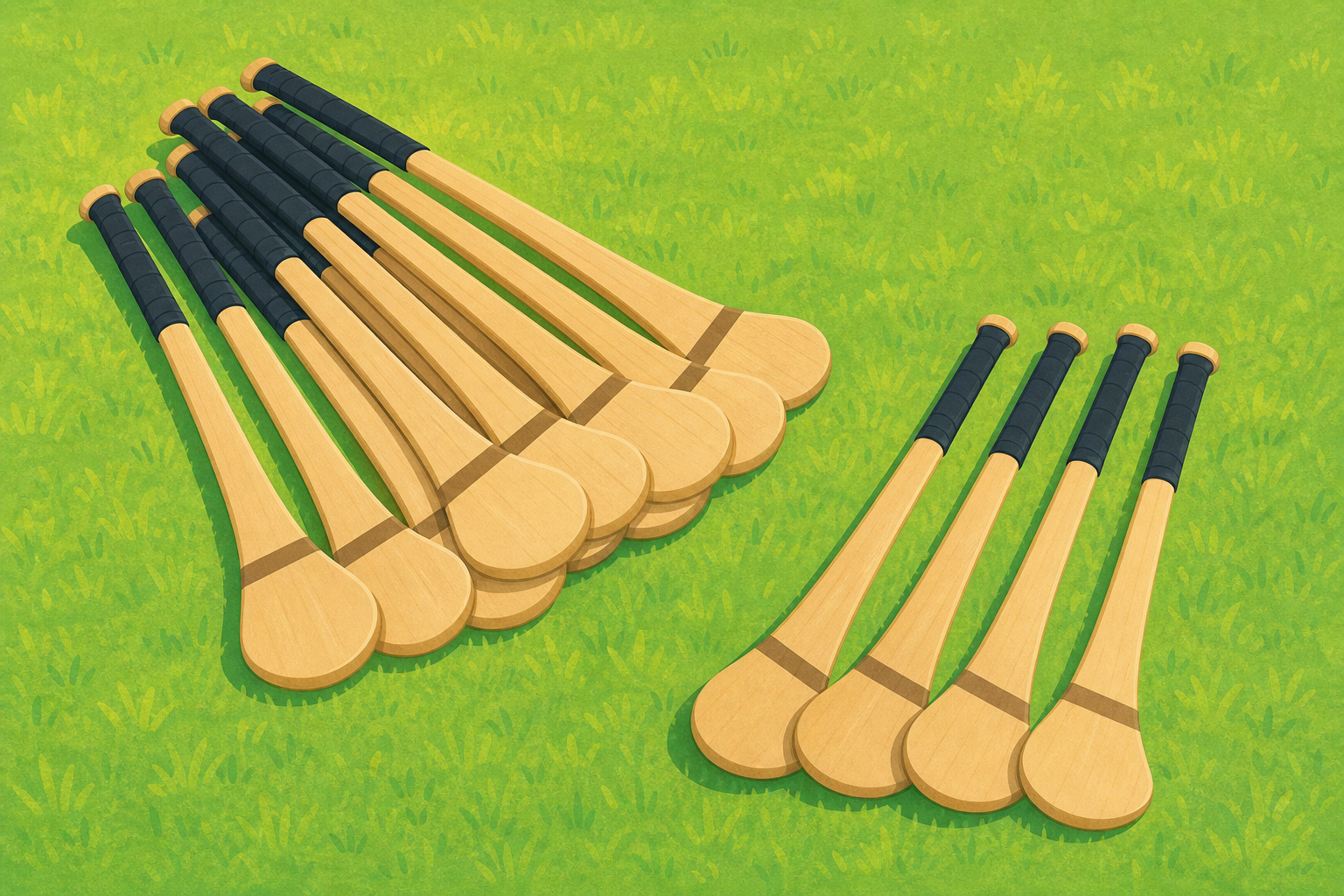
Picture this: your team has 13 hurleys to share out between 4 players so everyone has the same number. How many hurleys does each player get? And here is the tricky part: is there anything left over?
Hands up: what do we call the bit that is left over after we have shared as fairly as we can?
Take three hands-up answers, not open call-outs. Let a pupil share 13 into 4 out loud if they want to. Introduce the word remainder for the leftover only after pupils have noticed there is a bit that will not share.
The interactive deals counters into equal groups, one round at a time. Watch how many land in each group and how many are left over. That leftover is the remainder.
13 into 4: name nearest multiple below first (12), then the leftover. Three each, one left over, 3 remainder 1. Point to the single counter.
23 into 5: pause before the reveal, ask how many in each group and how many left over. Four each, three left over, 4 remainder 3.
29 into 6: the key one, big remainder. Predict first. Four each, five left over, 4 remainder 5. Ask could the remainder ever be 6 here? Draw out that a sixth group could still be filled, so the leftover stays smaller than 6.
30 into 4: ask what each group holds. Seven each, two left over, 7 remainder 2. Leftover 2 is smaller than 4.
Today we work through these four divisions one after another at the board, dealing the counters into equal groups and reading off the leftover each time: 14 ÷ 3, then 22 ÷ 4, then 26 ÷ 6, then 40 ÷ 7. Each one leaves something over, and we will say the remainder aloud and check it is smaller than the number of groups before we move on to the next one.
This round is for talking it through together — pupils take turns at the board and the class agrees or corrects out loud. The four divisions run one after another in the interactive activity, so move to the next challenge once the class confirms each answer.
For each division: an individual pupil deals the counters into the group circles, reads how many landed in each group (the quotient) and how many are left over (the remainder). Have the class say each answer as 'quotient remainder' together — e.g. 'four remainder two'. After each one ask 'is the leftover smaller than the number of groups?' and get a thumbs-up. 26 ÷ 6 is the wrinkle: the remainder is 2, but pupils often stop dealing too early — watch for a group that could still take one more.
In your maths copy, work these two divisions and write each answer as “□ remainder □”:
When you have both, check each remainder is smaller than the number you divided by.
Walk the room glancing at how pupils write the leftover and whether they checked the remainder against the divisor. This is whole-class copybook practice, not marking — no individual correction, just a quick look for the “remainder smaller than divisor” check.
Today we solve these remainder problems from real life, one step harder each time: 11 buns shared among 3 friends, then 22 sweets shared among 5 friends, then 34 cones packed into 6 bags, then 50 children put into 8 teams. For each one, deal the counters into equal groups, read off the quotient and the remainder, and then say what the leftover actually means in the story.
These are the practice questions — pupils take turns at the board, deal the counters, and the class confirms the quotient and remainder before moving on. Keep the board work brisk rather than over-explaining. The interactive activity shows both the number in each group and the leftover, so pupils can read the whole answer off the screen.
After the interactive activity confirms the answer, ask the class for each: what does the remainder mean here? — 2 buns nobody gets, 2 sweets left in the packet, 4 cones that do not fill a bag, 2 children with no full team. Draw out that the remainder is always smaller than the divisor because otherwise another whole group could be made.
One steer for pupils: the interactive always builds the divisor number of groups and shows how many in each (the sharing model). For the packing and teams stories that means the board shows the other way round (6 groups of 5 for the cones, 8 groups of 6 for the children). The number in each group is still the quotient you want (how many full bags or teams), and the leftover is what cannot make another full group. Use the numbers on screen, then talk through what the remainder means in each story.
You're previewing this lesson. Get full access to this lesson and hundreds more — each one ready to teach, with interactive activities, printable resources and pupil progress tracking built in.