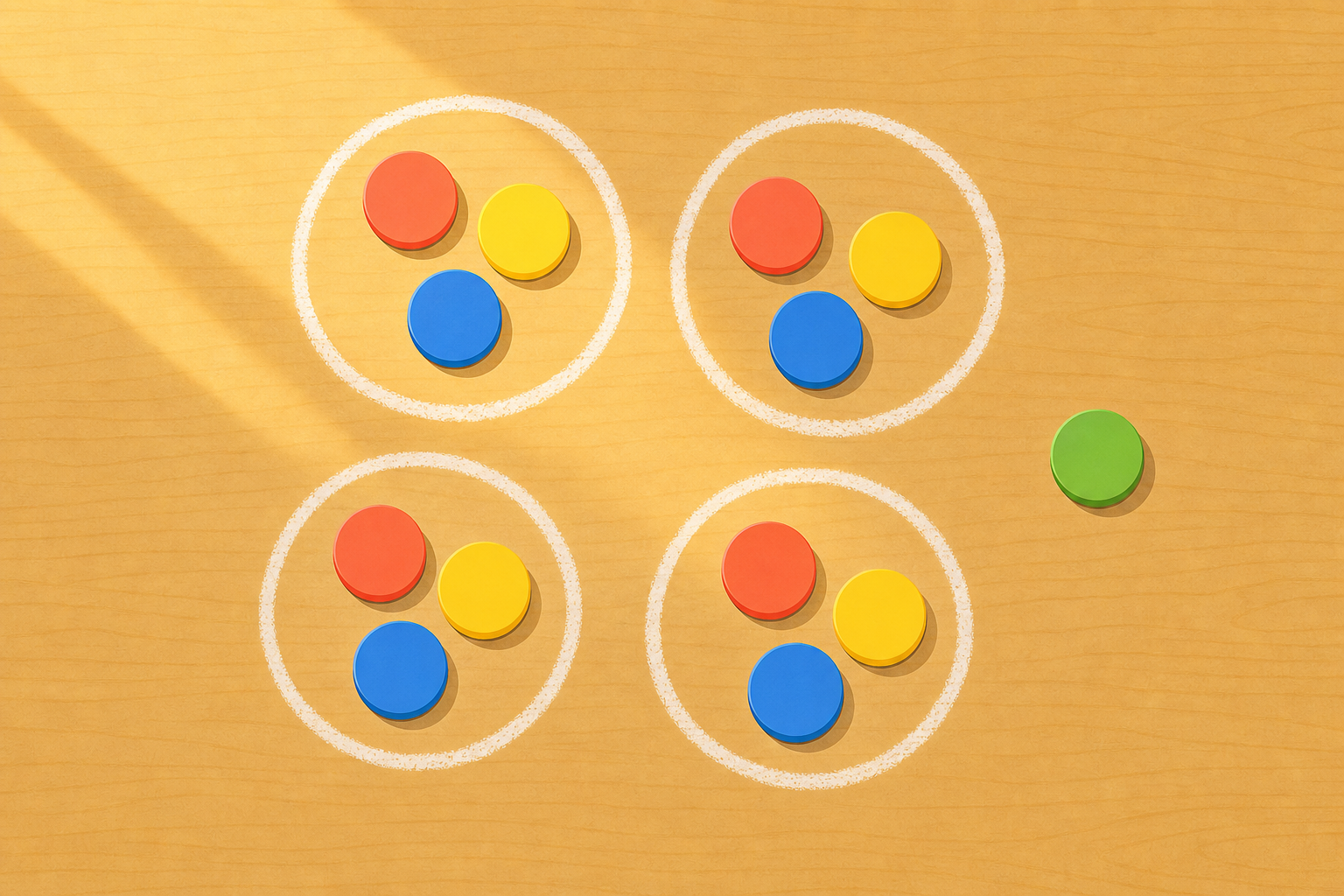
Here's a sharing puzzle for us. Imagine we have 13 counters and four friends want to share them out fairly, one each, round and round the table.
Share them out fairly. How many does each friend get, and is anything left on the table? Why can we not keep sharing it out?
Show the picture of the 13-counter pile and the four groups as you pose the puzzle, so pupils see the share rather than picture it cold. Give five seconds of quiet think-time before any hands go up, then take two or three answers. Do not confirm yet — the whole lesson names that leftover as the remainder. If a pupil says "cut the last one in four", acknowledge it and park it: "today we keep whole counters, so it has to stay left over."
Look at the counters shared into the groups. Notice how many each group gets and how many are left over. That leftover is the remainder.
Take one at a time; class reads each result as "… each, remainder …" before you move on.
13 ÷ 4: three each, remainder 1. Point to the single leftover, ask "can everyone get another one?" Four groups need four to go round again; we have one.
17 ÷ 5: predict first, take two guesses, then deal. Three each, remainder 2.
22 ÷ 3: seven each, remainder 1. A big starting pile can still leave a tiny remainder.
20 ÷ 5: the key one. Four each, remainder 0 — shared out perfectly.
Keep repeating the check: the leftover is always fewer than the number of groups.
Before the last round is dealt, everyone predicts how many each group gets and how many will be left over. Then we all read the answer aloud together as "… each, remainder …" and check the leftover is smaller than the number of groups before we move on to the next share.
Today we work through these together on the board: 19 ÷ 4, then 15 ÷ 3, then 21 ÷ 5. One of us comes up and deals the counters round the groups one at a time, and stops when there are too few left to go round again.
This round is for talking it through together — pupils take turns at the board and the class agrees or corrects out loud.
Run the interactive in explore mode. It shows one share at a time, so re-set and re-key the numbers between each of the three shares: start on 19 ÷ 4, then reset to 15 ÷ 3, then reset to 21 ÷ 5. Call a fresh pupil up for each share; the rest of the class predicts the answer before the last round is dealt.
Between each share, keep the watching class with you: take two hands-up predictions, or turn-and-name a pupil to say the expected remainder before you reveal. Watch for the pupil who tries to keep dealing when only 2 counters are left across 4 groups — pause them and ask the class "can we give one to every group?"
In your maths copy, work out these two shares by drawing dots and sharing them into groups. Ring the leftover, and write each answer as "… each, remainder …".
Draw the groups, deal your dots round them one at a time, then check: is your leftover smaller than the number of groups?
Walk the room glancing for the ringed leftover and the "… each, remainder …" wording — this is whole-class copybook practice, not marking. Prompt any pupil whose remainder is as big as the group size to keep sharing.
Today we work through these numbers together on the board: 11 ÷ 2, then 16 ÷ 5, then 25 ÷ 4, and finally 29 ÷ 6. Before each one is dealt, we predict how many each group gets and how many will be left over.
The last one is the trickiest — six groups and a big pile — so watch how big the remainder can get.
These are the practice questions — pupils take turns at the board, check each answer, and the class confirms before moving on. Keep the board work brisk rather than over-explaining.
Each time, use the Check button so the class sees the ✓, then have them read the answer aloud. Keep repeating the rule: the remainder is always smaller than the number of groups.
You're previewing this lesson. Get full access to this lesson and hundreds more — each one ready to teach, with interactive activities, printable resources and pupil progress tracking built in.
