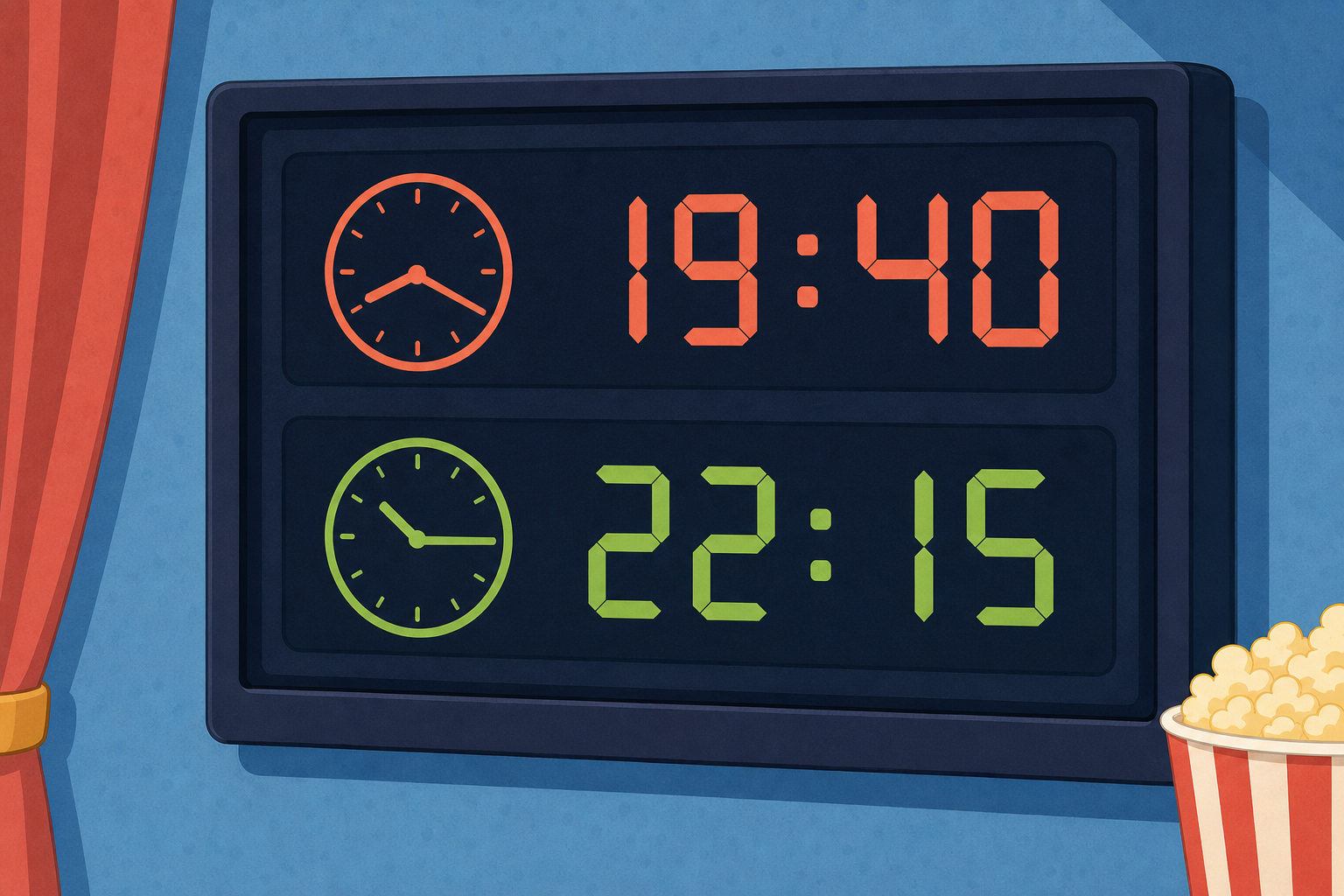
A film starts at 19:40 and ends at 22:15. How long is the film?
Some people try to just subtract the digits and get muddled when the minutes seem to go backwards. Before we work it out together, have a think: why can't we simply subtract 19:40 from 22:15 the way we subtract ordinary numbers? It is completely fine not to know yet, we will figure this out together in a moment.
Display the two times side by side and take three hands-up answers, not open call-outs. Give five seconds of quiet think-time first.
Listen for the trap: a pupil who says '22 take 19 is 3, 15 take 40 is...' has hit the borrowing problem that makes counting-up the better method. Do not resolve it yet, that is the job of the next step. Just surface the puzzle.
Watch the two clocks and the hops drawn beneath them. We count up in three hops: 20 minutes to reach 20:00, then 2 whole hours to 22:00, then 15 minutes on to 22:15. Add the hops: 20 min + 2 h + 15 min = 2 h 35 min.
This time the hops are: 5 minutes to 09:00, then 4 whole hours to 13:00, then 10 minutes on to 13:10. What total do the hops give us?
This finish time is the next morning, so the hops land on midnight first. Watch how they stop at 00:00, then carry on into the new day. The duration keeps adding forward right across midnight.
This journey is longer than a single day, so the clock face cannot hold it all. We count it on paper instead. Monday to Tuesday is one whole day, which is 24 hours. Tuesday to Wednesday is another whole day, another 24 hours. That is 24 + 24 = 48 hours so far, landing us at 09:00 on Wednesday. From 09:00 to 14:00 on Wednesday is 5 more hours. So the whole span is 48 + 5 = 53 hours.
Now watch the other way round. A train leaves at 14:20 and the journey takes 2 h 45 min. We count that duration up onto the clock to find the arrival: 40 min to 15:00, then 2 hours to 17:00, then 5 minutes on to 17:05. So the train arrives at 17:05. Same hops, but this time we add the duration to a start time to land on the finish.
Walk each example aloud, one at a time, naming each hop from the board text as you go.
Today we work through a fresh journey together: a train leaves at 14:20 and the journey takes 2 h 45 min. Before we touch the clock, let's predict each hop aloud: first the jump to the next whole hour, then the whole hours, then the last minutes. Then a pupil sets the arrival on the clock and we press Check to see if the hands are right and the hops match what we predicted.
This round is for talking it through together. A pupil comes to the board, but the class predicts first and the answer stays hidden until Check is pressed.
Before anyone touches the hands, ask one pupil to predict the first hop (40 min to 15:00), a second to predict the whole hours (2 hours to 17:00), a third to predict the last minutes (5 min to 17:05). Then the pupil at the board sets the arrival hands to 17:05 and presses Check; the class confirms the revealed hops match the predictions. Total 2 h 45 min.
Watch for the pupil who tries to do 17 − 14 = 3 and stalls on the minutes — revoice the counting-up route as the reliable one.
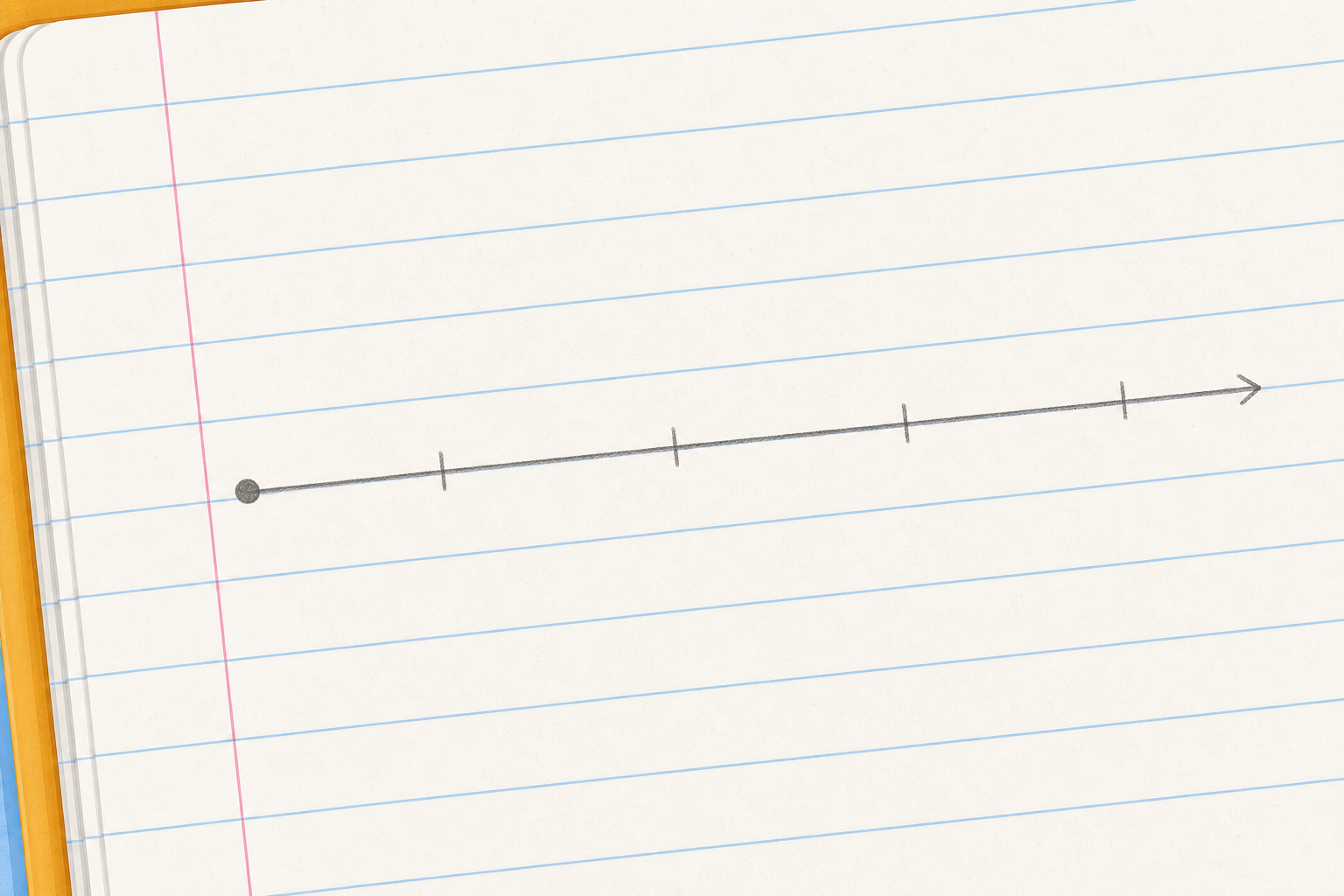
In your maths copy, for each elapsed-time example draw a short bridging number line. Mark the start time, then write each hop you counted along it (for example: 20 min, then 2 h, then 15 min). Record the total beside it.
Do this for these three journeys:
Walk the room glancing for the order of the hops, to the next whole hour first, then whole hours, then the last minutes. This is whole-class copybook practice, not marking. A pupil who has skipped the hop to the next whole hour is the one to catch.
Today we work through these journeys: each one gives a start time and how long the journey takes, and you set the arrival clock by counting the duration up onto the hands, just like the train example we set together. The elapsed readout will confirm the duration once you've set the hands.
The last one crosses midnight, so remember to stop at 00:00 first.
These are the practice questions. Pupils take turns at the board, check each answer, and the class confirms before moving on. Keep the board work brisk rather than over-explaining.
For each item, the pupil counts up the given duration from the start time and moves the hands to the arrival, exactly as modelled with the 14:20 train; the elapsed readout confirms the journey length. The class predicts the arrival aloud before the pupil sets the hands.
The last item crosses midnight. Pause here and ask the class to count to 00:00 first (1 h 20 min), then on into the new day (6 h 25 min). Revoice: 'stop at midnight, then carry on'. The two-day duration is not on the clock today; if a fast finisher asks, point them back to the board working of 09:00 Mon to 14:00 Wed = 53 hours that is still up on the board.
One pupil says you can always just subtract the start time from the finish time to find how long a journey is. Another says you have to count up in hops. Who is right, and how would you settle the argument?
Listen for pupils naming the borrowing problem as the reason subtracting the digits goes wrong (the minutes seem to go backwards). Revoice a strong answer as 'counting up never makes you borrow, so it never trips you up'.
Steer them to a settling test: try both methods on 19:40 to 22:15 and see which gives 2 h 35 min cleanly. Head off the misconception that the landing time is the same as the duration when you cross midnight.
Next we read real timetables and schedules, and we start to think about time zones, what time it is in New York or Sydney when it is afternoon here in Ireland.
Keep this brisk. Recap the three hops once more and the midnight waypoint before moving on.
You're previewing this lesson. Get full access to this lesson and hundreds more — each one ready to teach, with interactive activities, printable resources and pupil progress tracking built in.