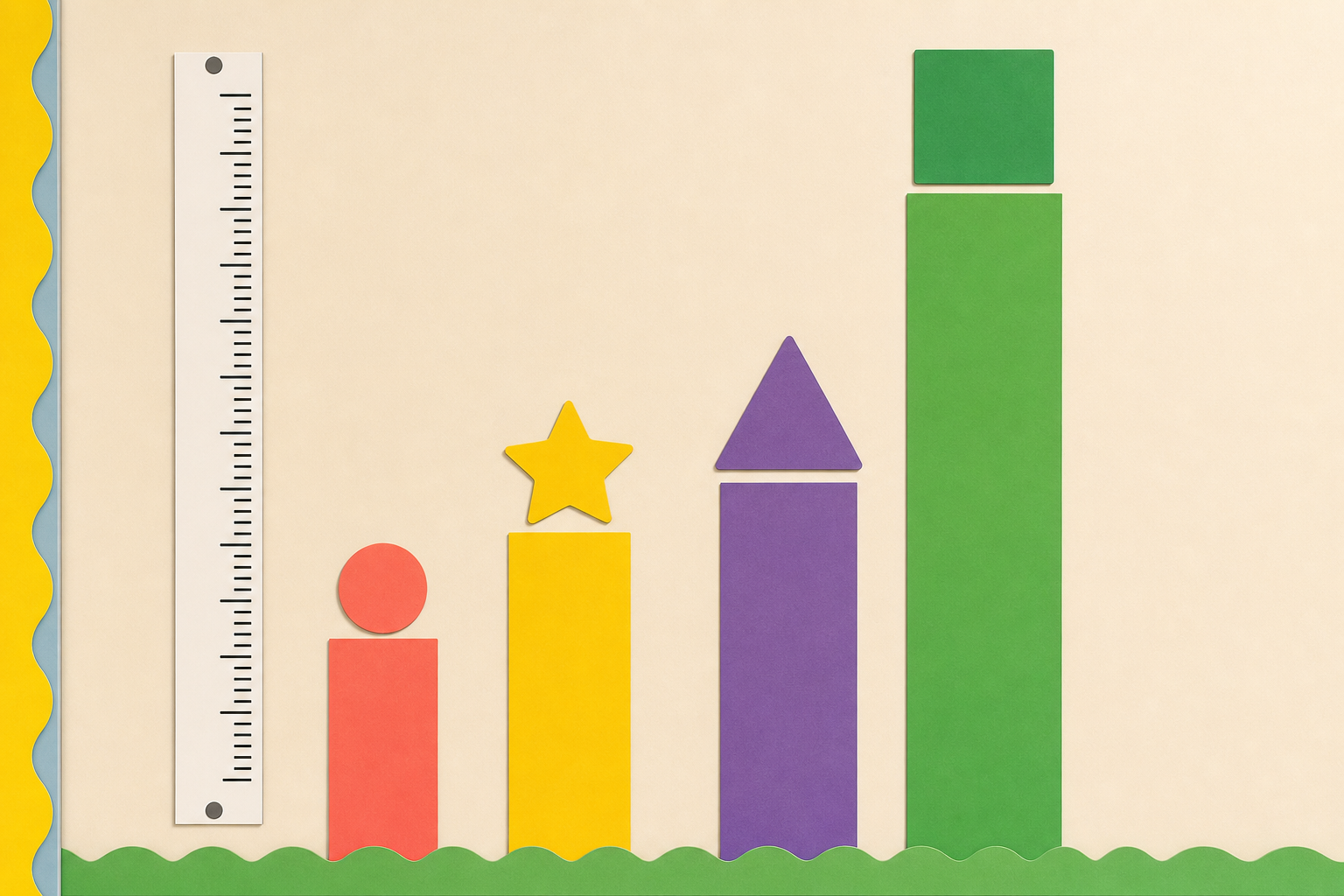
Think back over your maths this year. When a whole class picks a favourite sport, one sport always gets chosen more than the rest. In maths that most-chosen one has a special name — the mode. If you drew a bar chart of favourite sports, how would you spot the mode straight away?
Take three hands-up answers, not open call-outs. Draw out the word mode from a pupil if you can rather than supplying it yourself. The fresh chart to work on comes up on screen in the next step.
Here is a favourite-sports chart to read together. Read the tallest bar, then the shortest. Then we will work out how many more chose the top sport than the bottom one, and finally which sport is the mode. Watch how we trace each bar across to the scale rather than guessing by height.
Point to the football bar and trace across to the scale; do the same for camogie. Ask for the difference before you say it. The mode is the category, football, not the number 12 — head off pupils who name the count. Revoice a strong answer: so the mode is the sport most people picked, not how many picked it.
Now we hunt for missing numbers on the balance. A letter can stand for the missing number just like a box does — so b means the same thing as □. We will work through □ + 5 = 11, then b − 4 = 6, then □ + 8 = 14. Look carefully at the take-away one: on b − 4 = 6 the letter is the amount we start with, before we take any away. So the start must be bigger than the 6 we are left with. Predict how much bigger, then slide the beam to check. Watch the beam: it only hangs level when both sides weigh the same.
This is the practice round — pupils take turns at the board and the class agrees or corrects out loud.
For each sentence, ask is the box a part or the whole here? before anyone slides the unknown. On the take-away sentence, watch for pupils who guess a small number — the beam will not level, so let them see it tip and try again. Do not name the answer for them; the whole point is that they predict and check. Revoice: the beam only levels when both sides are worth the same.
In your maths copy, write the mode from this small tally: Football lllll, Hurling lll, Camogie ll. Then solve □ + 7 = 12 and write the missing number in the box.
Walk the room glancing at whether pupils wrote the sport name (Football) as the mode, not the count. No individual marking — this is whole-class copybook practice, not assessment.
Now three fresh puzzles on the board. Each one is a small step harder. First we find a missing number: □ + 6 = 15. Next comes a take-away one with a letter: b − 3 = 9. Last comes a fact family. A fact family is the same three numbers making one add sentence and one take-away sentence. If we know that 6 + 7 = 13, then the same three numbers also make 13 − 6 = □. Work out what belongs in the box from the add sentence, predict the value, then level the beam to check each time.
This is the practice round — pupils take turns at the board, check each answer, and the class confirms before moving on. Keep the board work brisk rather than over-explaining.
Name which strand each one tests: the first two are missing-number sentences, the last is a fact family. On the take-away sentence, hold out for the larger start value — let a wrong guess tip the beam rather than correcting it verbally, then point pupils back to the take-away build from the previous step. Let pupils predict before each Check.
You're previewing this lesson. Get full access to this lesson and hundreds more — each one ready to teach, with interactive activities, printable resources and pupil progress tracking built in.