1 - Getting Started ~5 mins
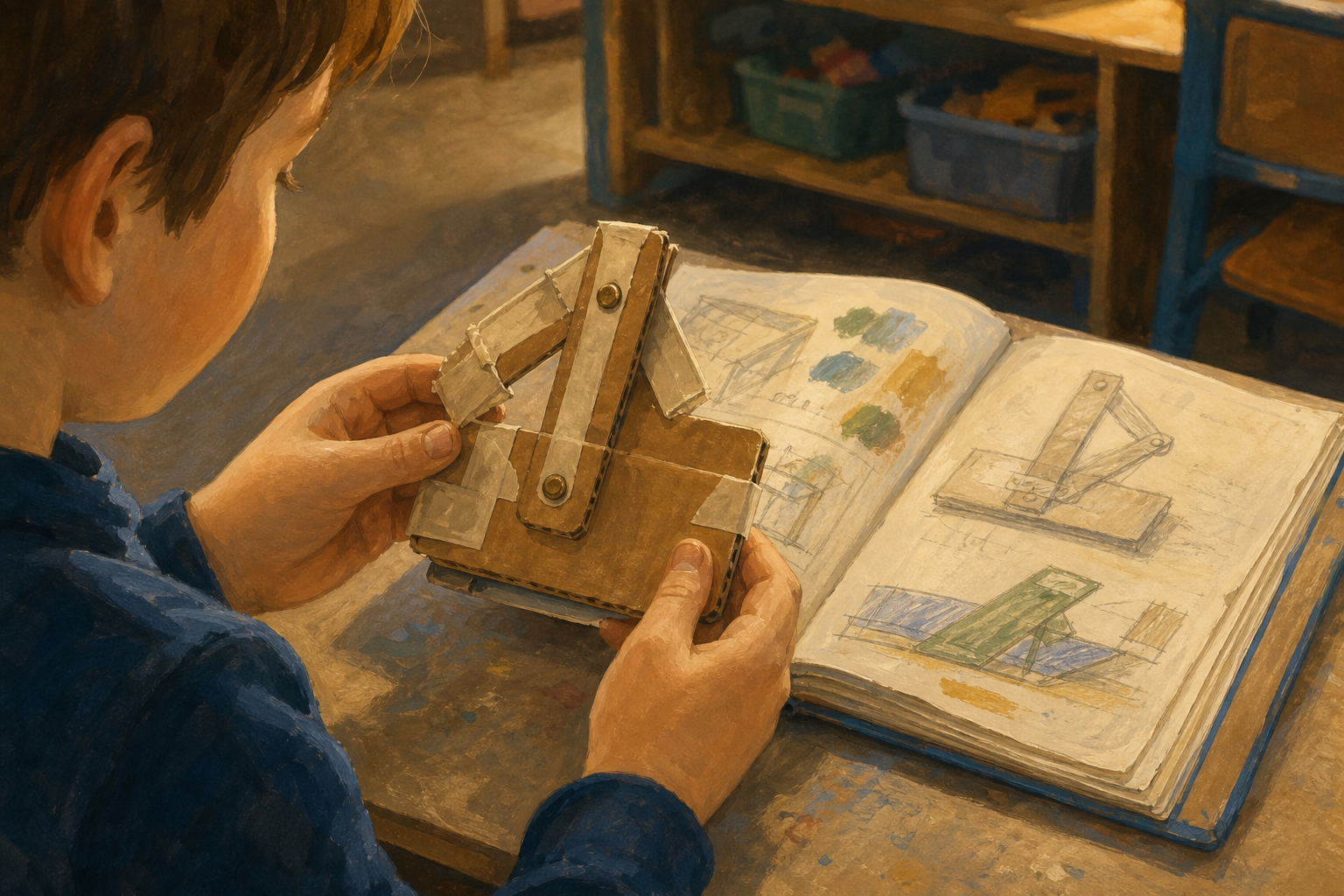 All year you have wondered, tested, built and fixed. Today you are the engineer of the year. Think of one build or investigation you are proud of. What was it? What did it have to do?
Real engineers finish a project by sharing it and asking: what worked, and what would we change next time?
Keep this light and celebratory. Have the year's prototypes and journals out on tables so pupils can pick one to talk about.
Ask a couple of pupils to name aloud what their build or investigation had to do for its user. Do not explain the showcase yet, just spark the memory.
2 - What Makes a Good Showcase ~6 mins
Engineers use three big ideas when they share their work. Let's learn them.
| Concept | Why it matters | Example |
|---|---|---|
| Iteration — making a change to your design, testing it, then improving it again | Almost no design works perfectly first time, so the changes you made are the best part of the story | A group's paper bridge sagged, so they folded the card to make it stiffer and it held more weights |
| Showcase — sharing your work and explaining the choices you made | A good build is only useful if you can explain how it helps its user | Explaining why you chose foil to keep a sandwich dry instead of paper |
| Reflection — looking back to work out what went well and what to change next | It helps you and your listeners learn, just like real engineers do after a project | Saying "our slider worked, but next time we would make the card thicker" |
This table is pupil-facing, on the IWB. Read each row with the class and point to a real prototype on a table as an example of each idea.
Head off the common miss: pupils tend to describe only the finished object. Stress that the iteration — the moment it did not work and how they fixed it — is the most interesting part to share.
The next step reveals the four parts of the showcase itself, so keep this step to the three big ideas only. Do not merge the two lists.
3 - The Four Parts of Your Showcase ~4 mins
Now here are the four parts every showcase should cover. Keep this list in your head when you plan yours.
- The user and the problem — who you designed for and what they needed
- What you made — your build or investigation
- One change you made — what you fixed when it did not work first time
- One thing you would change next — how you would make it even better
This is the checklist pupils will follow. Read the four parts aloud and point back to the table in the previous step so pupils see that iteration lives inside part 3 and reflection lives inside part 4.
Say clearly: three big ideas, four parts to say aloud. Ask a pupil to repeat the four parts back so everyone holds the same list.
4 - Model the Showcase ~7 mins
Watch how a showcase sounds. Let's walk through one together using the four parts, so you know what yours should include.
Model the full showcase yourself with one real prototype from the room, thinking aloud through every beat so pupils have the whole shape before they plan their own. Say each part out loud:
- The user and problem: "Our buddy in the younger class kept losing their pencils, so we needed something to hold them on the desk."
- What we made: "We made a cardboard pencil holder with three tubes."
- A change we made: "The tubes fell over when it was empty, so we made a wider base and it stood up."
- What we would change next: "Next time we would use stronger card so it lasts longer."
Then invite the class to spot the four parts in what you said. Keep it to one worked example so every pupil sees the pattern before planning.
5 - Plan Your Showcase ~14 mins
Your teacher is giving each group a reflection page now. In your group, pick one build or investigation from the year. On the reflection page, plan the four parts of your showcase: the user and problem, what you made, one change you made, and one thing you would change next.
Decide who will say each part so everyone in the group speaks.
Hand out the printed ReflectionSheet page to each group now, and give groups their prototypes and journals from the year. Circulate and prompt the reflective beat: "What did you have to fix? What did the feedback change?"
Differentiation: less-confident groups tell their four parts aloud to you first, then jot key words; confident groups add why they chose their materials and what they learned about their user.
Timing note: this paper planning is part of their Investigation Journal reflection page for the year.
Unlock the full learning experience
You're previewing this lesson. Get full access to this lesson and hundreds more — each one ready to teach, with interactive activities, printable resources and pupil progress tracking built in.
This lesson is copyright of Coding Ireland 2017 - 2025. Unauthorised use, copying or distribution is not allowed.