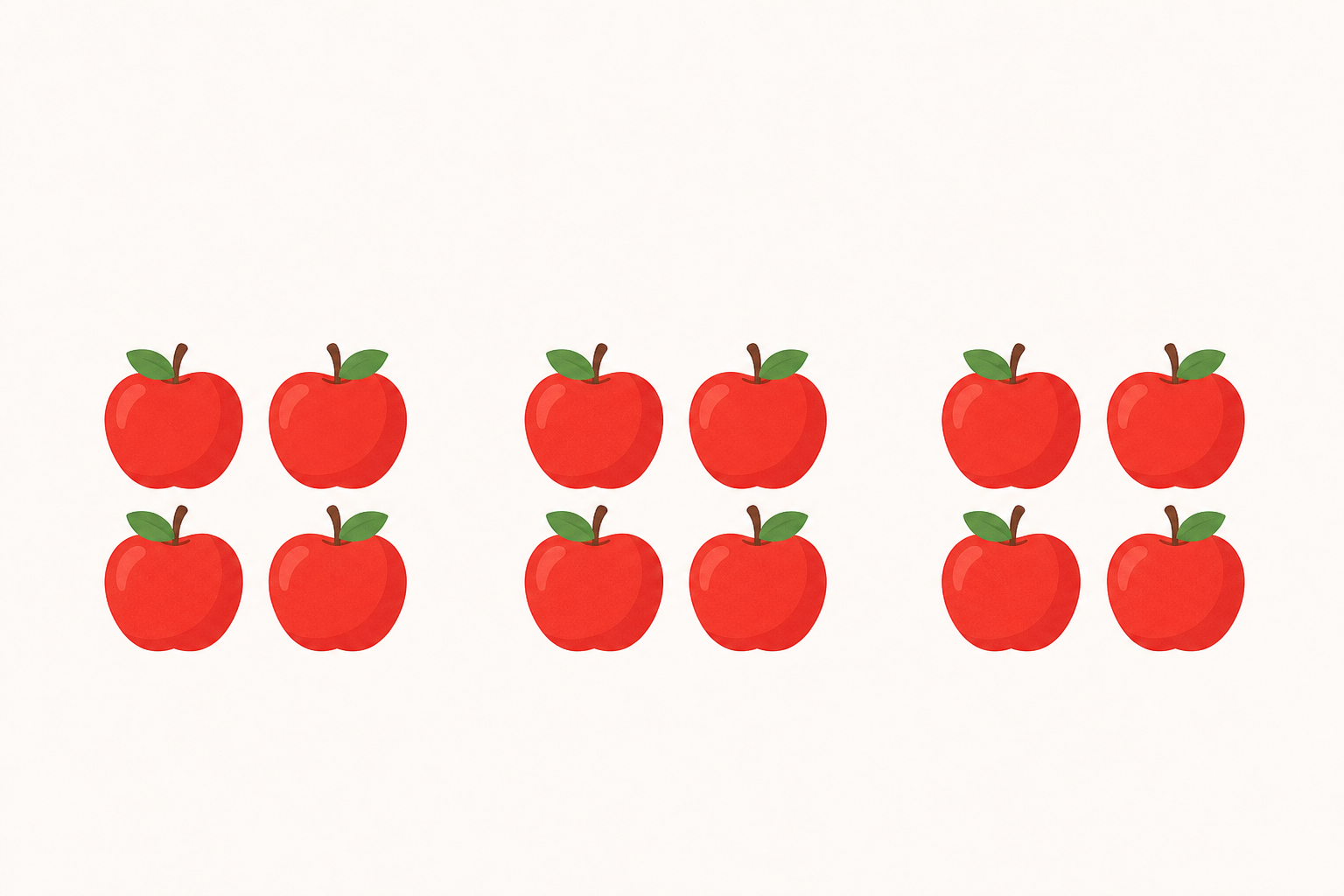
Look at this: 4 + 4 + 4. That is three lots of four.
Is there a shorter way to write three lots of four, without adding it all out one bit at a time?
Write 4 + 4 + 4 on the board and take three hands-up answers, not open call-outs. Give a few seconds of quiet think-time first. Someone will likely say "twelve" (the total) and someone may say "three fours" or "three times four" — steer toward the shorter way of writing it, not just the total.
Two pans, and each pan holds one way of writing the same amount. When both pans hold the same value, the beam hangs level.
Now the same idea again, with a different number of groups. Watch whether the beam still hangs level.
Work these live — don't read them out as a script. Point at the left pan and ask the class to count the groups aloud, then ask how many are in each group.
Both pans now show the same equal groups, so pupils see an expression balancing an expression, not a number balancing a sum. So both pans weigh the same is the phrase to keep returning to — the beam being level is the proof they match.
If the balance-scales interactive fails to load: draw two pans on the board, stack the addition as counter tallies in the left pan and the equal groups as the same tallies in the right, and rub out or add tallies until the class agrees both sides match.
Today we lay counters into equal rows and write the multiplication that matches. First we make 3 rows of 4. Then 2 rows of 6. Then 5 rows of 2. Last of all, 3 rows of 3. Each time, count the groups, count how many are in each, and say both the repeated addition and the multiplication.
Talk this one through together — pupils take turns at the board and the class agrees or corrects out loud.
A pupil lays the counters in rows under the visualiser (or drags on the IWB) while the rest of the class lays the same at their desks with their own counters. For each set: how many rows? how many in each row? what is the repeated addition? what is the multiplication?
If time is short, drop the final set (3 rows of 3) — the first three cover the idea, and set-up plus clear-down between sets eats the clock.
In your maths copy, write these two lines:
Underneath each line, write the total to show the two ways balance.
Walk the room glancing at whether pupils have the right number of groups (four threes; two sixes) — this is whole-class copybook practice, not marking. Look for anyone who writes 4 × 3 for the second line rather than 6 + 6.
This copybook entry is the lesson's non-digital artefact. There is no printable worksheet — the two lines in each pupil's own maths copy are the record of today's learning, so make sure everyone completes and keeps them. If a pupil is unsure how to begin, they may copy the board lines and then work each one out.
Today we balance the beam by finding the missing number. Work out how many equal groups are hiding in each puzzle.
First, two where the group size or number of groups is missing:
Then two where the missing part is inside the addition:
This is the practice round — pupils take turns at the board, check each answer, and the class confirms before moving on. Keep the board work brisk rather than over-explaining.
The callout to keep asking: how many equal groups are hiding in this addition? Let a pupil predict before pressing Check.
If a pupil points out that 4 × 3 would also make twelve, agree — both name the same amount — but keep the board written as three fours so the group order stays clear.
If the balance-scales interactive is unavailable: write each equation on the board, take the missing number as hands-up answers, and prove each one by counting the groups aloud with the class before moving on.
You're previewing this lesson. Get full access to this lesson and hundreds more — each one ready to teach, with interactive activities, printable resources and pupil progress tracking built in.