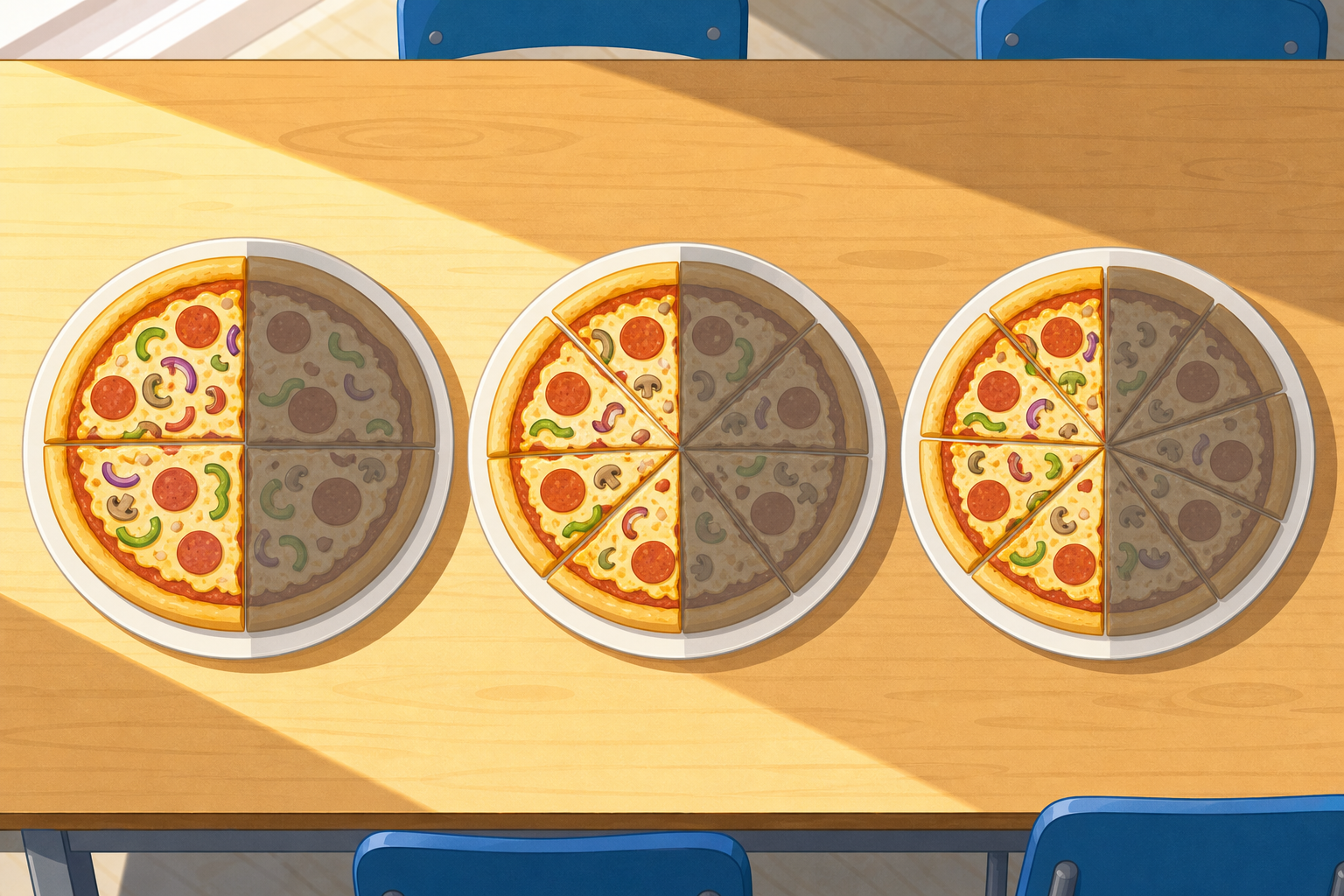
Look at these three pizzas, each showing a fraction: 2/4, 3/6 and 4/8. Are they actually the same amount of pizza, even though the numbers look so different? And if they are the same, which one is written in the simplest, tidiest way?
The fraction strips show equal fractions lined up against their simplest form. Watch where each strip reaches the same length. To simplify, we divide the top and bottom by the same number until they cannot go any smaller.
Today we explore equivalent fractions on the strips. We will build a fraction, then find another strip that reaches the same length. Try 4/8 first, then look for the simplest strip that matches it. Next we will check 9/12 the same way, naming the common factor we divide by each time.
In your maths copy, write each of these fractions and beside it write its simplest form. Between the two, write the number you divided the top and bottom by. Then circle the simplest form.
Today we work through these together on the strips: simplify 4/6, then 9/12, then 16/24. Each time, shade the fraction you are given and then shade the same amount on the simpler strip — the strips line up, so a correct simplest form comes out exactly the same length. The last one halves more than once. Then a quick oral stretch: in your head, name three different fractions that all equal 3/5, and tell us what you multiplied the top and bottom by each time.
How do you know when a fraction cannot be simplified any further? What do the top and bottom numbers have in common, or not have in common, once you reach the simplest form?
Next we will compare and order fractions that have different bottom numbers, using a common denominator to line them up fairly.
You're previewing this lesson. Get full access to this lesson and hundreds more — each one ready to teach, with interactive activities, printable resources and pupil progress tracking built in.