Mathematics
Intermediate
50 mins
Teacher/Student led
+80 XP
What you need:
IWB/Projector/Large Screen
Metre stick
Measuring jug
Weighing scales

Estimate Then Measure Around the Room and Yard

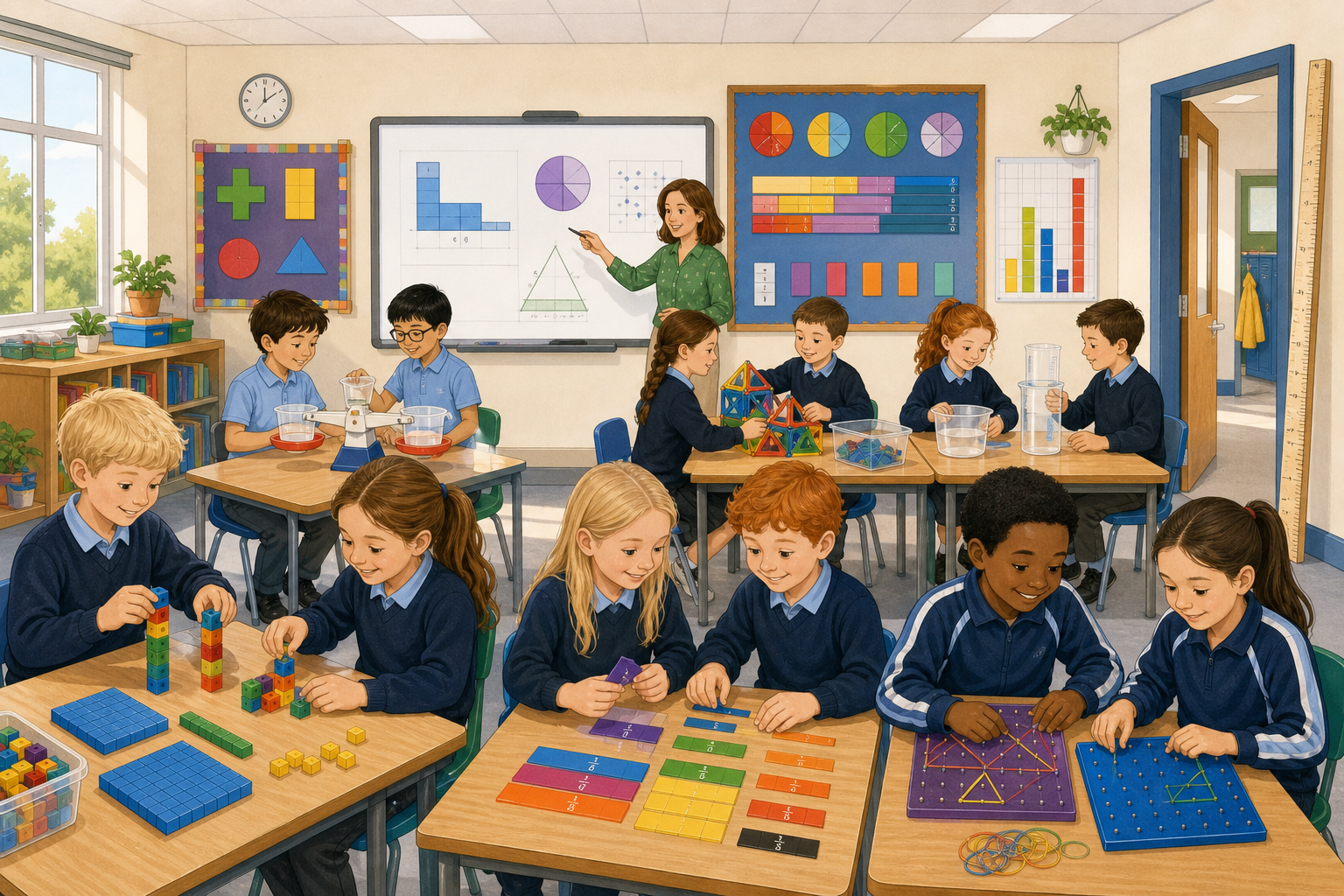
Estimate lengths, weights and capacities around the school, then measure them with the right tools and units. Record your estimates and measurements in a table to see how close you got.
Teacher Class Feed

Load previous activity

    1 - Getting Started ~4 mins

    Illustration for Getting StartedLook around the room for a second. Without touching anything, roughly how tall do you think the classroom door is? Would you count that in centimetres or in metres?
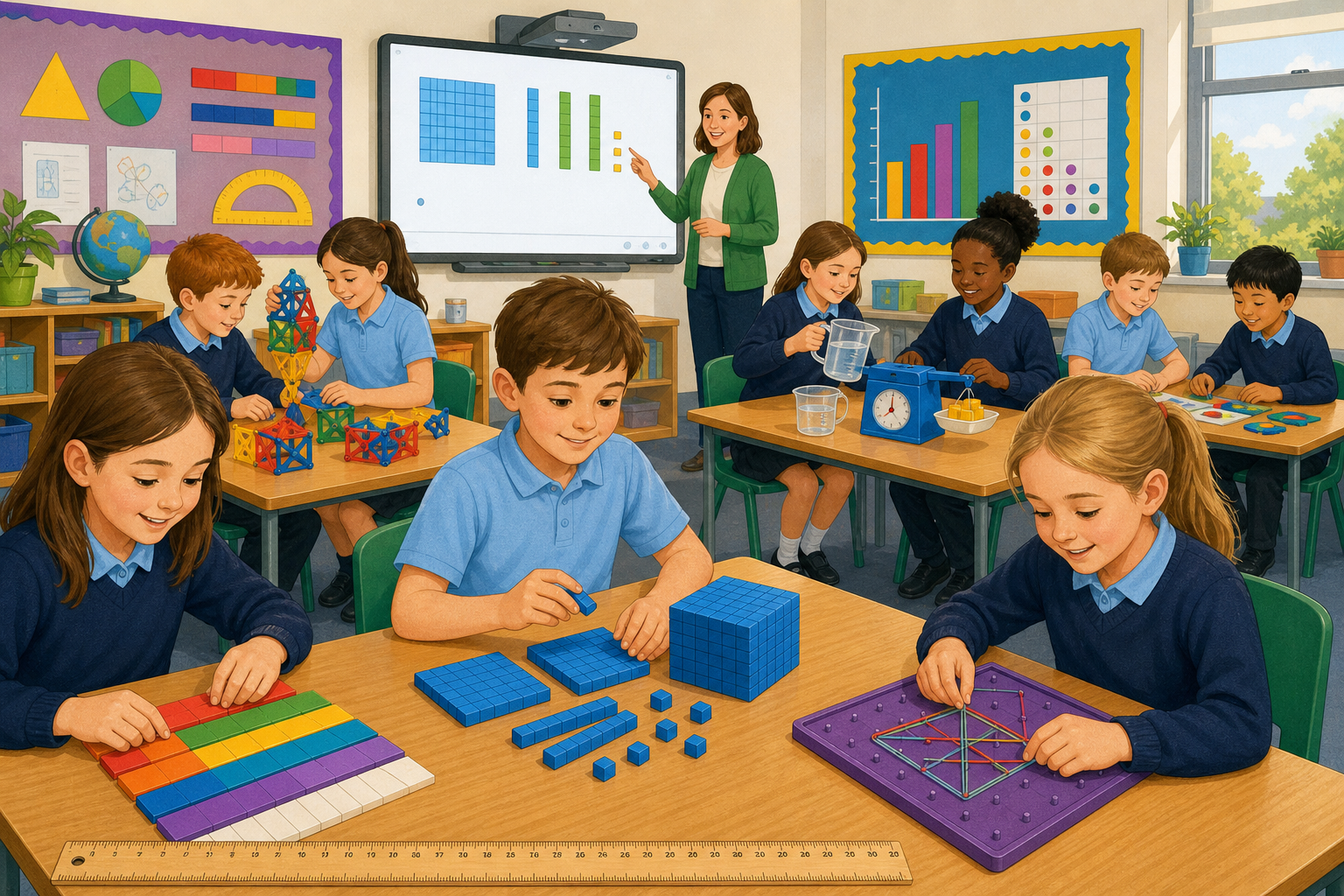
    Now think about a full schoolbag beside a single pencil. One of those you would weigh, and the other you could measure with a ruler. Today you are going to be a measuring detective: you will guess first, then measure, and see how close your guesses come.

    2 - Watch and Notice ~9 mins

    Illustration for Watch and NoticeWe measure four things: a desk, a yard, a schoolbag and a water bottle. Watch how we pick a sensible unit and a sensible tool for each one, and see us estimate first, then measure.

    Length: the desk

    Key point

    Line the zero of the ruler with one end of the desk and read the mark at the other end. A desk is measured in centimetres.

    3 - Try It Together ~7 mins

    Today we build our record together on the board. You watch and answer aloud with the class here — your own writing comes in the next step, when you rule your table in your copy.

    Key point

    We will log four things in order, saying our estimate before we measure each one: first the length of a desk in centimetres, then the length of the yard (or corridor) in metres, then the weight of a schoolbag in kilograms, and last how much a water bottle holds in millilitres.

    For each one we ask the same two questions out loud before anyone measures: which unit fits, and which tool do we need? Once we have the real measure, we work out the gap, that is how far each guess was from the real measure.

    How long, how heavy or how full is each thing — and how close were our estimates?

    Collect:

    • For each of four items: an estimate (with its unit), the measured value (with its unit), and the gap between them.

    Show it as: A four-column table on the IWB: item / estimate / measure / unit, one row per item, filled together, with the gap worked out aloud beside each row.

    4 - Rule Your Table in Your Copy ~2 mins

    COPYBOOK MOMENT

    Illustration for Rule Your Table in Your CopyIn your maths copy, rule an item / estimate / measure / unit table with four columns. Leave the rows blank for now. At the stations you will write each item, your estimate and the measure, choosing a sensible unit as you go.

    5 - Class Challenge ~18 mins

    Key point

    At every station, write your estimate before you touch a tool, then record the measure beside it and work out the gap — how far your guess was from the real measure.

    1. Station 1 — door: measure the door height in metres and centimetres with a metre stick.
    2. Station 2 — schoolbags: weigh three schoolbags and put them in order from lightest to heaviest.
    3. Station 31 litre: find a container that holds about 1 litre and check it with a jug.
    4. Station 4 — yard: pace the length of the yard, then rename your paces into metres. Remember from the board: one pace is about 50 cm, so 10 paces is about 500 cm, which is about 5 m. Count your paces, multiply by about 50 cm, then rename that many centimetres into metres.

    How close can you get your estimate to the real measure at each of four stations?

    At each station, write your estimate first, choose the right tool, measure, record the value with its unit, then work out the gap between estimate and measure.

    1. Station 1: estimate the door height, then measure it with a metre stick in metres and centimetres.
    2. Station 2: estimate the weight of three schoolbags, then weigh them and put them in order from lightest to heaviest.
    3. Station 3: find a container you think holds about 1 litre, then check it with the measuring jug.
    4. Station 4: pace the length of the yard, then rename your pace count into metres (one pace is about 50 cm).

    Ways to start:

    • Say your estimate out loud before you pick up any tool.
    • Name the unit that fits before you measure — cm, m, g, kg, ml or l.

    Stretch:

    • At the yard station, work out whether your paced length is more or less than 10 m.
    • For one station, say how you could make your next estimate closer.

    Record: The item / estimate / measure / unit table in your maths copy, plus a gap noted beside each row.

    Share back: A sampled two or three groups read out one measure each; the fuller discussion of whose estimates were closest carries into the next step.

    Answers & strategies (teacher)
    1. Station 1: estimate the door height, then measure it with a metre stick in metres and centimetres. — A typical classroom door is about 2 m (often 1 m 95 cm to 2 m 10 cm); record both the metres and the leftover centimetres.
    2. Station 2: estimate the weight of three schoolbags, then weigh them and put them in order from lightest to heaviest. — Order the three by their measured weight in kilograms; a full schoolbag is usually 3 kg to 6 kg.
    3. Station 3: find a container you think holds about 1 litre, then check it with the measuring jug. — 1 litre = 1,000 ml; a container is close if the jug reads between about 900 ml and 1,100 ml.
    4. Station 4: pace the length of the yard, then rename your pace count into metres (one pace is about 50 cm). — Multiply the number of paces by about 50 cm, then rename to metres — for example 10 paces is about 500 cm, which is about 7 m.
    Pupil practice
    Module 4 · Measures: Length, Weight and Capacity Measures
    Lesson 55 · Estimate Then Measure Around the Room and Yard
    Download Activity Book page (PDF)
    123learn · Online learning platform

    Unlock the full learning experience

    You're previewing this lesson. Get full access to this lesson and hundreds more — each one ready to teach, with interactive activities, printable resources and pupil progress tracking built in.

    Hundreds of curriculum-aligned lessons
    Interactive activities in every lesson
    Printable resources & progress tracking
    Copyright Notice
    This lesson is copyright of Coding Ireland 2017 - 2025. Unauthorised use, copying or distribution is not allowed.
    🍪 Our website uses cookies to make your browsing experience better. By using our website you agree to our use of cookies. Learn more
