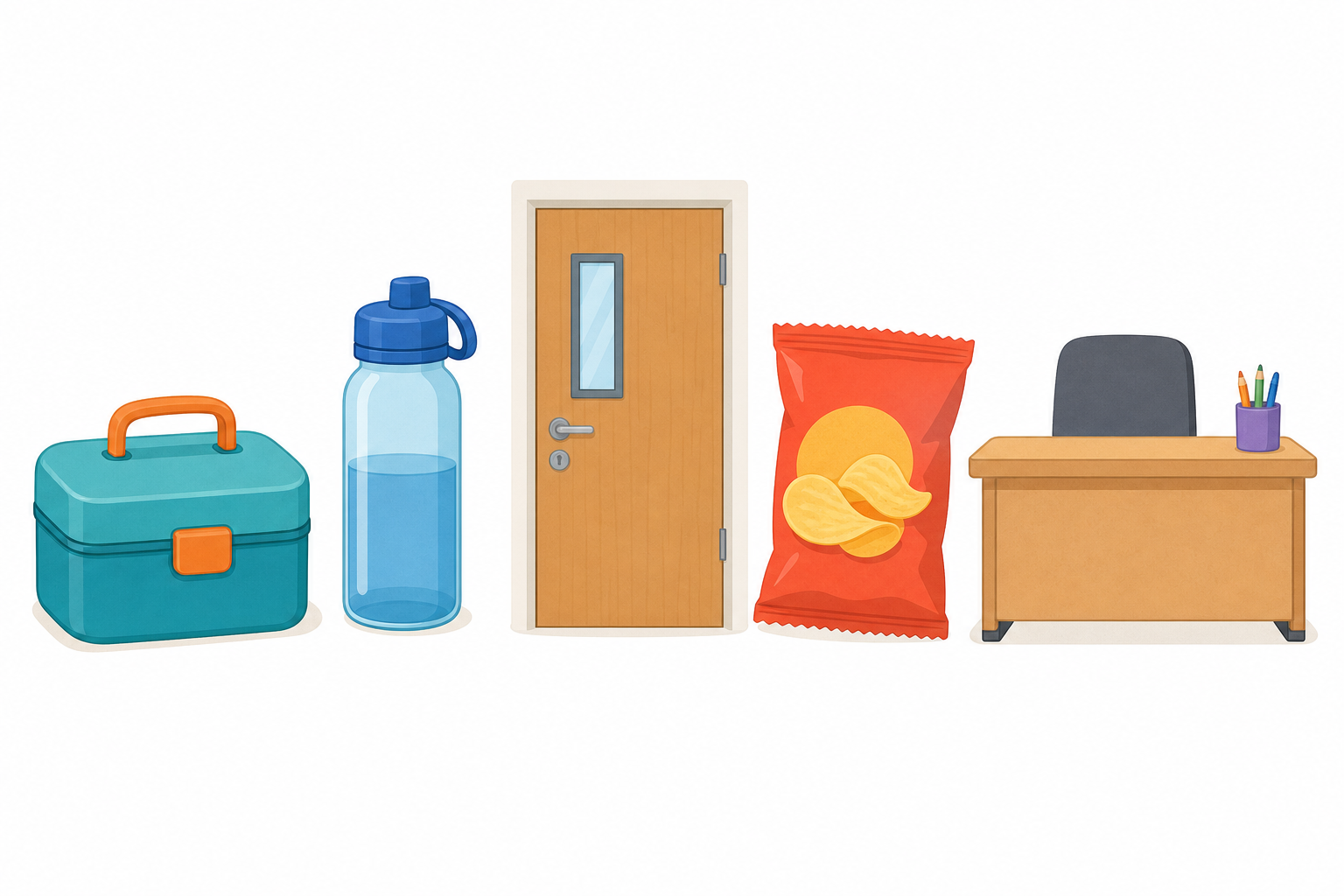
Here are five everyday things: a lunchbox, a full water bottle, the classroom door, a bag of crisps, and the teacher's desk.
Which one do you think would be the easiest to estimate well without measuring? Which one would be the trickiest?
Take three hands-up answers, not open call-outs. Do not settle which is right — the point is to surface that some things we have a good feel for and some we don't.
Listen for pupils who say the door or the desk are easy (we see them at known heights daily) and the crisp bag is hard (light things fool us). That instinct is the anchor idea arriving early.
Watch the three anchors at the front, one at a time: a one-metre stick, a one-kilogram bag of sugar, and a one-litre bottle of water. These are our anchors.
For each object that follows, notice how a good estimate compares it to one of these anchors first (about half the sugar bag, a bit longer than the metre stick) before anything is measured.
The ruler below shows the first anchor in use: an object edge a little past the metre stick, read to the nearest centimetre.
Hold each real anchor up as you name it — the physical bag of sugar in the hand does the teaching, the interactive just fixes the metre reading on the board. Say the comparison aloud each time: a bit longer than the stick, so a bit more than a metre.
The move to model is compare first, then measure — resist reading numbers off before the class has committed to a comparison. That habit is the whole lesson.
Today we estimate then measure three things in the room, anchoring each one first: the teacher's desk width (anchor: the metre stick), a full lunchbox (anchor: the sugar bag), and a water bottle poured into the jug (anchor: the litre bottle).
For each one we agree a class estimate out loud, write it down, and before we measure, everyone predicts whether we will be over or under. Then we measure and read the actual.
This round is for talking it through together — no marking yet. Pupils measure at the front on the shared tools; circulate and catch reading slips (eye square over the mark on the metre stick, the meniscus curve on the jug). The class reads aloud and you reconcile any disagreement as it comes up.
Keep the three measurements moving. Before each reveal, ask the class to predict over or under; between objects, turn and name the anchor being used, and revoice a good comparison: so you used the sugar bag and halved it — that's exactly the move. Hold out for the anchor comparison every time before a tool is picked up. If a pupil jumps to a number, ask what did you compare it to?
In your maths copy, make three short records. For each object write the estimate on one line and the actual reading on the next, with the correct unit.
Then work out the difference for each one: subtract the smaller number from the larger number so you can see how far off the estimate was. Write that difference on a third line.
Here is one worked example to copy the method from (use your own class numbers for the three objects):
Lunchbox mass
Estimate: 400 g
Actual: 350 g
Difference: 400 g − 350 g = 50 g
Do the same for desk width and bottle capacity. Compare the three differences and circle the closest estimate of the round (the one with the smallest difference).
Walk the room glancing for estimate-above-actual layout, the correct unit on every line, and a third line that is a real subtraction, not a guess. No marking, this is whole-class copybook practice.
Board the worked lunchbox example end to end before they start their own three: estimate 400 g, actual 350 g, difference 400 − 350 = 50 g. Method cue: always larger minus smaller so the difference is a positive how-far-off. Then they repeat with the class desk and bottle numbers from Try It Together.
Slip to watch: missing units on the difference, or circling a lucky estimate without comparing the three differences. Prompt: which difference is smallest? That one is closest.
Now we practise reading four rulers to the nearest mark, each one a little finer than the last. Read each length in turn: the crayon, the pencil, the strip, and the long edge. On the fine rulers, count the small marks between the whole centimetres — each small mark is one tenth of a centimetre. Before each reveal, predict which mark the reading will be nearest.
These are the practice questions — pupils check each answer. Pupils take turns at the board and the class confirms before moving on; keep the board work brisk rather than over-explaining.
Before the first reading, model counting the small marks aloud on a fine ruler: after the 7 there are ten little marks to the next whole number, so each one is a tenth — 7.1, 7.2, 7.3 and so on. The tenths readings (the crayon and the strip) are the ones that catch people; the whole-centimetre readings (the pencil and the long edge) are the easier settle points between them.
Before each reveal ask pupils to predict which mark the reading is nearest. Fast finishers watch the board and predict the next reading; there are no desk devices in this beat.
You're previewing this lesson. Get full access to this lesson and hundreds more — each one ready to teach, with interactive activities, printable resources and pupil progress tracking built in.