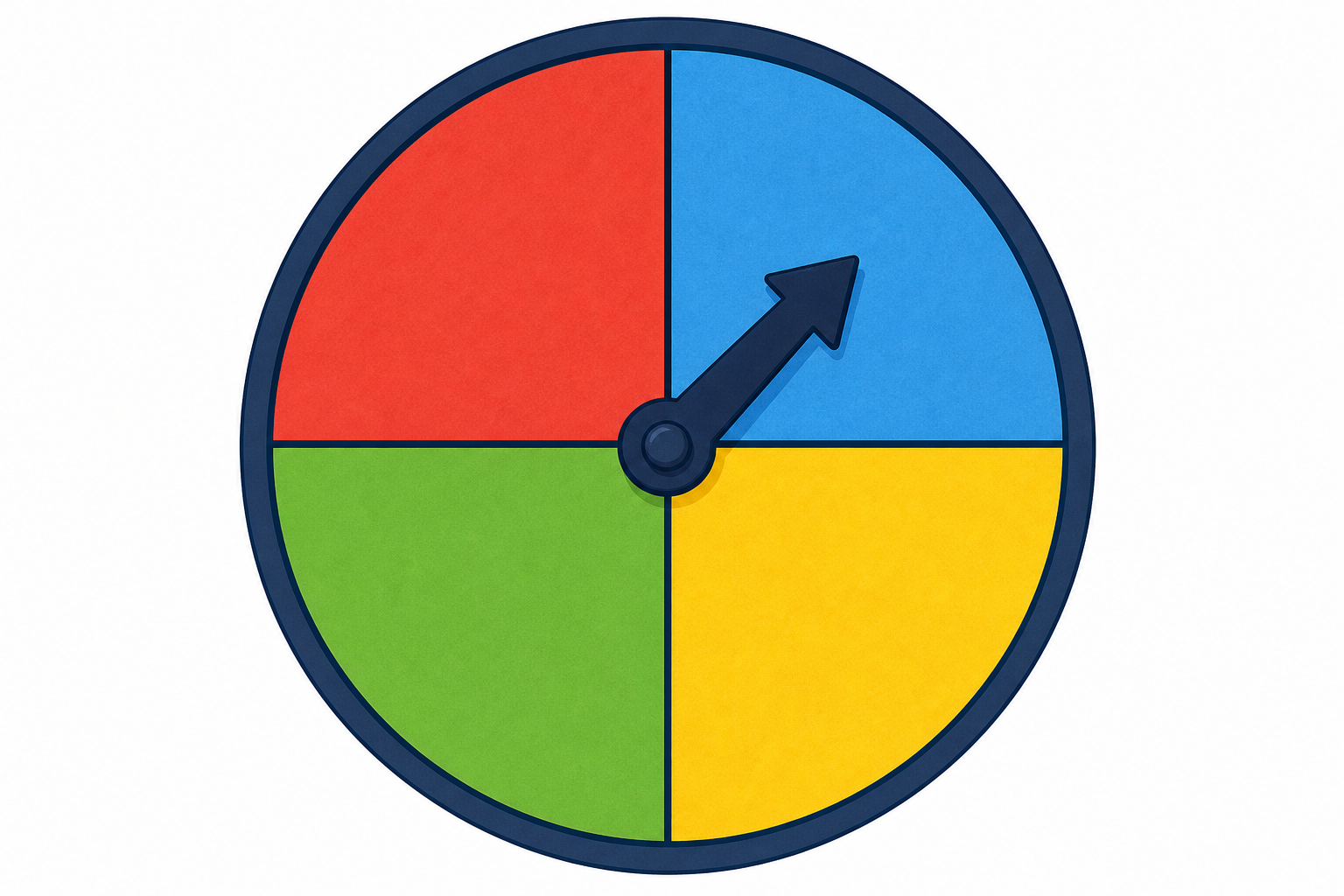
Picture a spinner split into four equal colours: red, blue, green and yellow. If we give it a spin, what is the chance it lands on red? See how many different ways you could write that answer down.
Watch three spinners on the board. On each one we work out the chance of a colour by counting the favourable segments (the ones we are asking about — here, the red ones) over the total segments. Then we write that same chance three ways: as a fraction, as a decimal, and as a percentage.
To turn a fraction into a decimal we divide the top number by the bottom number, then multiply by 100 to get the percentage:
So 1/4 = 0.25 = 25%. Look for how a fair spinner shares its chance equally, and be ready to say the third form for the last one before it appears.
In your maths copy, for each spinner outcome write the probability three ways in a row: first as a fraction, then its decimal, then its percentage. Work these three:
Check each row: the three forms should all match the same amount.
Today we work through a fresh spinner together: an eight-segment spinner where three segments are prizes. We find the chance of a prize, then write it as a fraction, a decimal and a percentage.
This time the fraction does not land on a tidy landmark, so we divide the top by the bottom on the board, then multiply by 100 for the percentage.
Write the chance of a prize three ways: as a fraction, a decimal and a percentage.
Keep this reference table beside you as you work:
Then we spin it a few times so you can see the outcomes appear. Some of you will come up to set the spinner and read out the three forms.
Today we work through these spinner problems together, each a step harder than the last. Take your time on the decimal for the last one:
For each one, set it up on the spinner, then write the chance as a fraction, a decimal and a percentage.
You're previewing this lesson. Get full access to this lesson and hundreds more — each one ready to teach, with interactive activities, printable resources and pupil progress tracking built in.