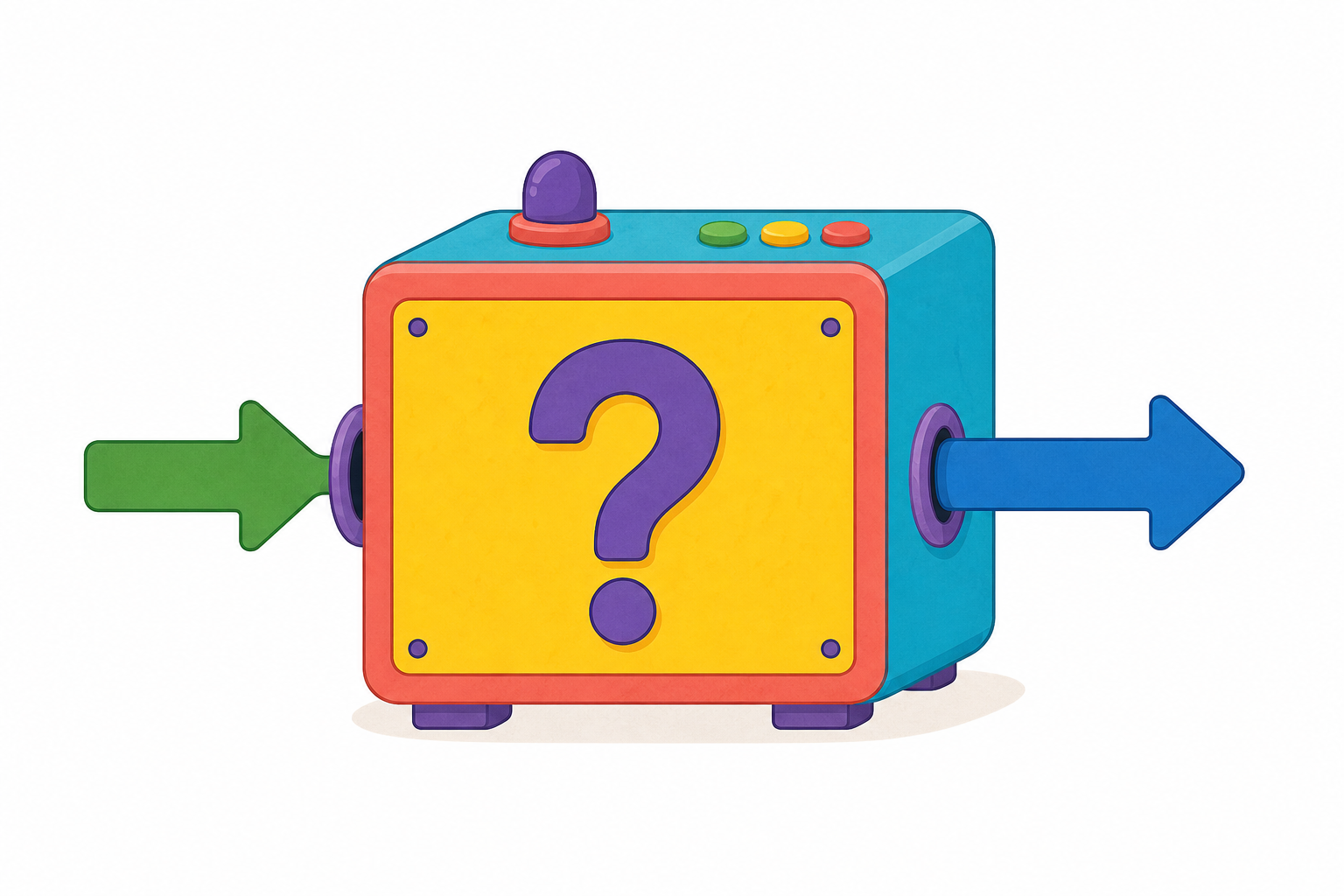
Here is a machine with its rule hidden behind a question mark. It has swallowed three numbers and spat three back out:
2 turned into 7. 5 turned into 16. 10 turned into 31.
What is the machine doing to every number that goes in?
Give ten seconds of quiet think-time before any hands go up, then take three hands-up answers. Do not confirm or correct yet — leave the pairs on the board; the whole lesson is about how we settle which rule is right.
Expect a split: some pupils will spot +5 works for the first pair only, others may jump straight to a two-step rule. Hold both without judging — the next step shows how we decide.
Four hidden-rule machines are on the board, each showing a few pairs of what goes in and what comes out. For each one, look at how the output relates to the input and be ready to say what the machine is doing. Watch out — some machines do two things to the number.
Machine A (2→7, 5→16, 10→31): rule is × 3 + 1. Someone often guesses + 5 from 2→7 — test it on 5, where +5 gives 10 but the machine gives 16, so the jump grows (2→7 is a jump of 5, 5→16 is a jump of 11). Growing jump means multiplying. Three lots of input give 6, 15, 30, each output 1 more.
Machine B (2→8, 5→20): × 4, the simplest single-step one. Ask what 0 would give.
Machine C (0→7, 3→10): + 7. The 0→7 pair hands the add-number over instantly.
Machine D (4→5, 6→9): × 2 − 3, the two-step one. Double 4 is 8 take 3 is 5; double 6 is 12 take 3 is 9. Hold out for pupils to name both steps in order.
Point at each pair; let them try before you confirm the rule.
Today we crack this hidden machine together: it turns 2 → 7, 5 → 16 and 10 → 31. We'll send fresh numbers through first — try 1, then 0, then 3 — and watch what comes out before anyone names the rule. Then we'll say the rule aloud and use Show rule to check.
Talk this one through together — pupils take turns at the board and the class agrees or corrects out loud.
Feed 1 first: the class predicts, the machine gives 4. Then 0: predict, it gives 1 (this is the number that kills +5 stone dead — 0+5 would be 5). Then 3: predict, it gives 10. By now the class should be settling on 'times 3, then add 1'. Have a pupil build that rule on the buttons and press Check before you tap Show rule.
Keep the back rows in it: after each prediction, turn and ask a pupil to name what the machine did, rather than only the pupil at the board.
Listen for the reasoning, not just the answer — revoice a pupil who says "the jumps get bigger so it must be a times". That is the deduction move the lesson is teaching.
In your maths copy, work out the rule for Machine A from Watch and Notice: 2 → 7, 5 → 16, 10 → 31. For each pair, write what the rule could be — 2 → 7 could be + 5 or × 3 + 1 — then test both on the next pair. Circle the rule you decide on.
Walk the room glancing at whether pupils are testing each guess on a second pair, not just the first — this is whole-class copybook practice, not marking. Nudge anyone who circles a rule after checking only one pair. Pupils who finish Machine A quickly can move on to Machines B, C and D from Watch and Notice; the rest can try those in their own time.
Now we crack four hidden machines together. Each one is a little trickier than the last. Send a number through before you name the rule, build it on the buttons, and press Check.
Watch the last machine closely. It gives 1 → 6. Someone might guess + 5, because 1 + 5 = 6 — and that fits the first pair perfectly. But send a second number through: 3 gives 14, not 8, so + 5 is wrong. One pair on its own was not enough. We only knew for sure once we tried a second number.
This is the practice round — pupils take turns at the board, check each answer, and the class confirms before moving on. Keep the board work brisk rather than over-explaining.
On each machine, ask "which number would settle it fastest?" before sending one through — 0 exposes the add-number, 1 halves the arithmetic. On the two-step machines (× 2 + 3 and × 4 + 2), hold out for both steps named in order; a pupil who says just "× 2" has half the rule.
The last machine is the one that lands the whole lesson and must not be skipped for time: it only gives itself away once pupils try a second number, because × 4 + 2 and + 5 agree on the first pair by accident. The description now shows this on the board — walk the class through the rival + 5 guess failing on the second pair.
You're previewing this lesson. Get full access to this lesson and hundreds more — each one ready to teach, with interactive activities, printable resources and pupil progress tracking built in.